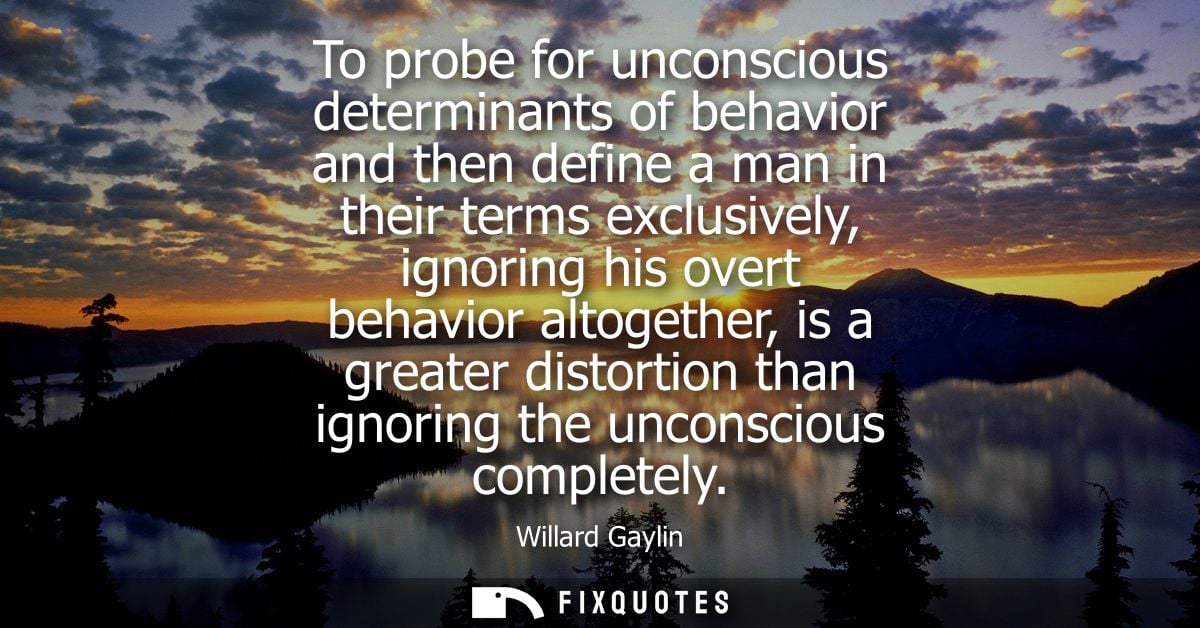
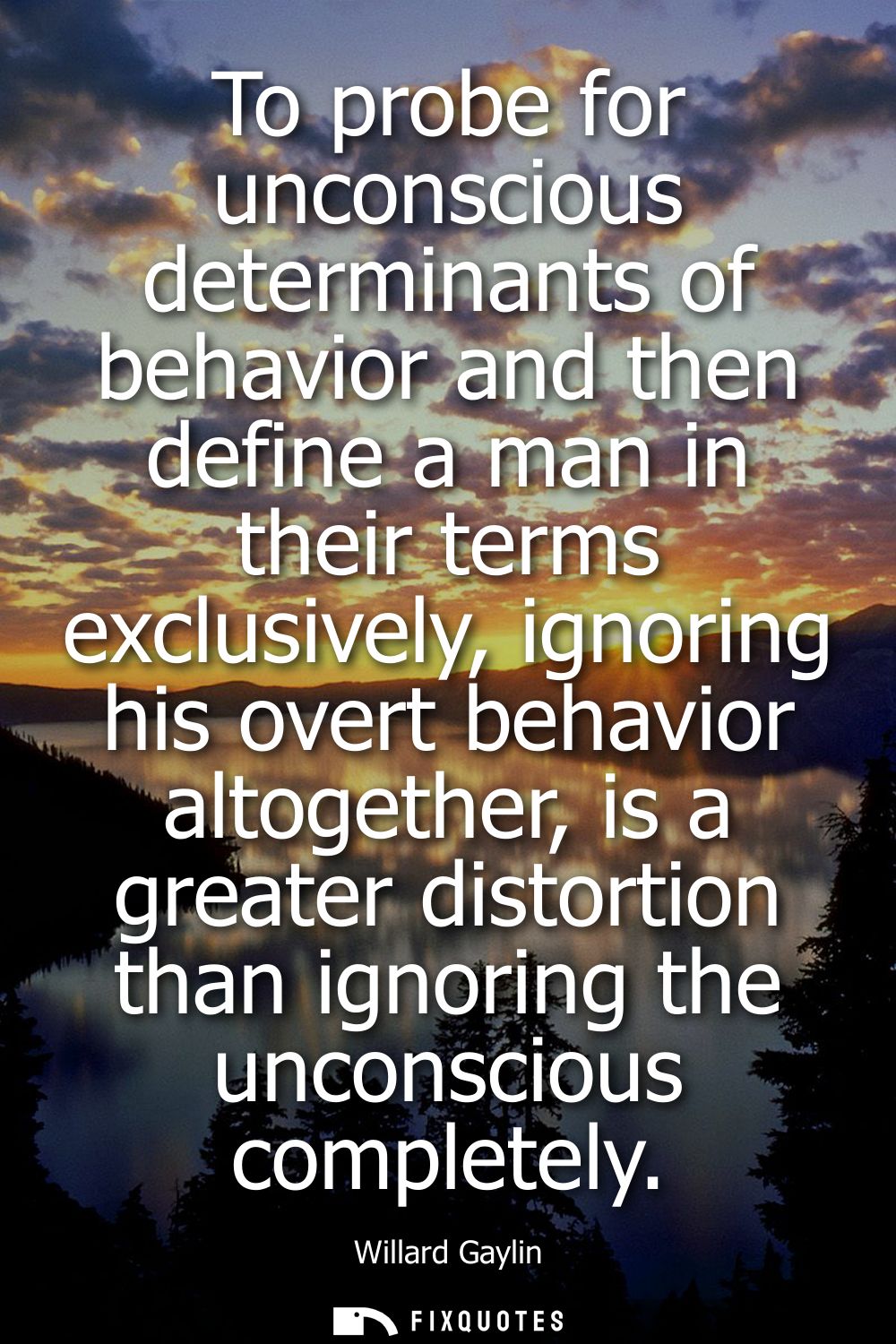
"To probe for unconscious determinants of behavior and then define a man in their terms exclusively, ignoring his overt behavior altogether, is a greater distortion than ignoring the unconscious completely"
About this Quote
The intent is methodological and ethical at once. Methodological, because he’s warning against a one-variable theory of human behavior that can’t be falsified: if every action is "really" something else, overt behavior becomes mere noise. Ethical, because defining someone exclusively by unconscious determinants turns interpretation into a kind of domination. You don’t have to listen to what a person does or says when you can outbid them with your superior explanation.
Subtext: the unconscious can become a convenient alibi for the interpreter’s certainty. It’s not hard to hear mid-to-late 20th century debates behind this - Freudian depth psychology versus behaviorism, psychoanalysis versus more empirical psychiatry, and the broader cultural moment when "hidden trauma" and "repressed desire" became everyday vocabulary. Gaylin’s line draws a boundary: yes, look beneath the surface, but don’t confuse depth with truth.
What makes it work rhetorically is the asymmetry. He doesn’t argue that unconscious motives are trivial; he argues that over-privileging them is worse than neglecting them. That reversal punctures intellectual fashion without pretending the mind is simple.
Quote Details
| Topic | Wisdom |
|---|---|
| Source | Help us find the source |
| Cite |
Citation Formats
APA Style (7th ed.)
Gaylin, Willard. (2026, January 16). To probe for unconscious determinants of behavior and then define a man in their terms exclusively, ignoring his overt behavior altogether, is a greater distortion than ignoring the unconscious completely. FixQuotes. https://fixquotes.com/quotes/to-probe-for-unconscious-determinants-of-behavior-136323/
Chicago Style
Gaylin, Willard. "To probe for unconscious determinants of behavior and then define a man in their terms exclusively, ignoring his overt behavior altogether, is a greater distortion than ignoring the unconscious completely." FixQuotes. January 16, 2026. https://fixquotes.com/quotes/to-probe-for-unconscious-determinants-of-behavior-136323/.
MLA Style (9th ed.)
"To probe for unconscious determinants of behavior and then define a man in their terms exclusively, ignoring his overt behavior altogether, is a greater distortion than ignoring the unconscious completely." FixQuotes, 16 Jan. 2026, https://fixquotes.com/quotes/to-probe-for-unconscious-determinants-of-behavior-136323/. Accessed 31 Mar. 2026.