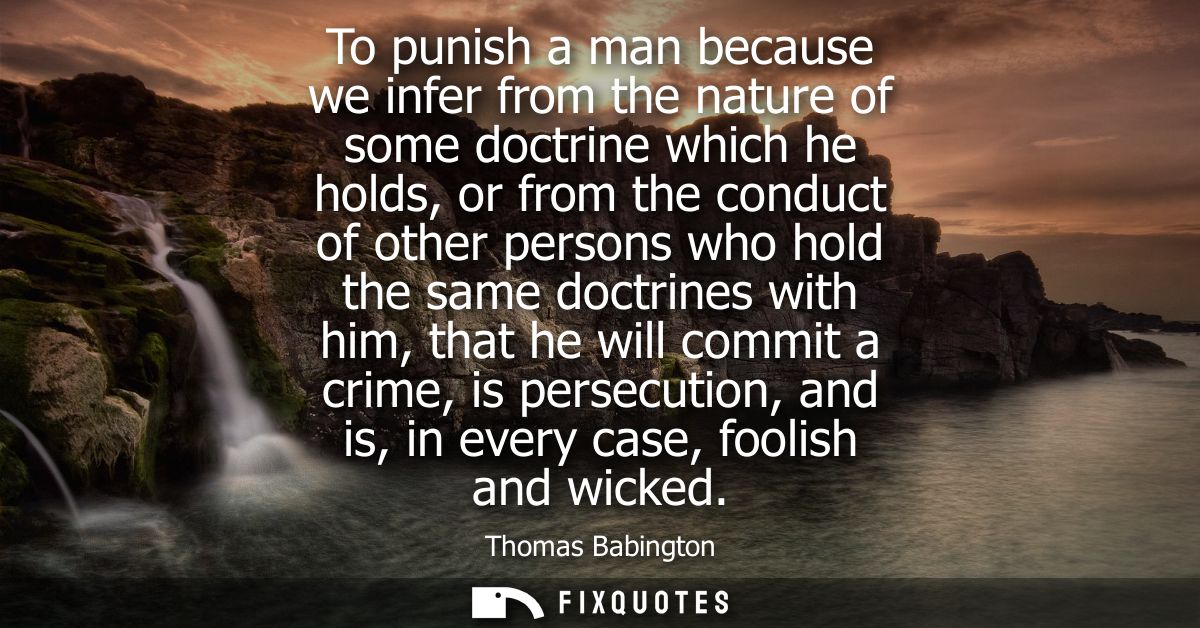
"To punish a man because we infer from the nature of some doctrine which he holds, or from the conduct of other persons who hold the same doctrines with him, that he will commit a crime, is persecution, and is, in every case, foolish and wicked"
About this Quote
The phrasing “we infer” quietly puts the accuser on trial. It frames suspicion as an act of imagination - a projection masquerading as prudence. Then he tightens the vise: the inference comes either from “the nature” of a doctrine (thought crime) or from “the conduct of other persons” (guilt by association). Those are the classic engines of persecution, whether dressed up as national security, moral hygiene, or religious orthodoxy.
Calling it “in every case, foolish and wicked” is doing double work. “Wicked” is the obvious moral verdict; “foolish” is the strategic jab. Persecution isn’t just cruel, it’s counterproductive: it turns belief into martyrdom, drives communities underground, and replaces social trust with surveillance. That’s why the sentence lands as more than Victorian liberal piety. It anticipates how states manufacture enemies by collapsing identity into threat.
Context matters: Macauley wrote in an era of British reform and empire, when governments routinely rationalized repression as preventive. The quote reads like a warning label for any society tempted to treat ideology as intent and affiliation as evidence.
Quote Details
| Topic | Human Rights |
|---|---|
| Source | Help us find the source |
| Cite |
Citation Formats
APA Style (7th ed.)
Babington, Thomas. (2026, January 18). To punish a man because we infer from the nature of some doctrine which he holds, or from the conduct of other persons who hold the same doctrines with him, that he will commit a crime, is persecution, and is, in every case, foolish and wicked. FixQuotes. https://fixquotes.com/quotes/to-punish-a-man-because-we-infer-from-the-nature-8442/
Chicago Style
Babington, Thomas. "To punish a man because we infer from the nature of some doctrine which he holds, or from the conduct of other persons who hold the same doctrines with him, that he will commit a crime, is persecution, and is, in every case, foolish and wicked." FixQuotes. January 18, 2026. https://fixquotes.com/quotes/to-punish-a-man-because-we-infer-from-the-nature-8442/.
MLA Style (9th ed.)
"To punish a man because we infer from the nature of some doctrine which he holds, or from the conduct of other persons who hold the same doctrines with him, that he will commit a crime, is persecution, and is, in every case, foolish and wicked." FixQuotes, 18 Jan. 2026, https://fixquotes.com/quotes/to-punish-a-man-because-we-infer-from-the-nature-8442/. Accessed 31 Mar. 2026.