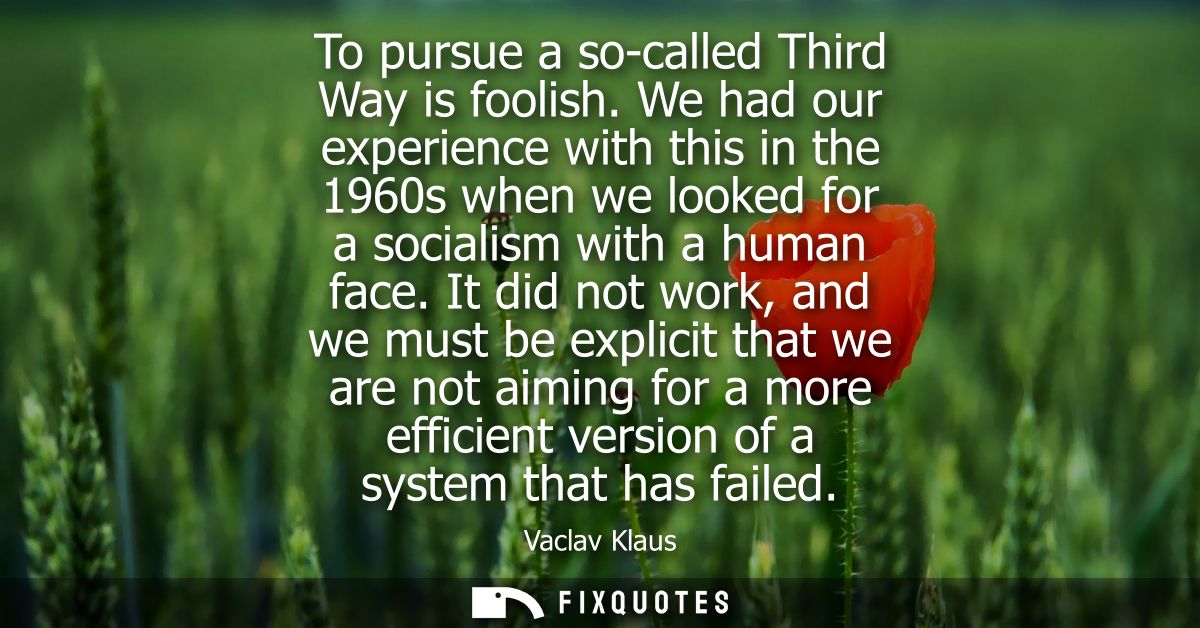
"To pursue a so-called Third Way is foolish. We had our experience with this in the 1960s when we looked for a socialism with a human face. It did not work, and we must be explicit that we are not aiming for a more efficient version of a system that has failed"
About this Quote
The loaded memory here is the Prague Spring and its famous slogan, “socialism with a human face.” Klaus invokes the 1960s not as nostalgia but as a scar. For Czechs and Slovaks, that experiment ended not in a policy seminar but under Soviet tanks, followed by “normalization,” censorship, and a forced retreat into public cynicism. In that context, “it did not work” is almost an understatement; it’s a refusal to allow Western-style managerial optimism to flatten lived experience into an abstract debate about models.
His real move is to deny reformers the comforting language of efficiency. “A more efficient version of a system that has failed” reads like a warning about technocrats who treat ideology as a software update. Klaus insists on explicitness because vagueness is how compromised projects survive: you rename the same architecture, promise kinder administrators, and call it progress. The quote is less an argument about economics than a demand for moral and historical clarity from post-communist politics - no euphemisms, no “faces,” no reruns.
Quote Details
| Topic | Freedom |
|---|---|
| Source | Help us find the source |
| Cite |
Citation Formats
APA Style (7th ed.)
Klaus, Vaclav. (2026, January 16). To pursue a so-called Third Way is foolish. We had our experience with this in the 1960s when we looked for a socialism with a human face. It did not work, and we must be explicit that we are not aiming for a more efficient version of a system that has failed. FixQuotes. https://fixquotes.com/quotes/to-pursue-a-so-called-third-way-is-foolish-we-had-92266/
Chicago Style
Klaus, Vaclav. "To pursue a so-called Third Way is foolish. We had our experience with this in the 1960s when we looked for a socialism with a human face. It did not work, and we must be explicit that we are not aiming for a more efficient version of a system that has failed." FixQuotes. January 16, 2026. https://fixquotes.com/quotes/to-pursue-a-so-called-third-way-is-foolish-we-had-92266/.
MLA Style (9th ed.)
"To pursue a so-called Third Way is foolish. We had our experience with this in the 1960s when we looked for a socialism with a human face. It did not work, and we must be explicit that we are not aiming for a more efficient version of a system that has failed." FixQuotes, 16 Jan. 2026, https://fixquotes.com/quotes/to-pursue-a-so-called-third-way-is-foolish-we-had-92266/. Accessed 12 Mar. 2026.