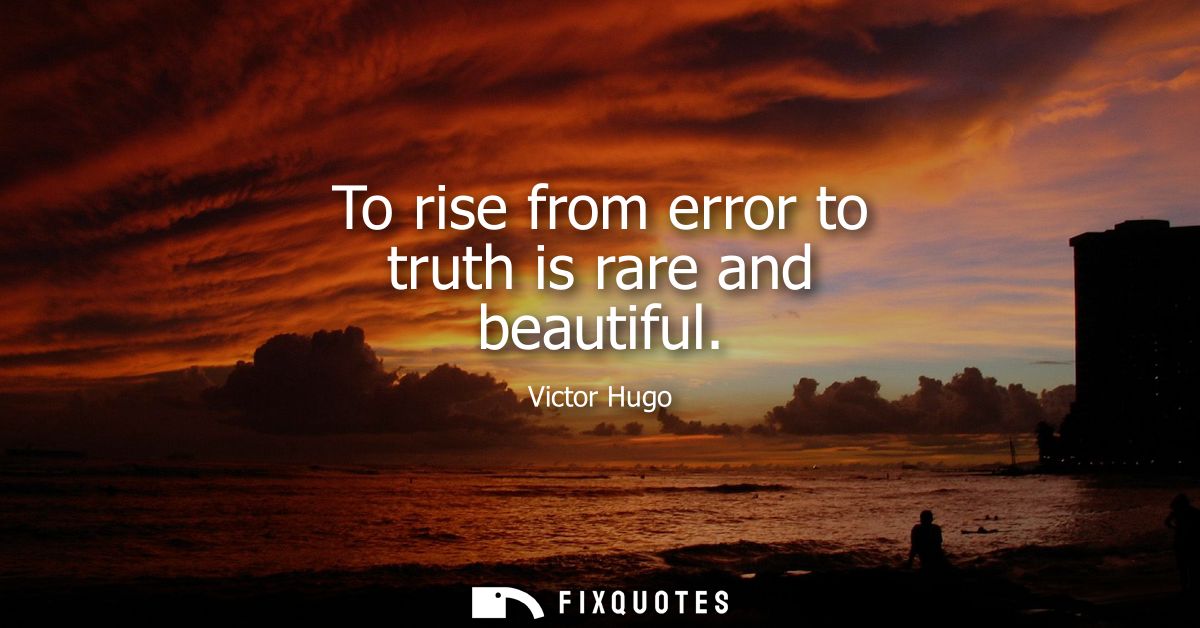
"To rise from error to truth is rare and beautiful"
About this Quote
Hugo frames self-correction as an aesthetic act, not a bureaucratic one. “Rare and beautiful” is a deliberate rebuke to the everyday machinery of pride: most people don’t climb out of error because error is comfy, identity-confirming, socially rewarded. To admit you were wrong is to risk status, lose face, fracture the story you tell about yourself. Hugo doesn’t romanticize certainty; he romanticizes the difficult pivot.
The verb choice matters. You don’t “step” from error to truth, you “rise.” Truth becomes altitude - hard-won, strenuous, a climb against gravity. Error is low ground: not just ignorance, but the seductions of habit, ideology, and self-interest. That upward motion is why the line works rhetorically: it flatters the reader’s better angel while quietly indicting how seldom we let it drive.
Context sharpens it. Hugo lived through revolutions, restorations, censorship, exile - a century that made “truth” feel both urgent and contested. In that world, changing your mind wasn’t a private quirk; it could be a political act with consequences. The sentence carries a liberal faith typical of his era: that humans can progress, morally and intellectually, even when institutions and mobs pull the other way.
Subtext: truth isn’t the absence of error; it’s what you reach after surviving it. The beauty is partly ethical (humility) and partly narrative (redemption). Hugo is selling a higher kind of heroism: not being right, but becoming right.
The verb choice matters. You don’t “step” from error to truth, you “rise.” Truth becomes altitude - hard-won, strenuous, a climb against gravity. Error is low ground: not just ignorance, but the seductions of habit, ideology, and self-interest. That upward motion is why the line works rhetorically: it flatters the reader’s better angel while quietly indicting how seldom we let it drive.
Context sharpens it. Hugo lived through revolutions, restorations, censorship, exile - a century that made “truth” feel both urgent and contested. In that world, changing your mind wasn’t a private quirk; it could be a political act with consequences. The sentence carries a liberal faith typical of his era: that humans can progress, morally and intellectually, even when institutions and mobs pull the other way.
Subtext: truth isn’t the absence of error; it’s what you reach after surviving it. The beauty is partly ethical (humility) and partly narrative (redemption). Hugo is selling a higher kind of heroism: not being right, but becoming right.
Quote Details
| Topic | Learning from Mistakes |
|---|---|
| Source | Help us find the source |
| Cite |
Citation Formats
APA Style (7th ed.)
Hugo, Victor. (2026, January 15). To rise from error to truth is rare and beautiful. FixQuotes. https://fixquotes.com/quotes/to-rise-from-error-to-truth-is-rare-and-beautiful-10577/
Chicago Style
Hugo, Victor. "To rise from error to truth is rare and beautiful." FixQuotes. January 15, 2026. https://fixquotes.com/quotes/to-rise-from-error-to-truth-is-rare-and-beautiful-10577/.
MLA Style (9th ed.)
"To rise from error to truth is rare and beautiful." FixQuotes, 15 Jan. 2026, https://fixquotes.com/quotes/to-rise-from-error-to-truth-is-rare-and-beautiful-10577/. Accessed 27 Mar. 2026.
More Quotes by Victor
Add to List