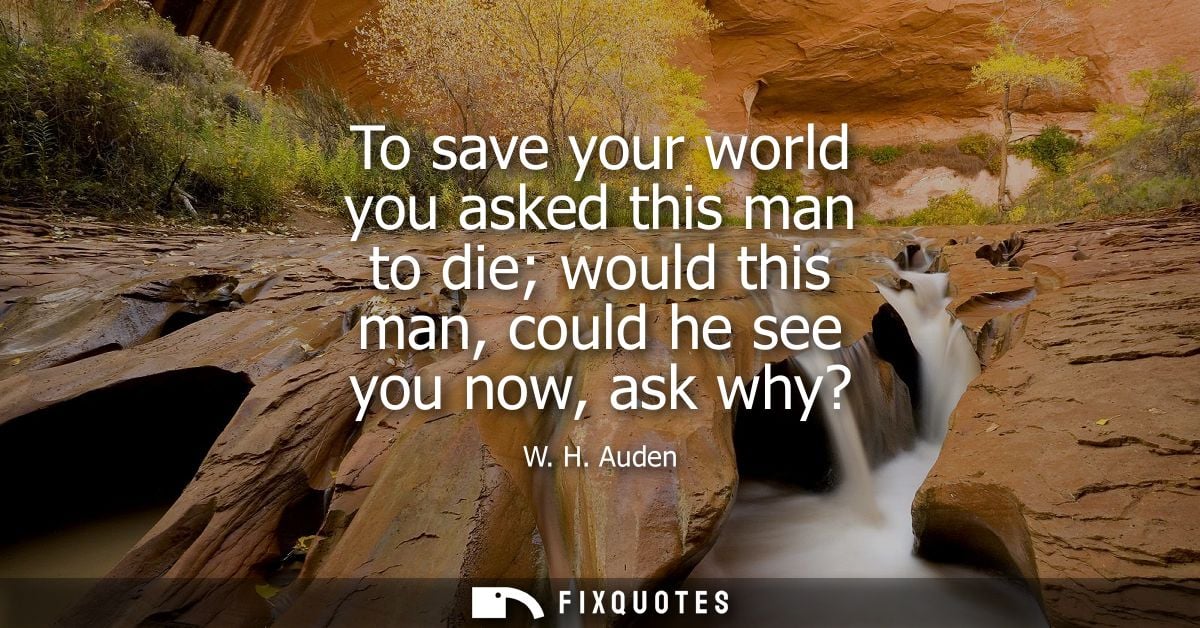
"To save your world you asked this man to die; would this man, could he see you now, ask why?"
About this Quote
Auden turns the heroic logic of sacrifice inside out with a single, needling question. The line has the cadence of a public epitaph, but its real energy is accusatory: it forces the living to account for the cost they’ve outsourced. “To save your world” sounds like the grand alibi nations and movements give themselves; “you asked this man to die” drags that abstraction back down to one body, one life, one irreversible decision. The pivot is pronouns. It’s not “our” world, not “his” war, but “your world” - a world maintained by others’ expendability.
The subtext is less about whether the death was “worth it” (a moral math Auden distrusts) than about what the saved world has become. The sting lands in “could he see you now.” It implies that whatever victory, peace, or normalcy was purchased has curdled: comfort without conscience, freedom without memory, ceremony without responsibility. Auden doesn’t need to describe decadence or hypocrisy; the conditional does it for him. If the dead returned, the living would feel newly strange to themselves.
Context matters: Auden wrote in the shadow of total war and mass political rhetoric, when “saving the world” was a phrase that could justify anything. His question isn’t pacifist naivete; it’s a demand for moral continuity. If you claim a man died for your world, you’re obligated to live in a way that makes that claim bear scrutiny. Otherwise the dead, imagined as lucid witnesses, would ask the one question propaganda can’t answer: why this, and why you?
The subtext is less about whether the death was “worth it” (a moral math Auden distrusts) than about what the saved world has become. The sting lands in “could he see you now.” It implies that whatever victory, peace, or normalcy was purchased has curdled: comfort without conscience, freedom without memory, ceremony without responsibility. Auden doesn’t need to describe decadence or hypocrisy; the conditional does it for him. If the dead returned, the living would feel newly strange to themselves.
Context matters: Auden wrote in the shadow of total war and mass political rhetoric, when “saving the world” was a phrase that could justify anything. His question isn’t pacifist naivete; it’s a demand for moral continuity. If you claim a man died for your world, you’re obligated to live in a way that makes that claim bear scrutiny. Otherwise the dead, imagined as lucid witnesses, would ask the one question propaganda can’t answer: why this, and why you?
Quote Details
| Topic | Ethics & Morality |
|---|---|
| Source | Help us find the source |
More Quotes by H. Auden
Add to List