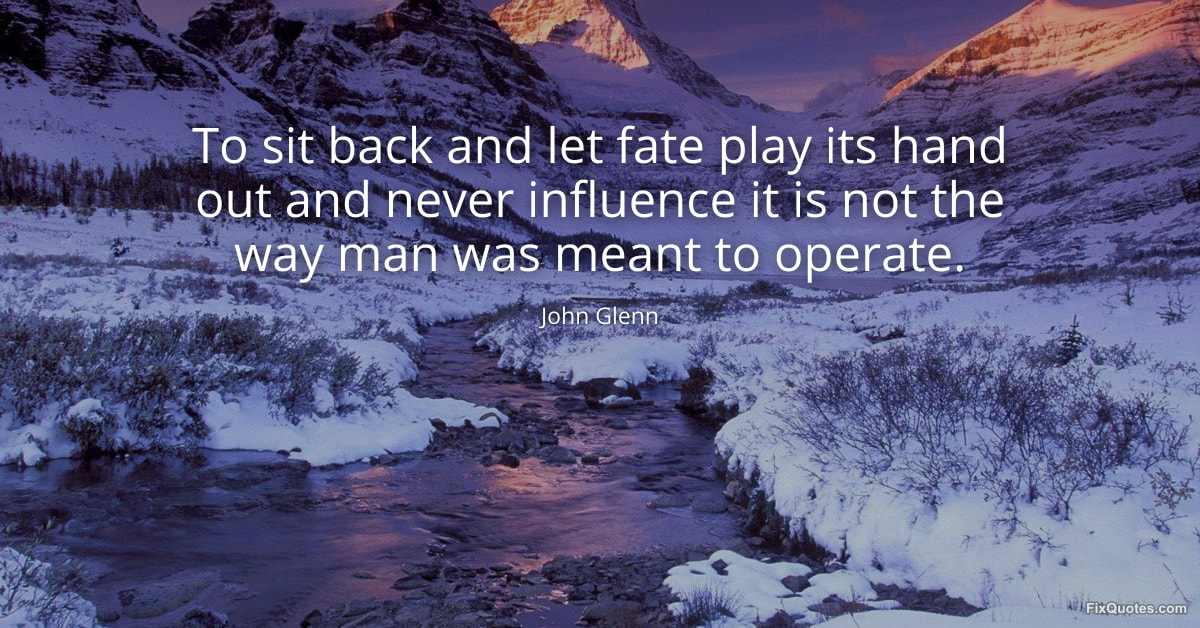
"To sit back and let fate play its hand out and never influence it is not the way man was meant to operate"
About this Quote
The subtext is also political. Mid-century America needed hero narratives that justified massive public investment and existential stakes. By framing influence as “the way man was meant to operate,” Glenn upgrades action from preference to purpose, turning technological ambition into a kind of civic anthropology. It’s not just that we can change outcomes; it’s unnatural not to try. That language quietly absolves the peril: if catastrophe is possible, so is control, and the moral failure is resignation.
It also reads as personal doctrine. Glenn was famous for discipline, procedure, and the tight-lipped professionalism of Mercury-era astronauts. The quote defends that ethos: the belief that preparation is a form of authorship. Fate may deal the cards, but Glenn’s point is that humans are obligated to count them, test them, and, when necessary, reach across the table.
Quote Details
| Topic | Free Will & Fate |
|---|---|
| Source | Help us find the source |
| Cite |
Citation Formats
APA Style (7th ed.)
Glenn, John. (2026, January 15). To sit back and let fate play its hand out and never influence it is not the way man was meant to operate. FixQuotes. https://fixquotes.com/quotes/to-sit-back-and-let-fate-play-its-hand-out-and-173458/
Chicago Style
Glenn, John. "To sit back and let fate play its hand out and never influence it is not the way man was meant to operate." FixQuotes. January 15, 2026. https://fixquotes.com/quotes/to-sit-back-and-let-fate-play-its-hand-out-and-173458/.
MLA Style (9th ed.)
"To sit back and let fate play its hand out and never influence it is not the way man was meant to operate." FixQuotes, 15 Jan. 2026, https://fixquotes.com/quotes/to-sit-back-and-let-fate-play-its-hand-out-and-173458/. Accessed 15 Mar. 2026.