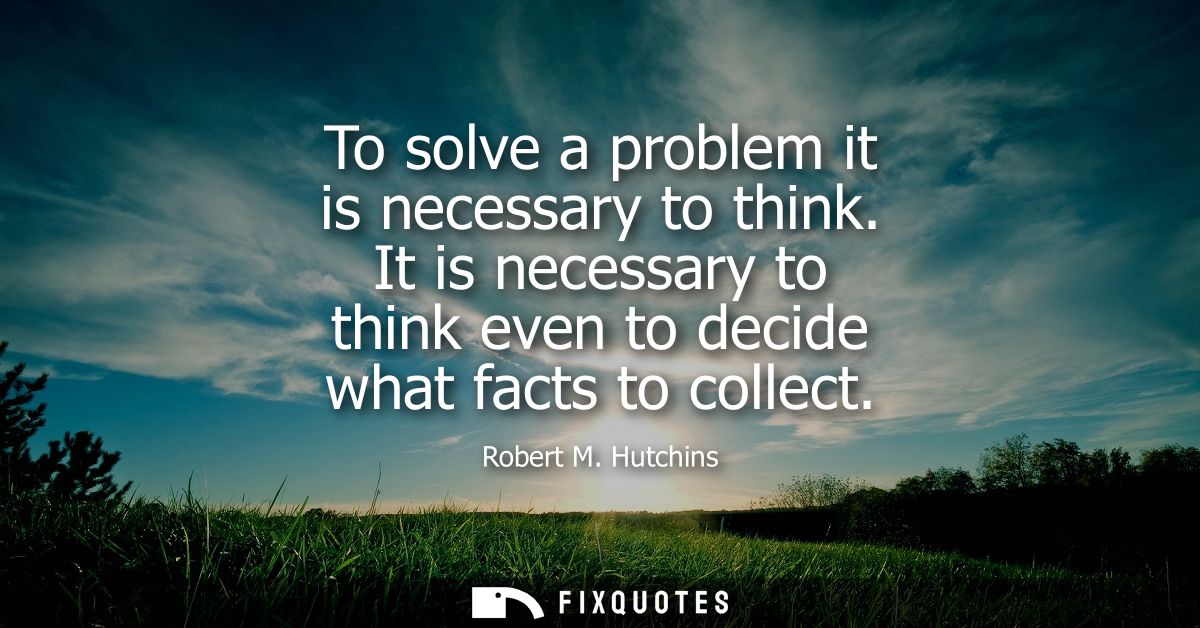
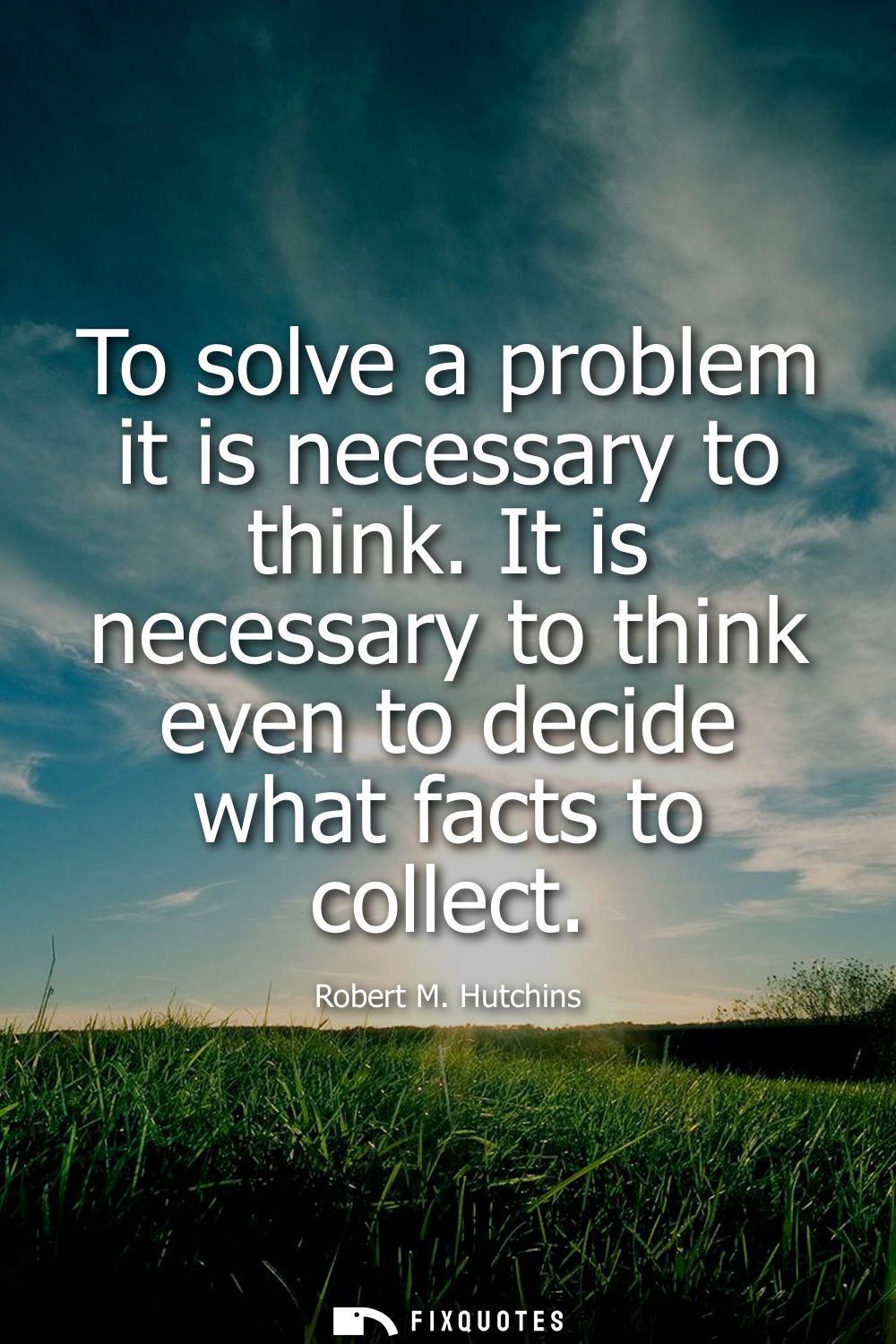
"To solve a problem it is necessary to think. It is necessary to think even to decide what facts to collect"
About this Quote
The line lands like a rebuke to the modern cult of “data-driven” everything. Hutchins isn’t dismissing facts; he’s warning that facts don’t arrive pre-labeled with meaning. Before the spreadsheet, before the survey instrument, before the “just show me the numbers” bravado, someone has to decide what counts as a number worth having. That decision is already an act of theory, of values, of imagination.
Hutchins, a major American educator and longtime University of Chicago president, is speaking from the mid-century faith in liberal education: the idea that thinking is not a decorative add-on to expertise but the engine that makes expertise coherent. His intent is pointedly pedagogical. He’s trying to pull students, administrators, and policy-makers away from the comforting fantasy that problems are solved by accumulation. Collecting facts can feel like progress because it’s measurable; thinking is messier, harder to audit, and easier to avoid.
The subtext is also a subtle critique of bureaucratic rationality. Institutions love “fact-finding missions” because they postpone judgment and distribute responsibility: if the data isn’t complete, the decision can wait. Hutchins insists that deciding what to collect is itself a decision, and therefore an ethical and political act. The quote works because it exposes the hidden first move in problem-solving: framing. Get the frame wrong and your “facts” will faithfully answer the wrong question.
Hutchins, a major American educator and longtime University of Chicago president, is speaking from the mid-century faith in liberal education: the idea that thinking is not a decorative add-on to expertise but the engine that makes expertise coherent. His intent is pointedly pedagogical. He’s trying to pull students, administrators, and policy-makers away from the comforting fantasy that problems are solved by accumulation. Collecting facts can feel like progress because it’s measurable; thinking is messier, harder to audit, and easier to avoid.
The subtext is also a subtle critique of bureaucratic rationality. Institutions love “fact-finding missions” because they postpone judgment and distribute responsibility: if the data isn’t complete, the decision can wait. Hutchins insists that deciding what to collect is itself a decision, and therefore an ethical and political act. The quote works because it exposes the hidden first move in problem-solving: framing. Get the frame wrong and your “facts” will faithfully answer the wrong question.
Quote Details
| Topic | Decision-Making |
|---|
More Quotes by Robert
Add to List