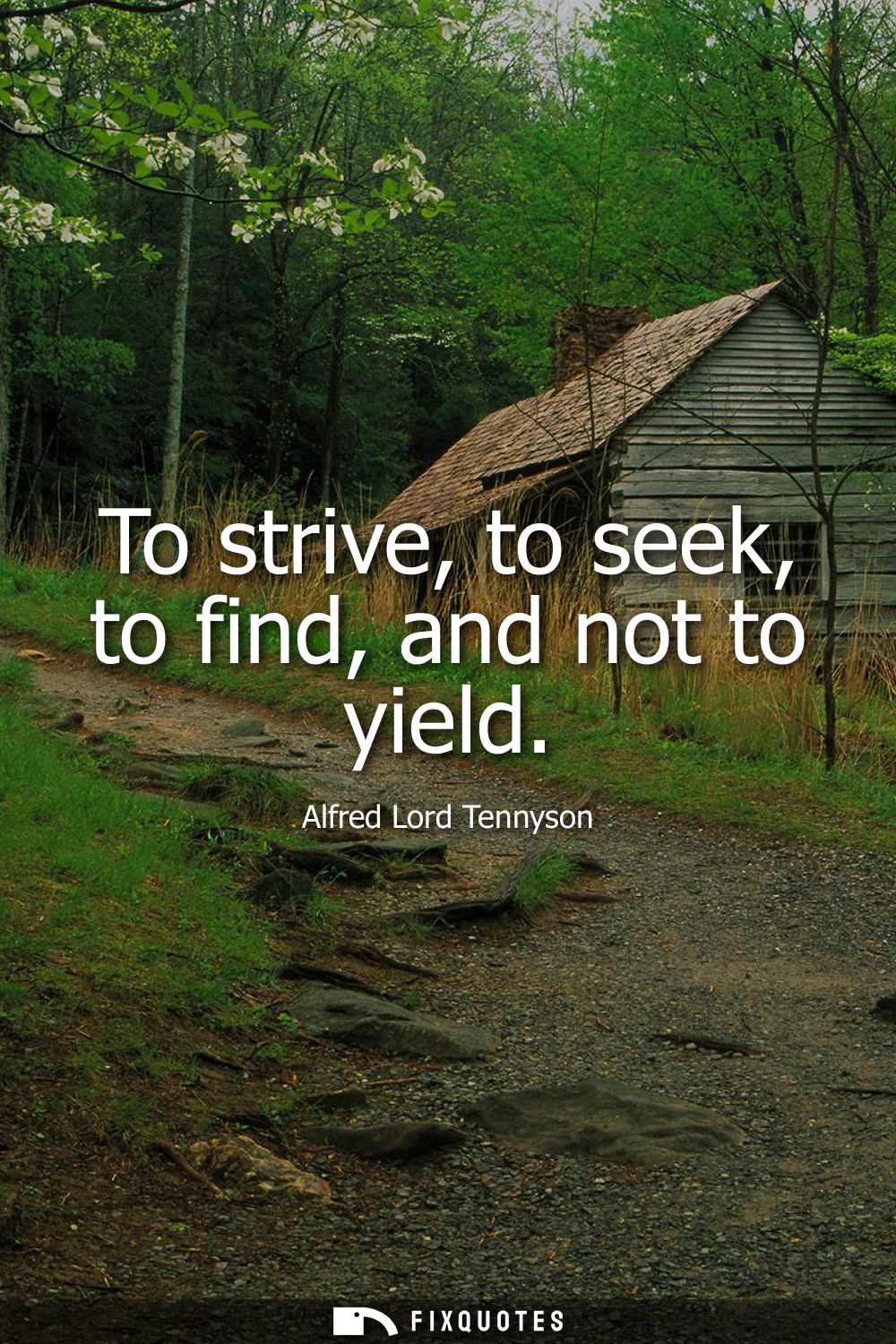
"To strive, to seek, to find, and not to yield"
About this Quote
A four-beat mantra that sounds like pure motivation until you remember where Tennyson puts it: in the mouth of a worn-out hero trying to talk himself back into motion. "To strive, to seek, to find, and not to yield" lands with the clean propulsion of a drumline, each infinitive a rung on a ladder, each comma a quick inhale. The rhetoric is engineered for recurrence: you can chant it, carve it, recruit with it. That’s why it became a Victorian catchphrase for grit and empire, the kind of line that flatters a society convinced that forward motion is virtue.
But in "Ulysses", its original context, the bravado has a hairline crack. Odysseus is not a young conqueror; he’s an aging king restless at home, scorning the "still hearth" and the slow work of governance. The subtext is less "never give up" than "I can’t live with ordinary life". His hunger for questing reads like aspiration and avoidance at once: a refusal to "yield" to mortality, yes, but also to domestic responsibility, to compromise, to the dull ethics of staying.
Tennyson wrote the poem shortly after the death of his friend Arthur Hallam, and that grief hums under the steel. The line is a spell against despair: keep moving so the loss can’t catch you. Its brilliance is that it can be both noble and suspect, an anthem that inspires precisely because it never admits what it’s running from.
But in "Ulysses", its original context, the bravado has a hairline crack. Odysseus is not a young conqueror; he’s an aging king restless at home, scorning the "still hearth" and the slow work of governance. The subtext is less "never give up" than "I can’t live with ordinary life". His hunger for questing reads like aspiration and avoidance at once: a refusal to "yield" to mortality, yes, but also to domestic responsibility, to compromise, to the dull ethics of staying.
Tennyson wrote the poem shortly after the death of his friend Arthur Hallam, and that grief hums under the steel. The line is a spell against despair: keep moving so the loss can’t catch you. Its brilliance is that it can be both noble and suspect, an anthem that inspires precisely because it never admits what it’s running from.
Quote Details
| Topic | Never Give Up |
|---|---|
| Source | Verified source: The Complete Works of Alfred, Lord Tennyson, Poet Laureate (Alfred Tennyson Baron Tennyson, 1884)ID: lh8_AAAAYAAJ
Evidence: Alfred Tennyson Baron Tennyson. Yet all experience is an arch wherethro ' Gleams that untravell'd world , whose margin ... To strive , to seek , to find , and not to yield . The woman of a thousand summers back , Godiva ,. 58 ULYSSES . Other candidates (1) Poems (Alfred Lord Tennyson, 1842)100.0% To strive, to seek, to find, and not to yield.. This line is the closing line of Alfred, Lord Tennyson’s poem “Ulysse... |
| Cite |
Citation Formats
APA Style (7th ed.)
Tennyson, Alfred Lord. (2026, March 2). To strive, to seek, to find, and not to yield. FixQuotes. https://fixquotes.com/quotes/to-strive-to-seek-to-find-and-not-to-yield-3658/
Chicago Style
Tennyson, Alfred Lord. "To strive, to seek, to find, and not to yield." FixQuotes. March 2, 2026. https://fixquotes.com/quotes/to-strive-to-seek-to-find-and-not-to-yield-3658/.
MLA Style (9th ed.)
"To strive, to seek, to find, and not to yield." FixQuotes, 2 Mar. 2026, https://fixquotes.com/quotes/to-strive-to-seek-to-find-and-not-to-yield-3658/. Accessed 29 Mar. 2026.
More Quotes by Alfred
Add to List