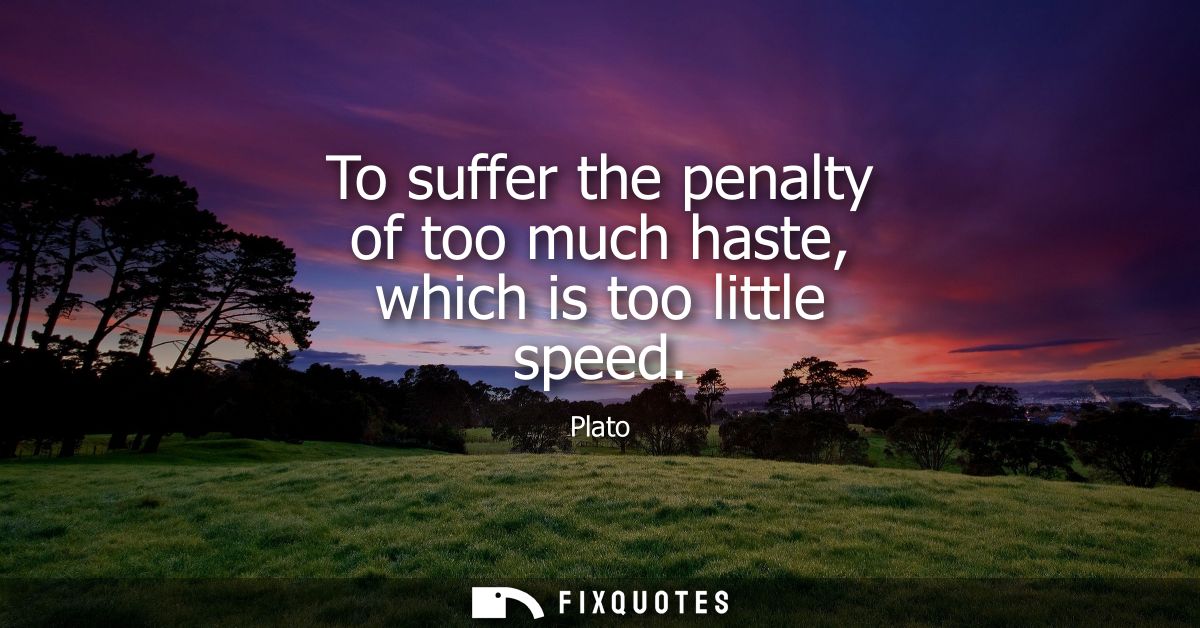
"To suffer the penalty of too much haste, which is too little speed"
About this Quote
Haste, Plato implies, is a counterfeit of speed: it looks like motion but produces friction, error, and ultimately delay. The line turns on a neat paradox - "too much haste" becomes "too little speed" - exposing the way impatience sabotages its own goal. It is philosophy as quality control. Real efficiency, in Plato's world, is not the sprint of impulse but the disciplined tempo of reason.
The intent is corrective, almost pedagogical. Plato is warning students of politics, ethics, and inquiry that rushing is not morally neutral; it is a cognitive failure. Haste is the soul letting appetite and anxiety seize the steering wheel. You can hear the broader Platonic suspicion of appearances: what seems fastest in the moment often belongs to the realm of illusion, while what actually moves you toward the good requires method, training, and internal order.
The subtext is also political. Athens, recovering from war and buffeted by demagogues, had seen what quick solutions and crowd moods could cost. Plato's philosophy is born in a city where trials, votes, and punishments could be executed with shocking speed - including the death of Socrates. Against that backdrop, the quote reads like a rebuke to civic impatience: a society can act fast and still go nowhere worth going.
It works because it shames the modern vice before modernity: the belief that urgency equals competence. Plato flips that prestige. The hurried person is not driven; they're stalled, mistaking turbulence for progress.
The intent is corrective, almost pedagogical. Plato is warning students of politics, ethics, and inquiry that rushing is not morally neutral; it is a cognitive failure. Haste is the soul letting appetite and anxiety seize the steering wheel. You can hear the broader Platonic suspicion of appearances: what seems fastest in the moment often belongs to the realm of illusion, while what actually moves you toward the good requires method, training, and internal order.
The subtext is also political. Athens, recovering from war and buffeted by demagogues, had seen what quick solutions and crowd moods could cost. Plato's philosophy is born in a city where trials, votes, and punishments could be executed with shocking speed - including the death of Socrates. Against that backdrop, the quote reads like a rebuke to civic impatience: a society can act fast and still go nowhere worth going.
It works because it shames the modern vice before modernity: the belief that urgency equals competence. Plato flips that prestige. The hurried person is not driven; they're stalled, mistaking turbulence for progress.
Quote Details
| Topic | Wisdom |
|---|---|
| Source | Help us find the source |
| Cite |
Citation Formats
APA Style (7th ed.)
Plato. (2026, January 14). To suffer the penalty of too much haste, which is too little speed. FixQuotes. https://fixquotes.com/quotes/to-suffer-the-penalty-of-too-much-haste-which-is-41850/
Chicago Style
Plato. "To suffer the penalty of too much haste, which is too little speed." FixQuotes. January 14, 2026. https://fixquotes.com/quotes/to-suffer-the-penalty-of-too-much-haste-which-is-41850/.
MLA Style (9th ed.)
"To suffer the penalty of too much haste, which is too little speed." FixQuotes, 14 Jan. 2026, https://fixquotes.com/quotes/to-suffer-the-penalty-of-too-much-haste-which-is-41850/. Accessed 12 Feb. 2026.
More Quotes by Plato
Add to List