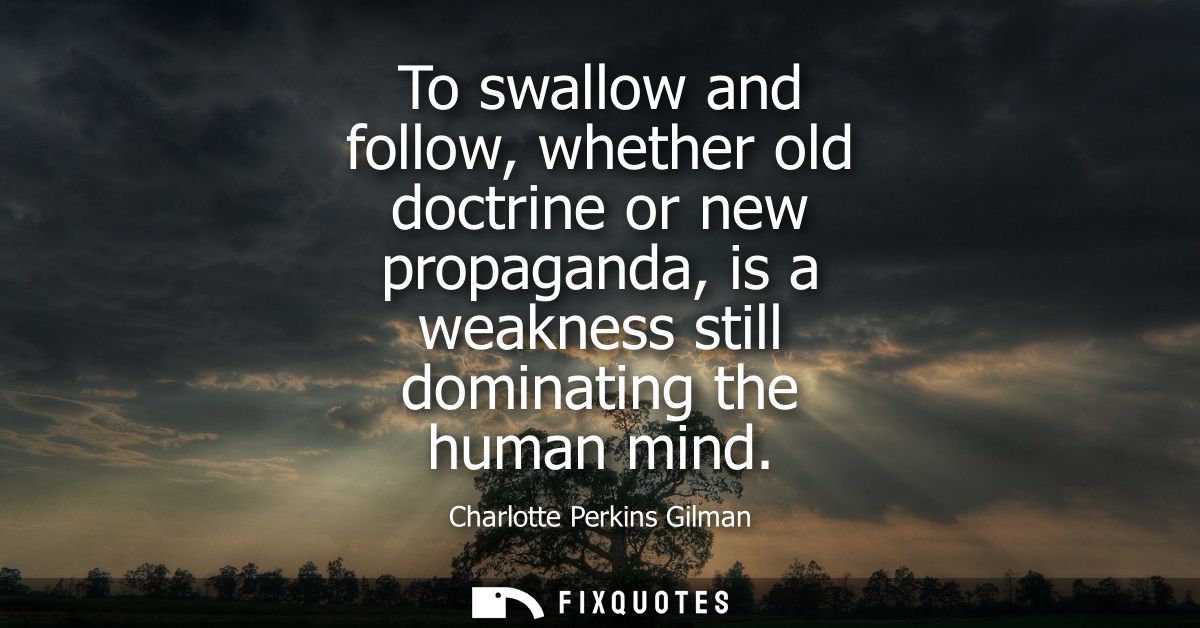
"To swallow and follow, whether old doctrine or new propaganda, is a weakness still dominating the human mind"
About this Quote
The intent is corrective, almost hygienic: stop treating inherited norms or mass messaging as neutral background noise. Gilman wrote in an America churning with industrial capitalism, suffrage politics, “scientific” social theories, and a booming press - a perfect ecosystem for both sanctified dogma and slick persuasion. As a feminist and social critic, she had a stake in showing how institutions train people to mistake conformity for virtue, especially women, whose “role” was frequently defended as timeless truth and then rebranded as modern common sense.
The subtext is bluntly democratic and faintly impatient: if the human mind remains dominated by this weakness, reform will always be reversible. Any movement can become its own catechism; any liberation can calcify into slogans. Gilman’s line asks for a harder kind of self-respect: skepticism not as cynicism, but as the discipline of thinking in public without becoming a mouthpiece.
Quote Details
| Topic | Reason & Logic |
|---|---|
| Source | Help us find the source |
| Cite |
Citation Formats
APA Style (7th ed.)
Gilman, Charlotte Perkins. (2026, January 16). To swallow and follow, whether old doctrine or new propaganda, is a weakness still dominating the human mind. FixQuotes. https://fixquotes.com/quotes/to-swallow-and-follow-whether-old-doctrine-or-new-101577/
Chicago Style
Gilman, Charlotte Perkins. "To swallow and follow, whether old doctrine or new propaganda, is a weakness still dominating the human mind." FixQuotes. January 16, 2026. https://fixquotes.com/quotes/to-swallow-and-follow-whether-old-doctrine-or-new-101577/.
MLA Style (9th ed.)
"To swallow and follow, whether old doctrine or new propaganda, is a weakness still dominating the human mind." FixQuotes, 16 Jan. 2026, https://fixquotes.com/quotes/to-swallow-and-follow-whether-old-doctrine-or-new-101577/. Accessed 12 Mar. 2026.