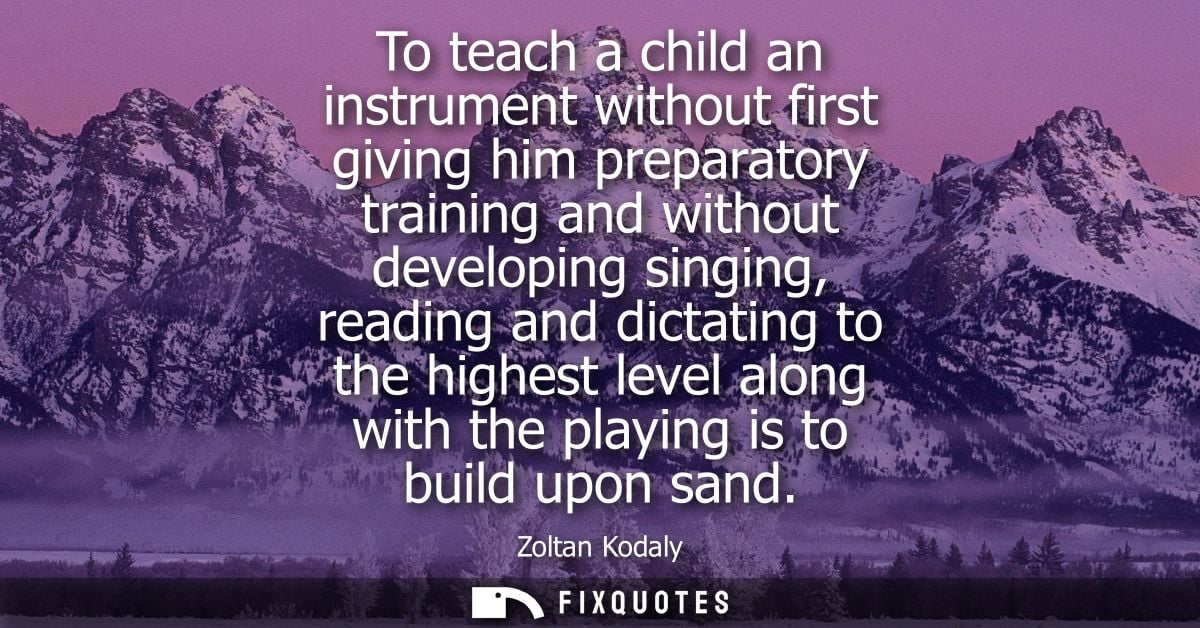
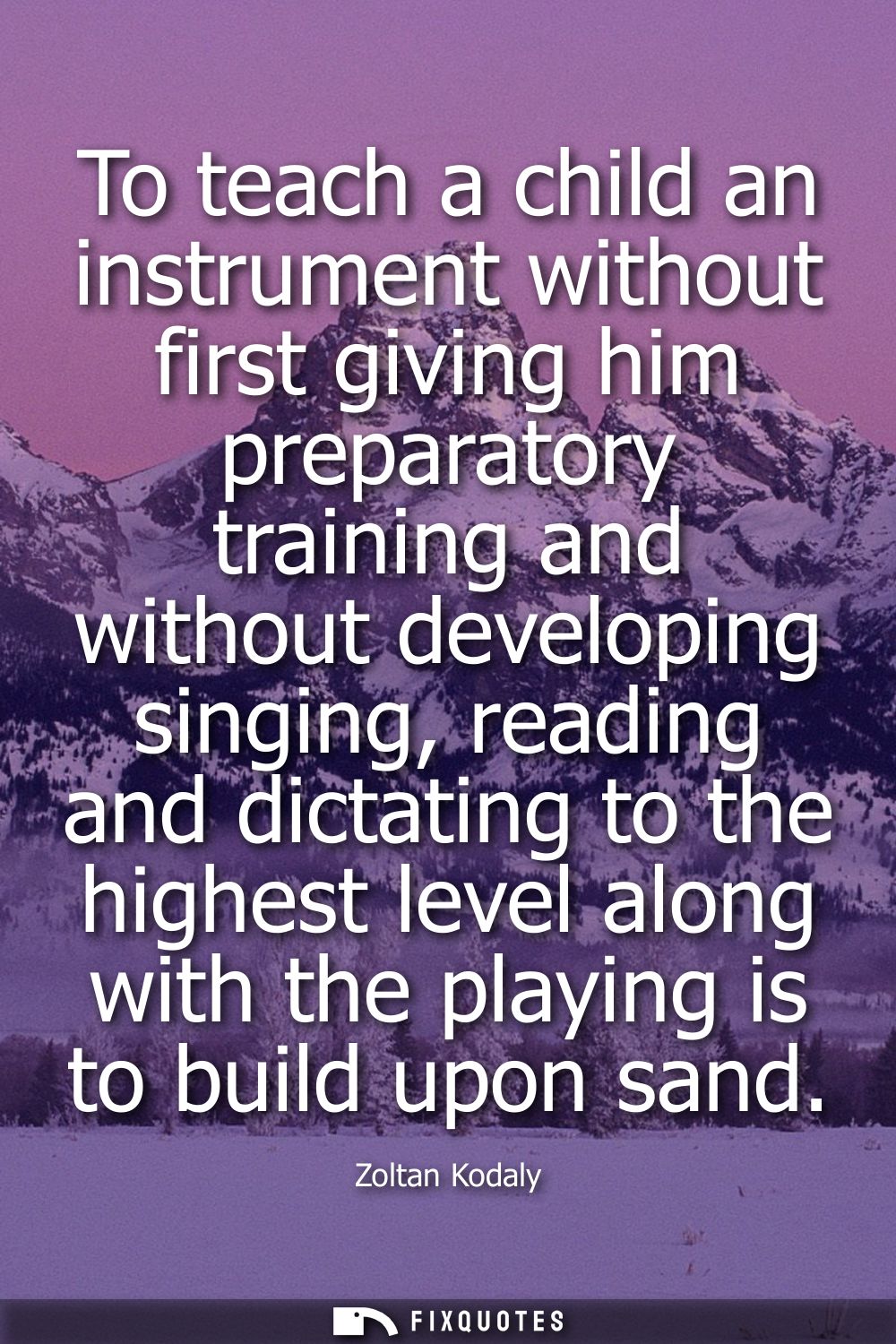
"To teach a child an instrument without first giving him preparatory training and without developing singing, reading and dictating to the highest level along with the playing, is to build upon sand"
About this Quote
The subtext is unmistakably democratic and nationalistic in the best sense of the word. Kodaly, working in early 20th-century Hungary, was part of a broader project: building a musically literate public, not merely producing virtuosos. Singing sits at the center because it’s the cheapest, most universal instrument, and because it binds sound to body. Dictation matters because it forces accountability: can you hear structure, not just imitate it? Reading matters because it makes music portable, shareable, independent of a single teacher or recording.
There’s also a quiet critique of prestige culture. Instrumental study, especially in bourgeois settings, can become a status object: early starts, expensive lessons, recital polish. Kodaly punctures that with a teacher’s realism. If the ear and the voice aren’t trained “to the highest level,” the impressive scaffolding of repertoire is cosmetic. The student hasn’t learned music; they’ve learned compliance.
Quote Details
| Topic | Teaching |
|---|---|
| Source | Later attribution: Kodály Today (Mícheál Houlahan, Philip Tacka, 2015) modern compilationISBN: 9780190235772 · ID: Z4ElCgAAQBAJ
Evidence:
... To teach a child an instrument without first giving him preparatory training and without developing singing , reading and dictating to the highest level along with the playing is to build upon sand.37 I heard the finest singing in the ... |
| Cite |
Citation Formats
APA Style (7th ed.)
Kodaly, Zoltan. (2026, March 22). To teach a child an instrument without first giving him preparatory training and without developing singing, reading and dictating to the highest level along with the playing, is to build upon sand. FixQuotes. https://fixquotes.com/quotes/to-teach-a-child-an-instrument-without-first-111458/
Chicago Style
Kodaly, Zoltan. "To teach a child an instrument without first giving him preparatory training and without developing singing, reading and dictating to the highest level along with the playing, is to build upon sand." FixQuotes. March 22, 2026. https://fixquotes.com/quotes/to-teach-a-child-an-instrument-without-first-111458/.
MLA Style (9th ed.)
"To teach a child an instrument without first giving him preparatory training and without developing singing, reading and dictating to the highest level along with the playing, is to build upon sand." FixQuotes, 22 Mar. 2026, https://fixquotes.com/quotes/to-teach-a-child-an-instrument-without-first-111458/. Accessed 28 Mar. 2026.