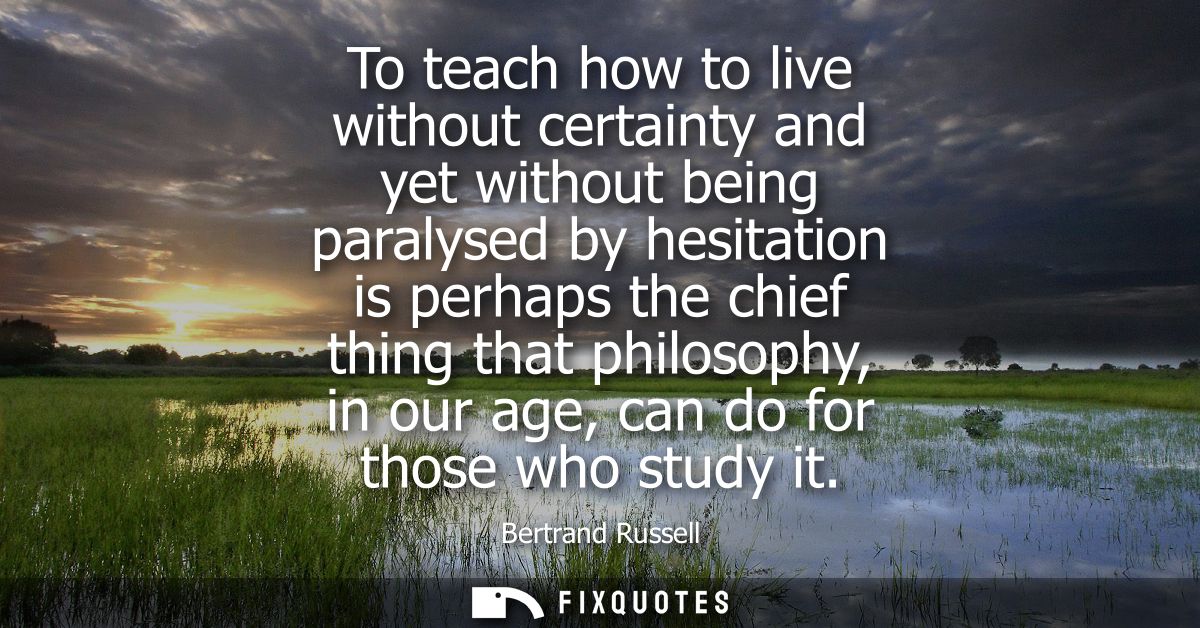
"To teach how to live without certainty and yet without being paralysed by hesitation is perhaps the chief thing that philosophy, in our age, can do for those who study it"
About this Quote
Russell turns philosophy into a kind of adult training program: not a warehouse for answers, but a discipline for staying functional when the universe refuses to cooperate with our need for closure. The line is engineered around a tightrope walk between two modern anxieties: the craving for certainty and the fear of being wrong. He concedes uncertainty as the baseline condition, then refuses the romantic pose of despair. What matters is the “yet”: you can live without guarantees and still act.
The subtext is a rebuke to two tribes Russell watched harden in the early 20th century. On one side, the dogmatists who treat ideology, religion, or “common sense” as a substitute for evidence. On the other, the skeptics who turn doubt into a personality and mistake paralysis for sophistication. Russell’s target is not ignorance, but the misuse of intelligence: hesitation that becomes an alibi for doing nothing.
Context matters because Russell lived through an age when certainty looked seductive and lethal. Totalizing political systems, nationalist mythologies, and the pseudo-certainties of bad science promised order at scale. Against that, Russell’s liberal, analytic temperament insists on fallibilism: you proceed with provisional beliefs, revise them, and keep your moral nerve.
Rhetorically, the sentence works by shrinking philosophy’s job description and inflating its urgency. “Perhaps the chief thing” sounds modest, but it’s a power move: he’s claiming philosophy’s most practical outcome is psychological and civic competence under ambiguity. In an era of hot takes and epistemic whiplash, Russell’s point lands as both diagnosis and instruction manual.
The subtext is a rebuke to two tribes Russell watched harden in the early 20th century. On one side, the dogmatists who treat ideology, religion, or “common sense” as a substitute for evidence. On the other, the skeptics who turn doubt into a personality and mistake paralysis for sophistication. Russell’s target is not ignorance, but the misuse of intelligence: hesitation that becomes an alibi for doing nothing.
Context matters because Russell lived through an age when certainty looked seductive and lethal. Totalizing political systems, nationalist mythologies, and the pseudo-certainties of bad science promised order at scale. Against that, Russell’s liberal, analytic temperament insists on fallibilism: you proceed with provisional beliefs, revise them, and keep your moral nerve.
Rhetorically, the sentence works by shrinking philosophy’s job description and inflating its urgency. “Perhaps the chief thing” sounds modest, but it’s a power move: he’s claiming philosophy’s most practical outcome is psychological and civic competence under ambiguity. In an era of hot takes and epistemic whiplash, Russell’s point lands as both diagnosis and instruction manual.
Quote Details
| Topic | Wisdom |
|---|
More Quotes by Bertrand
Add to List