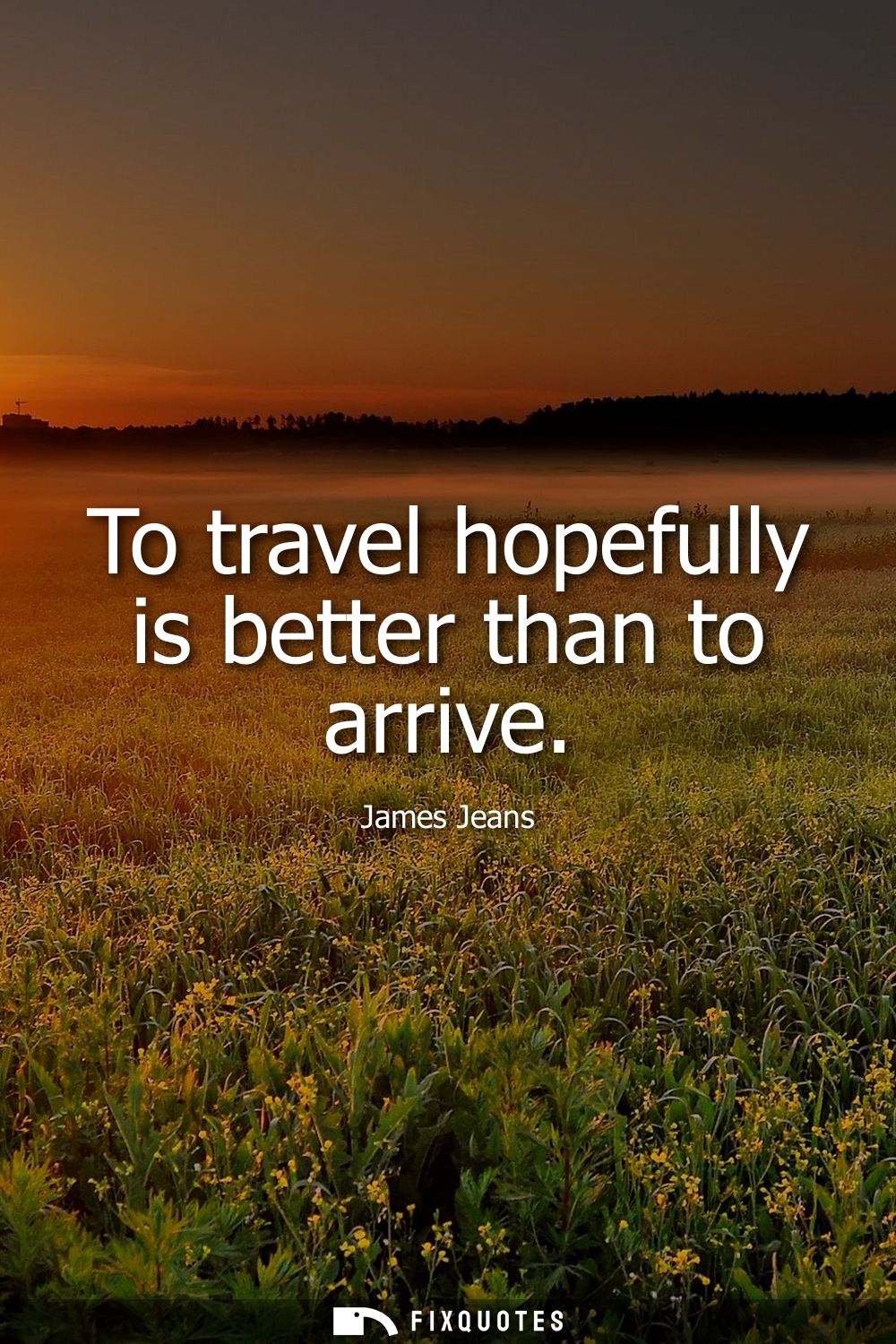
"To travel hopefully is better than to arrive"
About this Quote
"To travel hopefully is better than to arrive" sounds like a postcard slogan until you remember James Jeans wasn’t selling wanderlust; he was building models of a universe that refuses to sit still. Coming from a physicist who worked on stellar structure and the deep mathematics of matter, the line reads like a quiet rebuke to the fantasy of final answers. Arrival implies closure: the theorem proved, the experiment settled, the cosmos explained. Jeans knew better. In science, “arriving” is often just the moment a question changes clothes.
The intent is almost methodological. Hopeful travel is the disciplined posture of inquiry: you commit to a direction without pretending you’ve already conquered the destination. That’s not naïve optimism; it’s a survival strategy for anyone working at the edge of the known, where today’s elegant solution becomes tomorrow’s approximation. The subtext is an attack on intellectual complacency. Arrival can breed certainty, and certainty is how good thinking goes to die.
Context matters, too. Jeans wrote and spoke in an era when physics was undergoing a humiliating glow-up: classical mechanics gave way to relativity and quantum theory, and the universe expanded both literally and conceptually. A scientist watching foundational assumptions crack would naturally prize the journey - the creative, provisional, self-correcting motion of thought - over any trophy labeled “Truth.” The line works because it turns what sounds like resignation into a form of ambition: keep moving, keep revising, keep hoping, because the destination is always temporary.
The intent is almost methodological. Hopeful travel is the disciplined posture of inquiry: you commit to a direction without pretending you’ve already conquered the destination. That’s not naïve optimism; it’s a survival strategy for anyone working at the edge of the known, where today’s elegant solution becomes tomorrow’s approximation. The subtext is an attack on intellectual complacency. Arrival can breed certainty, and certainty is how good thinking goes to die.
Context matters, too. Jeans wrote and spoke in an era when physics was undergoing a humiliating glow-up: classical mechanics gave way to relativity and quantum theory, and the universe expanded both literally and conceptually. A scientist watching foundational assumptions crack would naturally prize the journey - the creative, provisional, self-correcting motion of thought - over any trophy labeled “Truth.” The line works because it turns what sounds like resignation into a form of ambition: keep moving, keep revising, keep hoping, because the destination is always temporary.
Quote Details
| Topic | Journey |
|---|---|
| Source | Help us find the source |
| Cite |
Citation Formats
APA Style (7th ed.)
Jeans, James. (2026, January 16). To travel hopefully is better than to arrive. FixQuotes. https://fixquotes.com/quotes/to-travel-hopefully-is-better-than-to-arrive-117697/
Chicago Style
Jeans, James. "To travel hopefully is better than to arrive." FixQuotes. January 16, 2026. https://fixquotes.com/quotes/to-travel-hopefully-is-better-than-to-arrive-117697/.
MLA Style (9th ed.)
"To travel hopefully is better than to arrive." FixQuotes, 16 Jan. 2026, https://fixquotes.com/quotes/to-travel-hopefully-is-better-than-to-arrive-117697/. Accessed 10 Mar. 2026.
More Quotes by James
Add to List