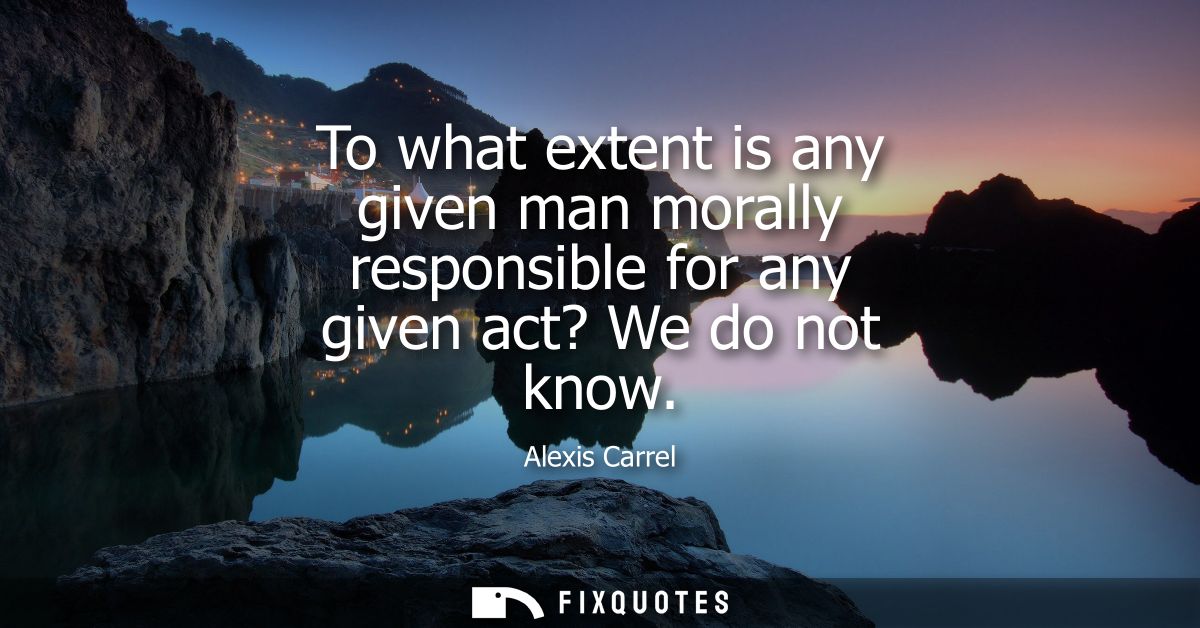
"To what extent is any given man morally responsible for any given act? We do not know"
About this Quote
Carrel’s question lands like a scalpel cut: not a plea for compassion, but an attempt to relocate moral judgment onto the uncertain terrain of biology and circumstance. “To what extent” is doing a lot of work here. It frames responsibility as a measurable variable, something that could, in theory, be quantified the way a lab might quantify blood pressure. Then comes the cold release valve: “We do not know.” It’s the authority of scientific humility deployed as a social argument.
The subtext is less “humans are complicated” than “the old moral vocabulary may be obsolete.” In the early 20th century, when neuroscience, psychiatry, and heredity were rapidly reshaping how elites talked about behavior, Carrel’s line echoes a broader cultural shift: from sin to diagnosis, from vice to mechanism. The rhetorical move isn’t to deny agency outright, but to suspend it indefinitely, placing ethics on probation pending further data.
That suspension matters because it can cut two ways. In the best reading, it’s a warning against easy condemnation: if causes are tangled - trauma, illness, social deprivation - moral certainty becomes a kind of ignorance. In the darker reading, “we do not know” becomes a permission slip for technocratic control, where experts, not citizens, decide how much freedom anyone deserves. Coming from Carrel, a celebrated scientist with controversial views about social engineering, the line carries that uneasy double edge: a sincere admission of complexity, and a strategic ambiguity that can make judgment disappear right when power wants it to.
The subtext is less “humans are complicated” than “the old moral vocabulary may be obsolete.” In the early 20th century, when neuroscience, psychiatry, and heredity were rapidly reshaping how elites talked about behavior, Carrel’s line echoes a broader cultural shift: from sin to diagnosis, from vice to mechanism. The rhetorical move isn’t to deny agency outright, but to suspend it indefinitely, placing ethics on probation pending further data.
That suspension matters because it can cut two ways. In the best reading, it’s a warning against easy condemnation: if causes are tangled - trauma, illness, social deprivation - moral certainty becomes a kind of ignorance. In the darker reading, “we do not know” becomes a permission slip for technocratic control, where experts, not citizens, decide how much freedom anyone deserves. Coming from Carrel, a celebrated scientist with controversial views about social engineering, the line carries that uneasy double edge: a sincere admission of complexity, and a strategic ambiguity that can make judgment disappear right when power wants it to.
Quote Details
| Topic | Ethics & Morality |
|---|
More Quotes by Alexis
Add to List