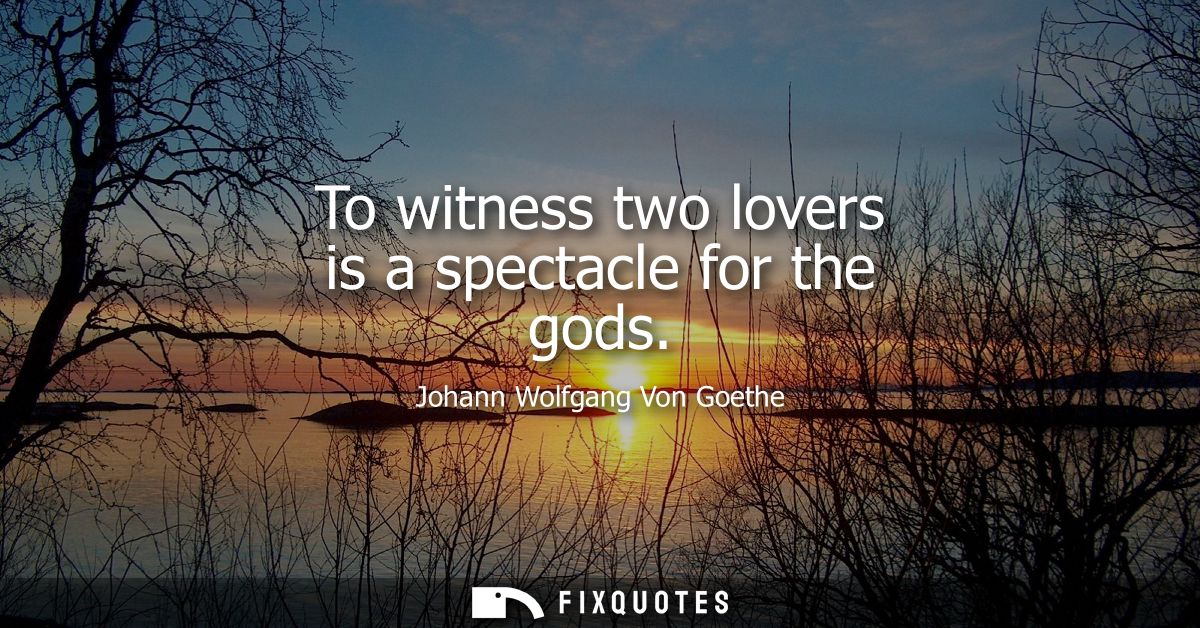
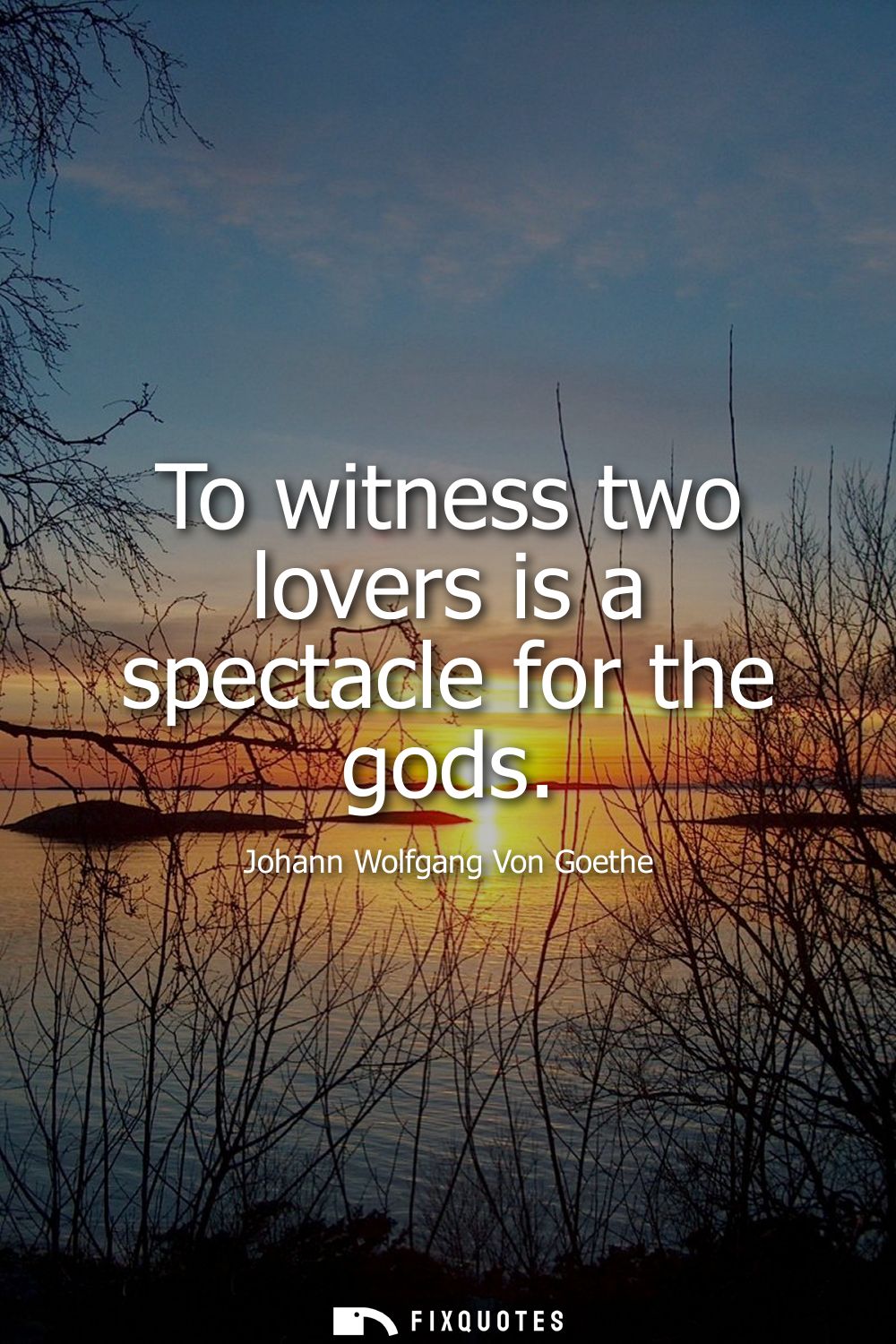
"To witness two lovers is a spectacle for the gods"
About this Quote
Romance, in Goethe's hands, is never just private; it’s a staged event with metaphysical lighting. “To witness two lovers is a spectacle for the gods” elevates an everyday scene into something liturgical and theatrical at once. The key move is “witness”: love isn’t defined here by vows or virtue but by its visibility, by the charge it throws into the world when two people lock into each other’s gravity. It’s a line that flatters human intimacy while quietly shrinking it, too. Lovers are dazzling, yes, but they’re also being watched. The gods are the audience.
That subtext fits Goethe’s era and obsessions. Writing at the hinge between Enlightenment rationality and Romantic hunger, he understood desire as both a force of nature and a social disturbance. In The Sorrows of Young Werther, love is a kind of beautiful catastrophe; in Faust, it’s the lever that moves souls, bargains, and ruin. This aphorism distills that worldview: love is sublime not because it’s harmless, but because it’s consequential. The divine “spectacle” suggests more than admiration; it hints at experiment, entertainment, even judgment. The gods watch the way a writer watches: fascinated by what humans do when they’re most alive and least governable.
There’s also an aesthetic manifesto embedded in the sentence. Lovers become art simply by being lovers; their intensity generates narrative without needing plot. Goethe, the consummate dramatist of feeling, is telling you why passion keeps returning as literature’s favorite engine: it offers action, risk, transformation, and a kind of radiance that makes everyone else in the room feel like a supporting character.
That subtext fits Goethe’s era and obsessions. Writing at the hinge between Enlightenment rationality and Romantic hunger, he understood desire as both a force of nature and a social disturbance. In The Sorrows of Young Werther, love is a kind of beautiful catastrophe; in Faust, it’s the lever that moves souls, bargains, and ruin. This aphorism distills that worldview: love is sublime not because it’s harmless, but because it’s consequential. The divine “spectacle” suggests more than admiration; it hints at experiment, entertainment, even judgment. The gods watch the way a writer watches: fascinated by what humans do when they’re most alive and least governable.
There’s also an aesthetic manifesto embedded in the sentence. Lovers become art simply by being lovers; their intensity generates narrative without needing plot. Goethe, the consummate dramatist of feeling, is telling you why passion keeps returning as literature’s favorite engine: it offers action, risk, transformation, and a kind of radiance that makes everyone else in the room feel like a supporting character.
Quote Details
| Topic | Romantic |
|---|---|
| Source | Help us find the source |
| Cite |
Citation Formats
APA Style (7th ed.)
Goethe, Johann Wolfgang Von. (2026, January 17). To witness two lovers is a spectacle for the gods. FixQuotes. https://fixquotes.com/quotes/to-witness-two-lovers-is-a-spectacle-for-the-gods-34331/
Chicago Style
Goethe, Johann Wolfgang Von. "To witness two lovers is a spectacle for the gods." FixQuotes. January 17, 2026. https://fixquotes.com/quotes/to-witness-two-lovers-is-a-spectacle-for-the-gods-34331/.
MLA Style (9th ed.)
"To witness two lovers is a spectacle for the gods." FixQuotes, 17 Jan. 2026, https://fixquotes.com/quotes/to-witness-two-lovers-is-a-spectacle-for-the-gods-34331/. Accessed 5 Apr. 2026.
More Quotes by Johann
Add to List