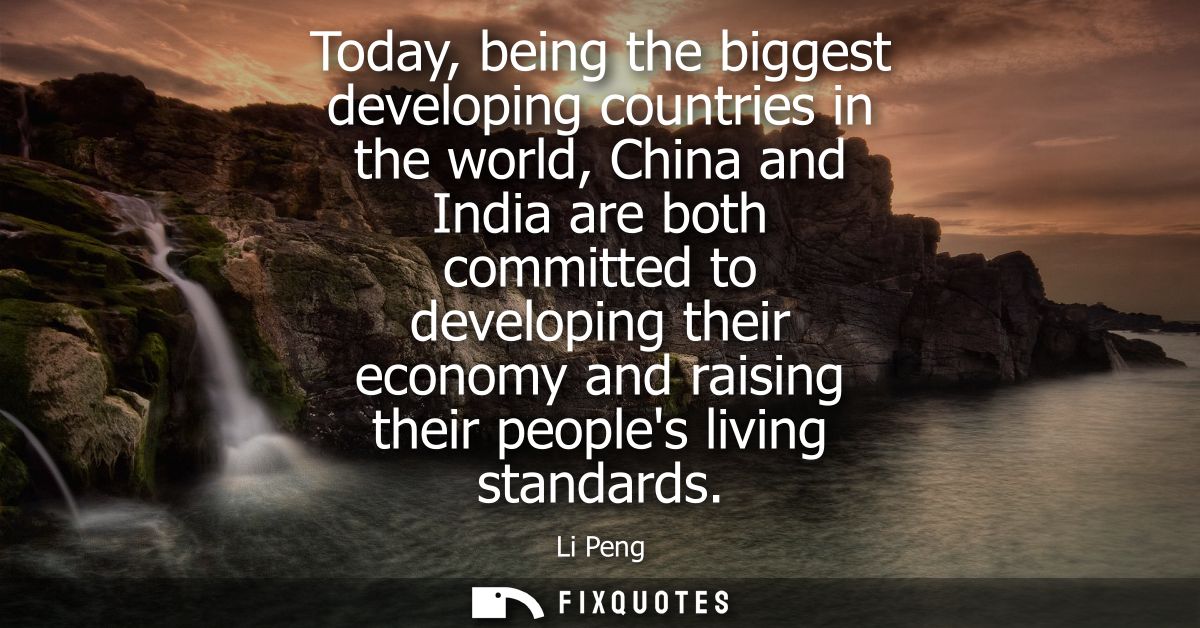
"Today, being the biggest developing countries in the world, China and India are both committed to developing their economy and raising their people's living standards"
About this Quote
Pairing China and India is strategic. It implies a shared destiny and, by extension, a potential bloc identity inside forums where “the developing world” can act as a voting mass or negotiating force. That’s a subtle bid to shift the center of gravity away from Western-defined rules and toward a multipolar order where these two giants can demand flexibility, technology access, and market space.
The phrasing is classic public-servant realism: no ideology, no romance, just “economy” and “living standards.” It collapses political questions into managerial metrics, which is especially pointed given Li Peng’s legacy in a system wary of political pluralism. The subtext is that legitimacy flows from performance: deliver growth, raise incomes, and you’ve answered your critics. It’s also a reminder that development is not just policy but a narrative of inevitability. If hundreds of millions must climb the ladder, then disruption to existing global hierarchies is framed not as threat, but as fairness.
Quote Details
| Topic | Vision & Strategy |
|---|---|
| Source | Help us find the source |
| Cite |
Citation Formats
APA Style (7th ed.)
Peng, Li. (2026, January 16). Today, being the biggest developing countries in the world, China and India are both committed to developing their economy and raising their people's living standards. FixQuotes. https://fixquotes.com/quotes/today-being-the-biggest-developing-countries-in-88483/
Chicago Style
Peng, Li. "Today, being the biggest developing countries in the world, China and India are both committed to developing their economy and raising their people's living standards." FixQuotes. January 16, 2026. https://fixquotes.com/quotes/today-being-the-biggest-developing-countries-in-88483/.
MLA Style (9th ed.)
"Today, being the biggest developing countries in the world, China and India are both committed to developing their economy and raising their people's living standards." FixQuotes, 16 Jan. 2026, https://fixquotes.com/quotes/today-being-the-biggest-developing-countries-in-88483/. Accessed 27 Mar. 2026.