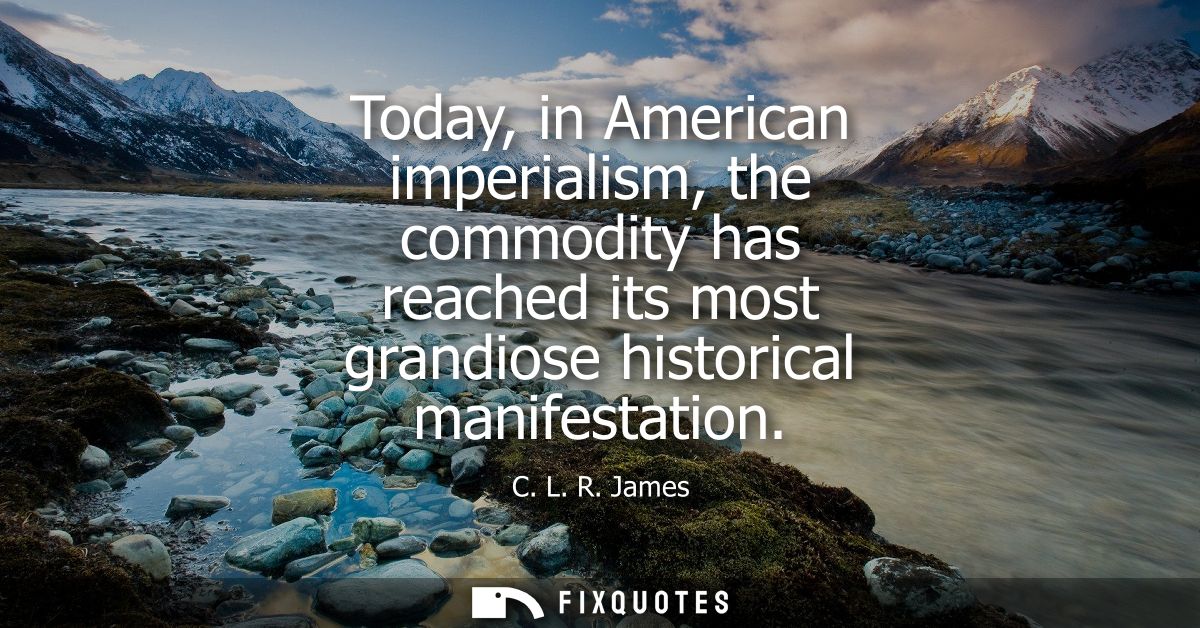
"Today, in American imperialism, the commodity has reached its most grandiose historical manifestation"
About this Quote
The specific intent is polemical and diagnostic. James, steeped in Marxism but allergic to bloodless theory, is pinpointing a shift from commodities as products to commodities as total social relationship. In the U.S.-led order, goods are no longer just exchanged; they become proofs of freedom, metrics of progress, and substitutes for collective purpose. That’s why the line lands with a mix of awe and indictment: “grandiose” suggests cathedrals, monuments, empire - except the monument is a brand.
The subtext is that imperialism has learned to dress domination as choice. You don’t have to be conquered if you can be enrolled as a consumer; you don’t have to agree if your horizon is quietly set by what’s purchasable, watchable, wearable. James is warning that cultural power can be as coercive as political rule, precisely because it feels pleasurable.
Context matters: writing in the long aftermath of World War II and amid decolonization, James is watching the old European empires fade while an American-centered system expands through markets and media. The commodity’s “historical manifestation” is grand because it’s everywhere - and because it makes empire look like lifestyle.
Quote Details
| Topic | Justice |
|---|---|
| Source | Help us find the source |
| Cite |
Citation Formats
APA Style (7th ed.)
James, C. L. R. (2026, January 17). Today, in American imperialism, the commodity has reached its most grandiose historical manifestation. FixQuotes. https://fixquotes.com/quotes/today-in-american-imperialism-the-commodity-has-49352/
Chicago Style
James, C. L. R. "Today, in American imperialism, the commodity has reached its most grandiose historical manifestation." FixQuotes. January 17, 2026. https://fixquotes.com/quotes/today-in-american-imperialism-the-commodity-has-49352/.
MLA Style (9th ed.)
"Today, in American imperialism, the commodity has reached its most grandiose historical manifestation." FixQuotes, 17 Jan. 2026, https://fixquotes.com/quotes/today-in-american-imperialism-the-commodity-has-49352/. Accessed 6 Mar. 2026.