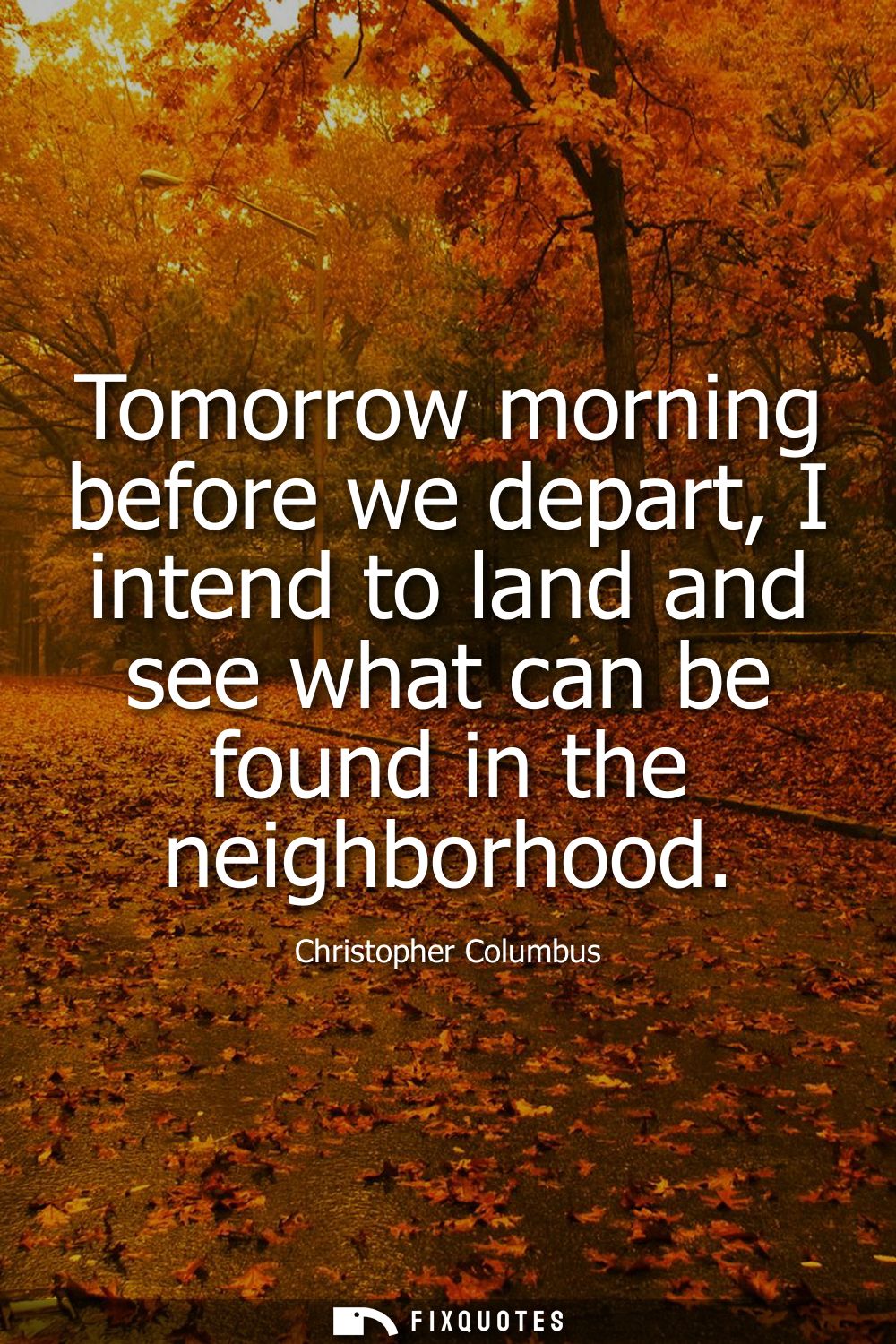
"Tomorrow morning before we depart, I intend to land and see what can be found in the neighborhood"
About this Quote
Context sharpens the chill. Columbus writes as a contractor of empire, tasked with delivering routes, riches, and converts to patrons who funded his voyage. He’s not merely sightseeing; he’s surveying. That bland “neighborhood” shrinks inhabited land into a blank local map, the kind a newcomer sketches when he expects to rename the streets. It’s a rhetorical trick that normalizes first contact by stripping it of stakes, as if people, polities, and sacred geographies are background scenery.
The line also telegraphs a method: touch down, assess, extract meaning and value, move on. “Before we depart” suggests a rhythm of disposable encounters, a drive-by epistemology where knowledge is gathered fast, filtered through expectation, and reported upward as actionable intelligence. The understated tone is the point. It makes the extraordinary violence of discovery culture sound like routine logistics, which is exactly how empires prefer to introduce themselves.
Quote Details
| Topic | Travel |
|---|---|
| Source | Help us find the source |
| Cite |
Citation Formats
APA Style (7th ed.)
Columbus, Christopher. (2026, January 17). Tomorrow morning before we depart, I intend to land and see what can be found in the neighborhood. FixQuotes. https://fixquotes.com/quotes/tomorrow-morning-before-we-depart-i-intend-to-30579/
Chicago Style
Columbus, Christopher. "Tomorrow morning before we depart, I intend to land and see what can be found in the neighborhood." FixQuotes. January 17, 2026. https://fixquotes.com/quotes/tomorrow-morning-before-we-depart-i-intend-to-30579/.
MLA Style (9th ed.)
"Tomorrow morning before we depart, I intend to land and see what can be found in the neighborhood." FixQuotes, 17 Jan. 2026, https://fixquotes.com/quotes/tomorrow-morning-before-we-depart-i-intend-to-30579/. Accessed 9 Feb. 2026.