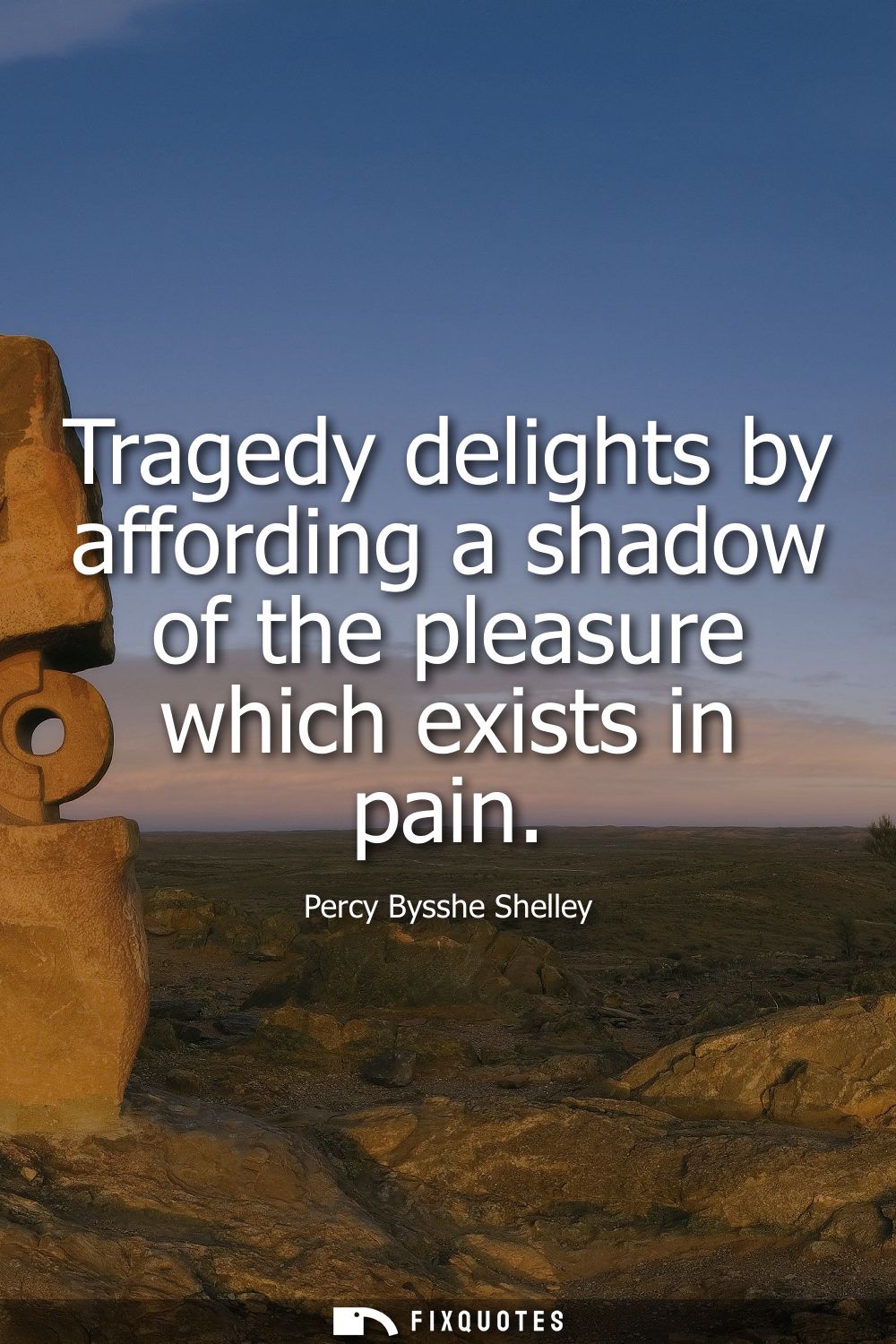
"Tragedy delights by affording a shadow of the pleasure which exists in pain"
About this Quote
The phrase “pleasure which exists in pain” reads like Romanticism refusing to flinch from contradiction. Shelley’s era was obsessed with extremes: revolution and repression, sublime nature and industrial blight, private longing and public catastrophe. In that climate, art becomes a pressure valve. Tragedy lets you experience intensity without consequence, a rehearsal of emotional catastrophe inside a frame. You’re not watching suffering; you’re watching meaning being made from suffering, and that alchemy is where the “delight” sneaks in.
Subtextually, Shelley is defending art against the charge of morbidity. The pleasure isn’t in pain as cruelty, but in pain as proof of depth: the mind recognizing its own capacity to feel, to endure, to metabolize loss into insight. That’s why “shadow” matters: tragedy doesn’t hand you raw trauma; it gives you a controlled darkness, a stylized bruise. The stage (or poem) becomes an ethics lab where we test how much sorrow we can hold, and come away strangely enlarged.
Quote Details
| Topic | Poetry |
|---|---|
| Source | Help us find the source |
| Cite |
Citation Formats
APA Style (7th ed.)
Shelley, Percy Bysshe. (2026, January 16). Tragedy delights by affording a shadow of the pleasure which exists in pain. FixQuotes. https://fixquotes.com/quotes/tragedy-delights-by-affording-a-shadow-of-the-101144/
Chicago Style
Shelley, Percy Bysshe. "Tragedy delights by affording a shadow of the pleasure which exists in pain." FixQuotes. January 16, 2026. https://fixquotes.com/quotes/tragedy-delights-by-affording-a-shadow-of-the-101144/.
MLA Style (9th ed.)
"Tragedy delights by affording a shadow of the pleasure which exists in pain." FixQuotes, 16 Jan. 2026, https://fixquotes.com/quotes/tragedy-delights-by-affording-a-shadow-of-the-101144/. Accessed 22 Mar. 2026.