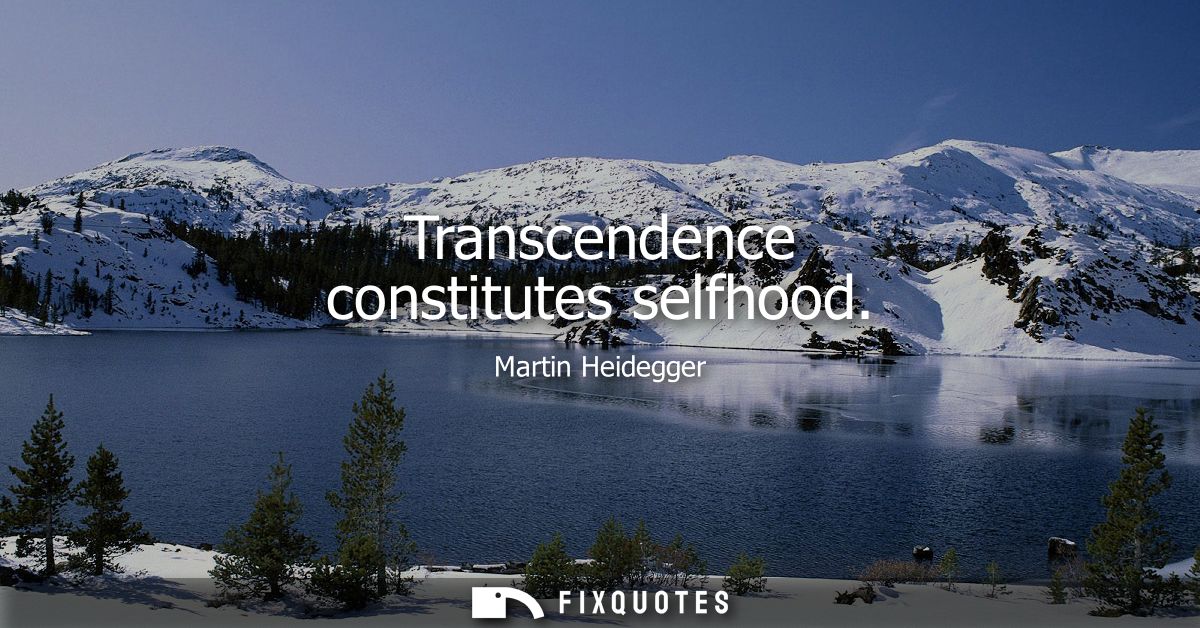
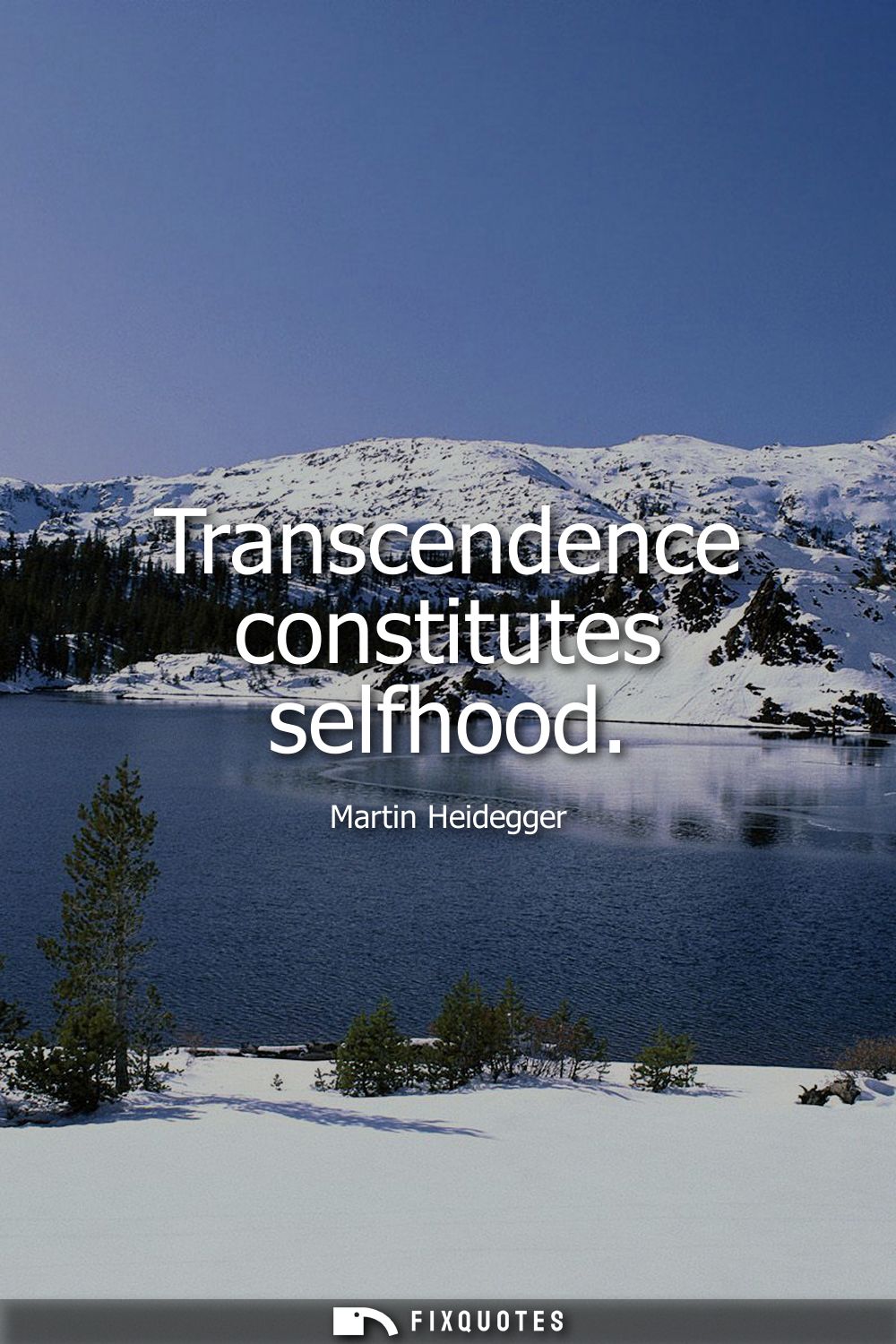
"Transcendence constitutes selfhood"
About this Quote
Heidegger’s line is a provocation disguised as a definition: you don’t first have a stable “self” and then occasionally reach for higher meaning. The reaching is the self. “Transcendence” here isn’t mystical escape or spiritual altitude; it’s the basic structure of human existence as he sees it - the way Dasein (the being we are) is always already beyond whatever it currently is, thrown into a world and forced to relate to it. Selfhood isn’t an inner possession tucked behind the eyes. It’s an ongoing project of taking up a situation, interpreting it, and orienting yourself toward possibilities.
That’s the subtext: if you try to locate identity in a private core, you miss the point. Heidegger wants to dethrone the modern picture of the self as a sealed container of thoughts and traits. Instead, your “who” emerges from your stance toward the world - the commitments you inhabit, the futures you anticipate, the meanings you let matter. Even refusal or drift becomes a way of transcending: you’re still positioned, still responding, still defined by how you evade definition.
Context sharpens the edge. In Being and Time (1927), Heidegger argues against both Cartesian introspection and a purely scientific account of humans. He’s after the existential mechanics underneath everyday life: we are beings for whom being is an issue. “Transcendence constitutes selfhood” is his compressed thesis that personhood is not substance but movement - the constant surpassing of the given into what could be, and the anxiety-laced freedom that comes with that.
That’s the subtext: if you try to locate identity in a private core, you miss the point. Heidegger wants to dethrone the modern picture of the self as a sealed container of thoughts and traits. Instead, your “who” emerges from your stance toward the world - the commitments you inhabit, the futures you anticipate, the meanings you let matter. Even refusal or drift becomes a way of transcending: you’re still positioned, still responding, still defined by how you evade definition.
Context sharpens the edge. In Being and Time (1927), Heidegger argues against both Cartesian introspection and a purely scientific account of humans. He’s after the existential mechanics underneath everyday life: we are beings for whom being is an issue. “Transcendence constitutes selfhood” is his compressed thesis that personhood is not substance but movement - the constant surpassing of the given into what could be, and the anxiety-laced freedom that comes with that.
Quote Details
| Topic | Deep |
|---|---|
| Source | Help us find the source |
| Cite |
Citation Formats
APA Style (7th ed.)
Heidegger, Martin. (2026, January 18). Transcendence constitutes selfhood. FixQuotes. https://fixquotes.com/quotes/transcendence-constitutes-selfhood-17109/
Chicago Style
Heidegger, Martin. "Transcendence constitutes selfhood." FixQuotes. January 18, 2026. https://fixquotes.com/quotes/transcendence-constitutes-selfhood-17109/.
MLA Style (9th ed.)
"Transcendence constitutes selfhood." FixQuotes, 18 Jan. 2026, https://fixquotes.com/quotes/transcendence-constitutes-selfhood-17109/. Accessed 25 Mar. 2026.
More Quotes by Martin
Add to List