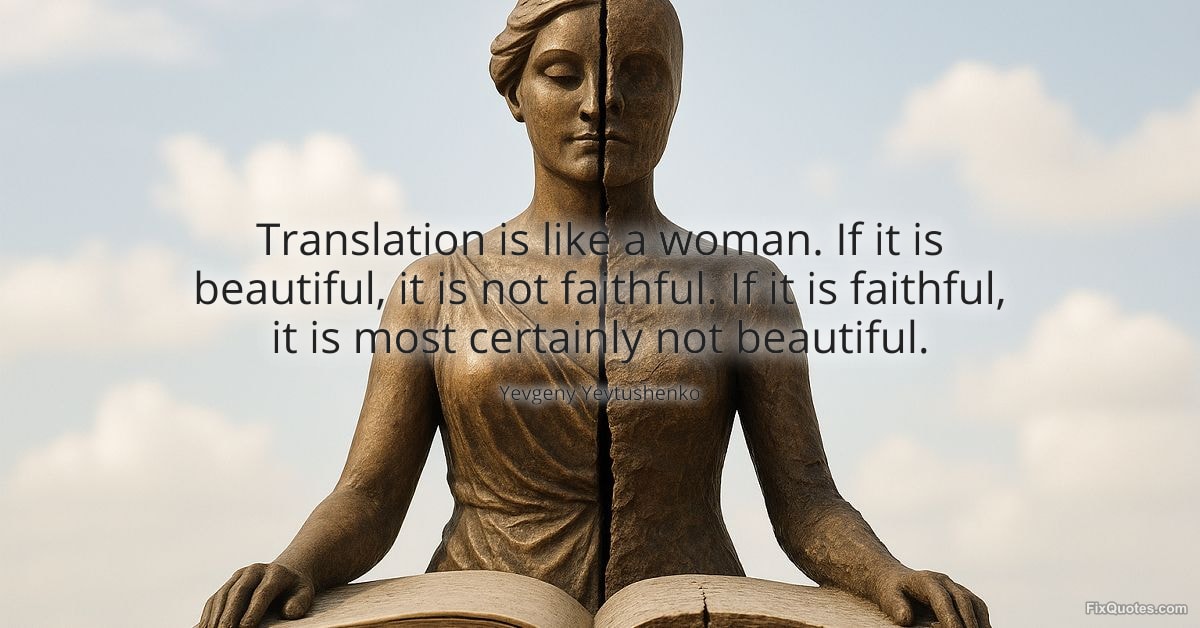
"Translation is like a woman. If it is beautiful, it is not faithful. If it is faithful, it is most certainly not beautiful"
About this Quote
The subtext is a defense of creative betrayal. Calling a “beautiful” translation “unfaithful” elevates the translator from clerk to artist, legitimizing deviation as the price of making a poem live. It’s also a warning: the closer you get to another writer’s voice, the more your own voice disappears; the more you make it sing in your language, the more it becomes yours. His certainty (“most certainly”) is part performance, part polemic - an attempt to settle an argument by force of aphorism.
Context sharpens the edge. Yevtushenko came up in a Soviet literary culture where words had stakes and where poets were translated, exported, and interpreted as public symbols. For someone whose fame depended on crossing borders, the quip is self-protective: if your work reads differently abroad, blame the necessary treachery of translation. Today the gendered analogy reads dated, but the underlying point still needles: fidelity is not a meter you can simply maximize; it’s a choice about which truths you’re willing to lose.
Quote Details
| Topic | Writing |
|---|---|
| Source | Evidence: ... Translation is like a woman. If it is beautiful, it is not faithful. If it is faithful, it is most certainly not beautiful. ~ Yevgeny Yevtushenko As far as modern writing is concerned, it is rarely rewarding to translate it, although it ... Other candidates (1) Yevgeny Yevtushenko (Yevgeny Yevtushenko) compilation32.6% tingtheir fate is like the chronicle of planetsnothing in them is not particularand planet is dissimilar from planet ... |
| Featured | This quote was our Quote of the Day on December 26, 2025 |
| Cite |
Citation Formats
APA Style (7th ed.)
Yevtushenko, Yevgeny. (2026, January 11). Translation is like a woman. If it is beautiful, it is not faithful. If it is faithful, it is most certainly not beautiful. FixQuotes. https://fixquotes.com/quotes/translation-is-like-a-woman-if-it-is-beautiful-it-96094/
Chicago Style
Yevtushenko, Yevgeny. "Translation is like a woman. If it is beautiful, it is not faithful. If it is faithful, it is most certainly not beautiful." FixQuotes. January 11, 2026. https://fixquotes.com/quotes/translation-is-like-a-woman-if-it-is-beautiful-it-96094/.
MLA Style (9th ed.)
"Translation is like a woman. If it is beautiful, it is not faithful. If it is faithful, it is most certainly not beautiful." FixQuotes, 11 Jan. 2026, https://fixquotes.com/quotes/translation-is-like-a-woman-if-it-is-beautiful-it-96094/. Accessed 5 Apr. 2026.