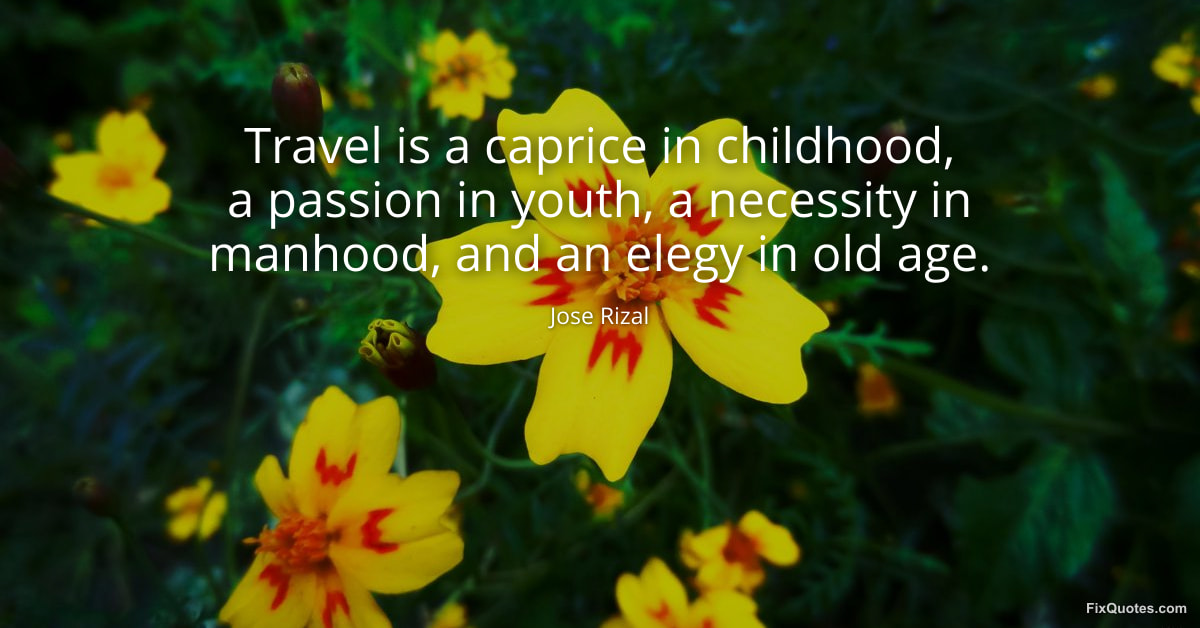
"Travel is a caprice in childhood, a passion in youth, a necessity in manhood, and an elegy in old age"
About this Quote
The subtext is that travel changes meaning once history starts demanding things from you. “Caprice” and “passion” are private moods; “necessity” is public pressure. In manhood, movement becomes strategy: education, exile, organizing, surviving surveillance. For a reformist writer under colonial rule, travel is how you learn, publish, network, and stay one step ahead of repression. The sentence’s elegance is almost a disguise for that reality; it reads like polished wisdom while pointing to coerced mobility.
Then the final turn: “an elegy in old age”. Elegy is grief shaped into art, suggesting that late-life travel is less about discovery than about revisiting loss - of time, of places that changed without you, of versions of yourself you can’t re-enter. Coming from a man executed at 35, it’s also a haunting imagined old age: the itinerant intellectual forecasting the melancholy of distance, as if every departure rehearses a farewell.
Quote Details
| Topic | Travel |
|---|---|
| Source | Help us find the source |
| Cite |
Citation Formats
APA Style (7th ed.)
Rizal, Jose. (2026, February 10). Travel is a caprice in childhood, a passion in youth, a necessity in manhood, and an elegy in old age. FixQuotes. https://fixquotes.com/quotes/travel-is-a-caprice-in-childhood-a-passion-in-185085/
Chicago Style
Rizal, Jose. "Travel is a caprice in childhood, a passion in youth, a necessity in manhood, and an elegy in old age." FixQuotes. February 10, 2026. https://fixquotes.com/quotes/travel-is-a-caprice-in-childhood-a-passion-in-185085/.
MLA Style (9th ed.)
"Travel is a caprice in childhood, a passion in youth, a necessity in manhood, and an elegy in old age." FixQuotes, 10 Feb. 2026, https://fixquotes.com/quotes/travel-is-a-caprice-in-childhood-a-passion-in-185085/. Accessed 29 Mar. 2026.