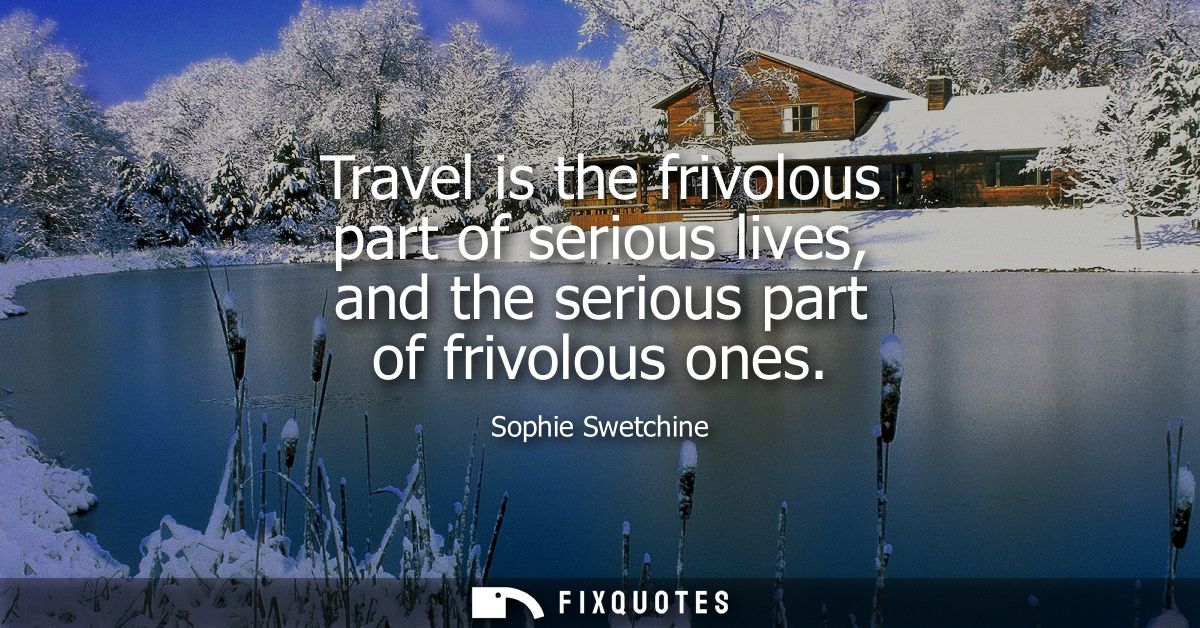
"Travel is the frivolous part of serious lives, and the serious part of frivolous ones"
About this Quote
That paradox lands because Swetchine is writing from inside a world where travel was both privilege and performance. A Russian-born salonniere who made her way into French intellectual society, she understood how status traveled: who got to leave, who got to narrate the leaving, and how those narratives laundered pleasure into respectability. The remark gently skewers a class habit: the grand tour as moral credential for the comfortable, and constant motion as a coping mechanism for those without interior ballast.
The subtext is less about geography than about temperament. Travel is a diagnostic of seriousness, not its proof. If you have obligations, you treat travel like dessert. If you lack them, you treat it like a job. Swetchine also anticipates a modern anxiety: when life feels thin, we reach for novelty and call it growth. Her wit is quiet but cutting because it refuses the romantic myth that movement automatically deepens the self. Sometimes it just rearranges the scenery around the same emptiness, or the same discipline.
Quote Details
| Topic | Travel |
|---|---|
| Source | Help us find the source |
| Cite |
Citation Formats
APA Style (7th ed.)
Swetchine, Sophie. (2026, January 15). Travel is the frivolous part of serious lives, and the serious part of frivolous ones. FixQuotes. https://fixquotes.com/quotes/travel-is-the-frivolous-part-of-serious-lives-and-166687/
Chicago Style
Swetchine, Sophie. "Travel is the frivolous part of serious lives, and the serious part of frivolous ones." FixQuotes. January 15, 2026. https://fixquotes.com/quotes/travel-is-the-frivolous-part-of-serious-lives-and-166687/.
MLA Style (9th ed.)
"Travel is the frivolous part of serious lives, and the serious part of frivolous ones." FixQuotes, 15 Jan. 2026, https://fixquotes.com/quotes/travel-is-the-frivolous-part-of-serious-lives-and-166687/. Accessed 25 Mar. 2026.