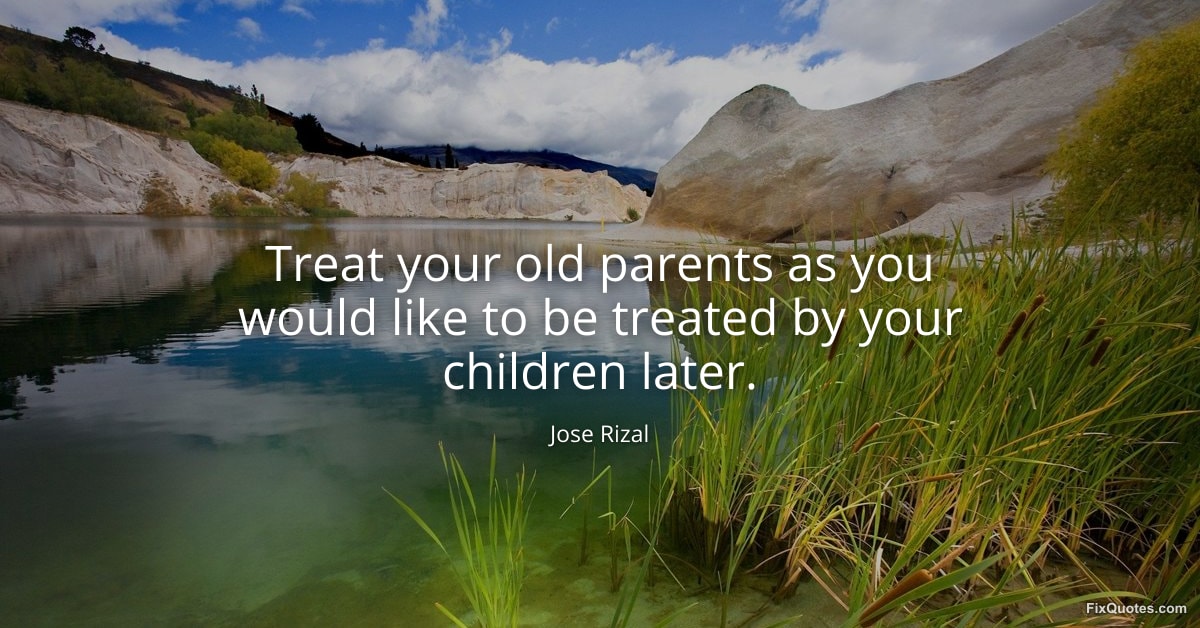
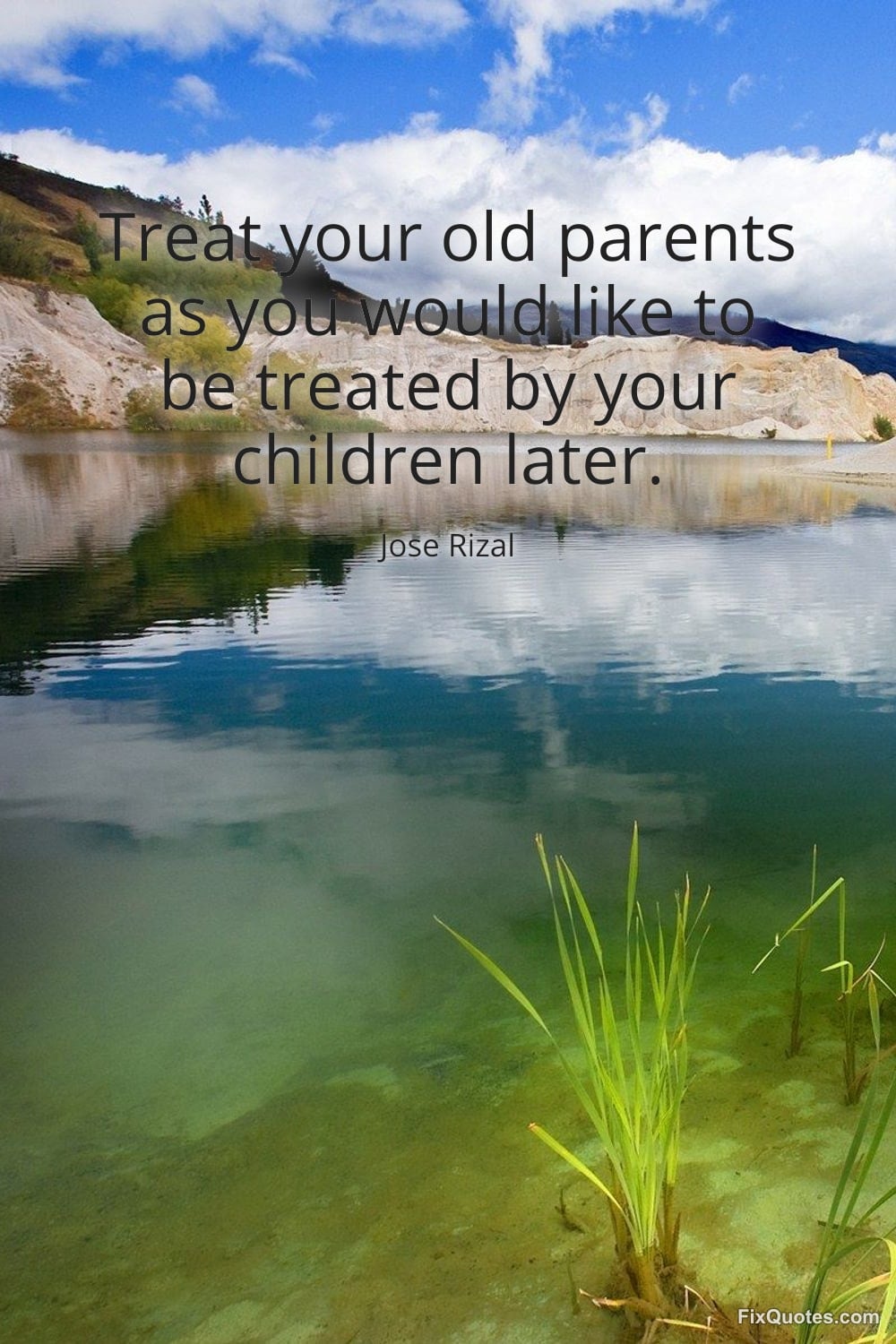
"Treat your old parents as you would like to be treated by your children later"
About this Quote
The intent is behavioral, not poetic. “Treat” is an action verb, not a feeling. Rizal is telling families to regulate themselves through example: care is not charity, it’s culture-making. The subtext is slightly sharper than it looks: if you neglect or humiliate the old, don’t expect tenderness when you’re the one repeating stories, moving slower, needing help. He’s also smuggling in a warning about power. Aging flips hierarchies; the strong become dependent, and the dependent become inconvenient. This maxim tries to pre-empt cruelty by making it strategically irrational.
Context matters. Rizal wrote in a colonial Philippines where modernization, class pressures, and imported values strained traditional kinship obligations. As a reform-minded writer, he often targeted the everyday ethics that hold a nation together. Here, the family becomes a micro-politics: a society that can’t honor its vulnerable at home won’t build justice in public. The line’s sting is its mirror: your children are watching, and they’re taking notes.
Quote Details
| Topic | Family |
|---|---|
| Source | Unverified source: A mi familia (Rizal's farewell letter from Fort Santiago) (Jose Rizal, 1953)
Evidence:
Tratad nuestros ancianos padres como quisierais ser tratados por vuestros hijos despues. (pp. 89–90 (Documentos Rizalinos)). This line appears in Rizal’s undated letter to his family, commonly titled “A mi familia,” believed written in Fort Santiago in December 1896 shortly before his execution. ... |
| Cite |
Citation Formats
APA Style (7th ed.)
Rizal, Jose. (2026, March 5). Treat your old parents as you would like to be treated by your children later. FixQuotes. https://fixquotes.com/quotes/treat-your-old-parents-as-you-would-like-to-be-173354/
Chicago Style
Rizal, Jose. "Treat your old parents as you would like to be treated by your children later." FixQuotes. March 5, 2026. https://fixquotes.com/quotes/treat-your-old-parents-as-you-would-like-to-be-173354/.
MLA Style (9th ed.)
"Treat your old parents as you would like to be treated by your children later." FixQuotes, 5 Mar. 2026, https://fixquotes.com/quotes/treat-your-old-parents-as-you-would-like-to-be-173354/. Accessed 3 Apr. 2026.