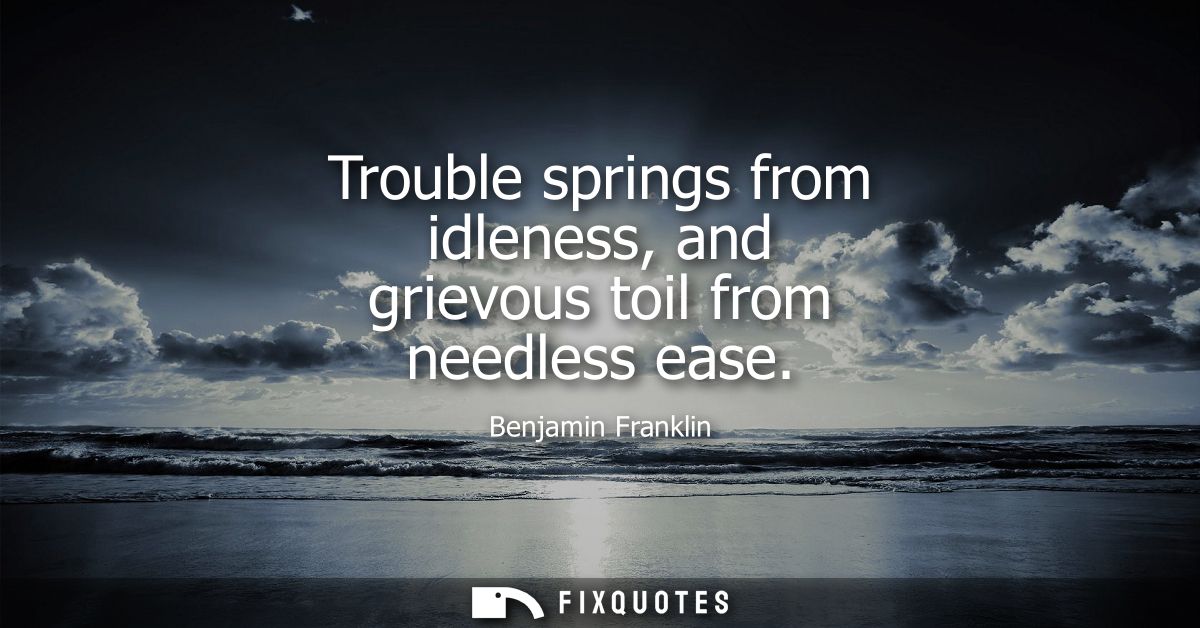
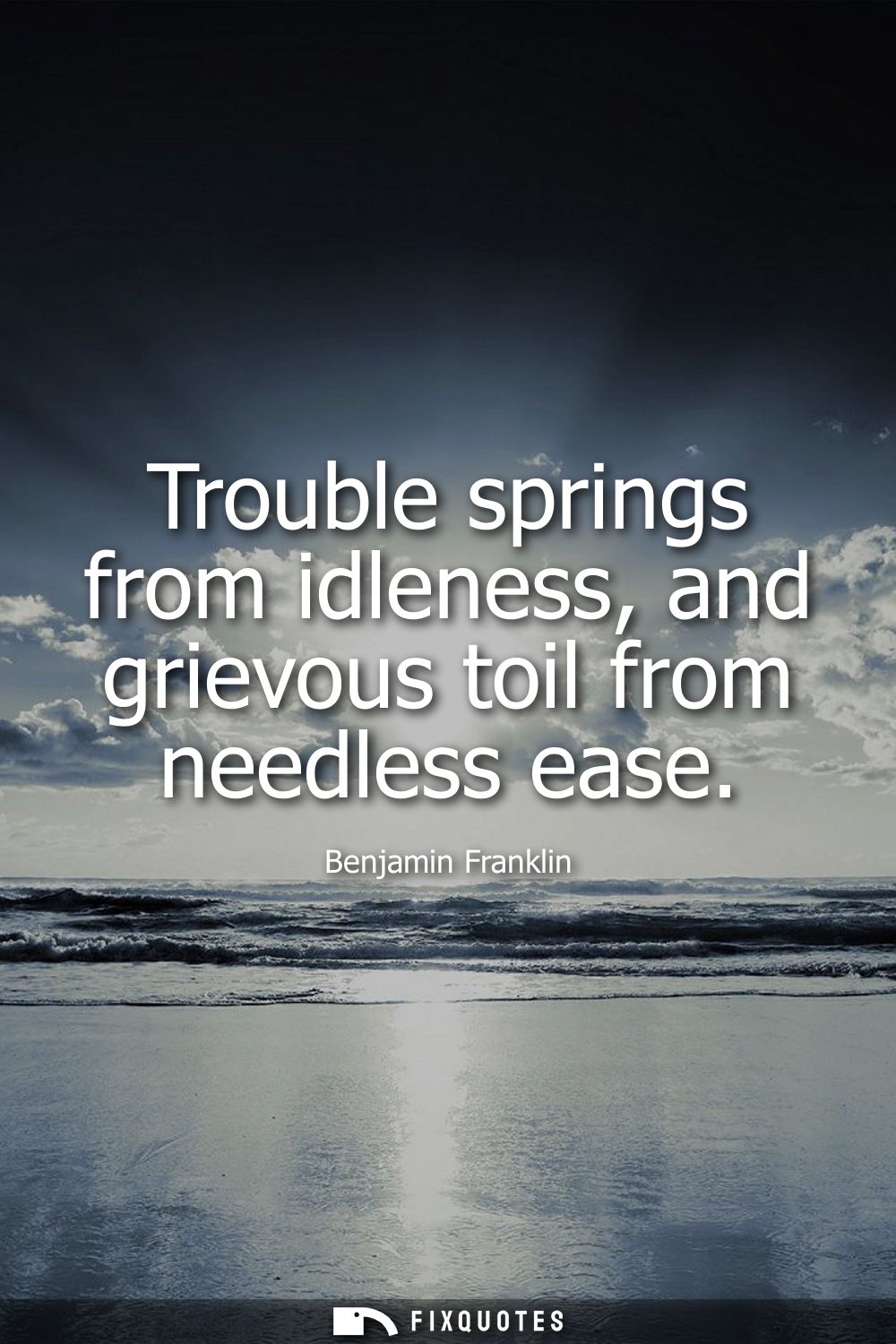
"Trouble springs from idleness, and grievous toil from needless ease"
About this Quote
As a politician and civic operator in a young, fragile republic, Franklin had a stake in turning private habits into public stability. Idleness isn’t just personal slackness; it’s a threat to the social order, a permission slip for debt, dependence, and disorder. The phrasing links cause and consequence with a clockmaker’s precision: “springs” suggests a mechanism, not a mood. This is Protestant ethics stripped of theology and repackaged as practical governance.
The subtext is as sharp as the aphorism is smooth: you don’t get to opt out of effort, you only get to choose its timing. Work now, or work later under worse conditions. That’s why the sentence lands with such durable force in American culture, where industriousness is treated less as a virtue than as an insurance policy. Franklin isn’t praising labor for its nobility; he’s selling it as the cheaper alternative to self-inflicted disaster.
Quote Details
| Topic | Work Ethic |
|---|---|
| Source | Verified source: Poor Richard improved (almanack for 1758) (Benjamin Franklin, 1758)
Evidence: Trouble springs from Idleness, and grievous Toil from needless Ease.. This sentence appears in the prefatory address (Father Abraham’s speech) in Benjamin Franklin’s final Poor Richard almanack: "Poor Richard improved: Being an Almanack and Ephemeris … for the Year of our Lord 1758" (printed in Philadelphia by B. Franklin and D. Hall). Founders Online (Franklin Papers) transcribes the original almanack text; the quote occurs in the paragraph beginning “Methinks I hear some of you say, Must a Man afford himself no Leisure?” and is introduced with “as Poor Richard says,” indicating Franklin is presenting it as one of the Poor Richard maxims within that preface/speech. Founders Online notes the preface is dated July 7, 1757, but the almanack itself is for the year 1758 (published in 1757/1758 season); the primary publication container is the 1758 almanack. Other candidates (1) Ben Franklin's Guide to Wealth (Erin Barrett, Jack Mingo, 2004) compilation95.0% ... blower versus a rake - it's expensive to buy and. Do you imagine that sloth will afford you more comfort than lab... |
| Cite |
Citation Formats
APA Style (7th ed.)
Franklin, Benjamin. (2026, February 27). Trouble springs from idleness, and grievous toil from needless ease. FixQuotes. https://fixquotes.com/quotes/trouble-springs-from-idleness-and-grievous-toil-25544/
Chicago Style
Franklin, Benjamin. "Trouble springs from idleness, and grievous toil from needless ease." FixQuotes. February 27, 2026. https://fixquotes.com/quotes/trouble-springs-from-idleness-and-grievous-toil-25544/.
MLA Style (9th ed.)
"Trouble springs from idleness, and grievous toil from needless ease." FixQuotes, 27 Feb. 2026, https://fixquotes.com/quotes/trouble-springs-from-idleness-and-grievous-toil-25544/. Accessed 7 Apr. 2026.