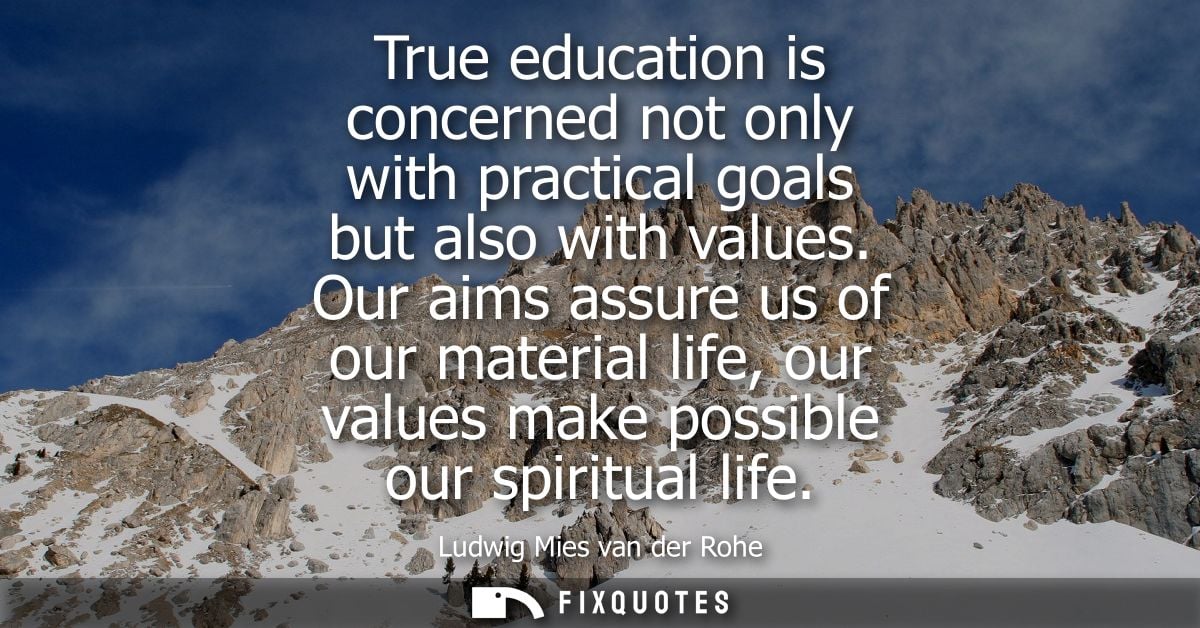
"True education is concerned not only with practical goals but also with values. Our aims assure us of our material life, our values make possible our spiritual life"
About this Quote
The phrasing is carefully balanced, almost like one of his facades. “Practical goals” aren’t dismissed, they’re demoted to the material baseline - necessary, even dignifying, but not sufficient. The subtext is a warning aimed at any culture that treats education as workforce training with better branding. Mies had watched Germany’s interwar turmoil, the rise of coercive ideologies, and then rebuilt a career in the American century, where efficiency and industry could easily swallow meaning whole. When he says values “make possible our spiritual life,” he’s not getting pious; he’s insisting that the inner life is not a luxury add-on. It’s a precondition for humane modernity.
There’s also a quiet defense of the arts and design in an era that loves measurable outcomes. Architecture is a practical discipline with moral consequences: it organizes bodies, power, privacy, and belonging. Mies is arguing that education should produce people capable of choosing ends, not just optimizing means. Otherwise you get immaculate technique serving shabby purposes - a world of perfect buildings, and impoverished citizens.
Quote Details
| Topic | Learning |
|---|---|
| Source | Help us find the source |
| Cite |
Citation Formats
APA Style (7th ed.)
Rohe, Ludwig Mies van der. (2026, January 18). True education is concerned not only with practical goals but also with values. Our aims assure us of our material life, our values make possible our spiritual life. FixQuotes. https://fixquotes.com/quotes/true-education-is-concerned-not-only-with-7003/
Chicago Style
Rohe, Ludwig Mies van der. "True education is concerned not only with practical goals but also with values. Our aims assure us of our material life, our values make possible our spiritual life." FixQuotes. January 18, 2026. https://fixquotes.com/quotes/true-education-is-concerned-not-only-with-7003/.
MLA Style (9th ed.)
"True education is concerned not only with practical goals but also with values. Our aims assure us of our material life, our values make possible our spiritual life." FixQuotes, 18 Jan. 2026, https://fixquotes.com/quotes/true-education-is-concerned-not-only-with-7003/. Accessed 28 Mar. 2026.