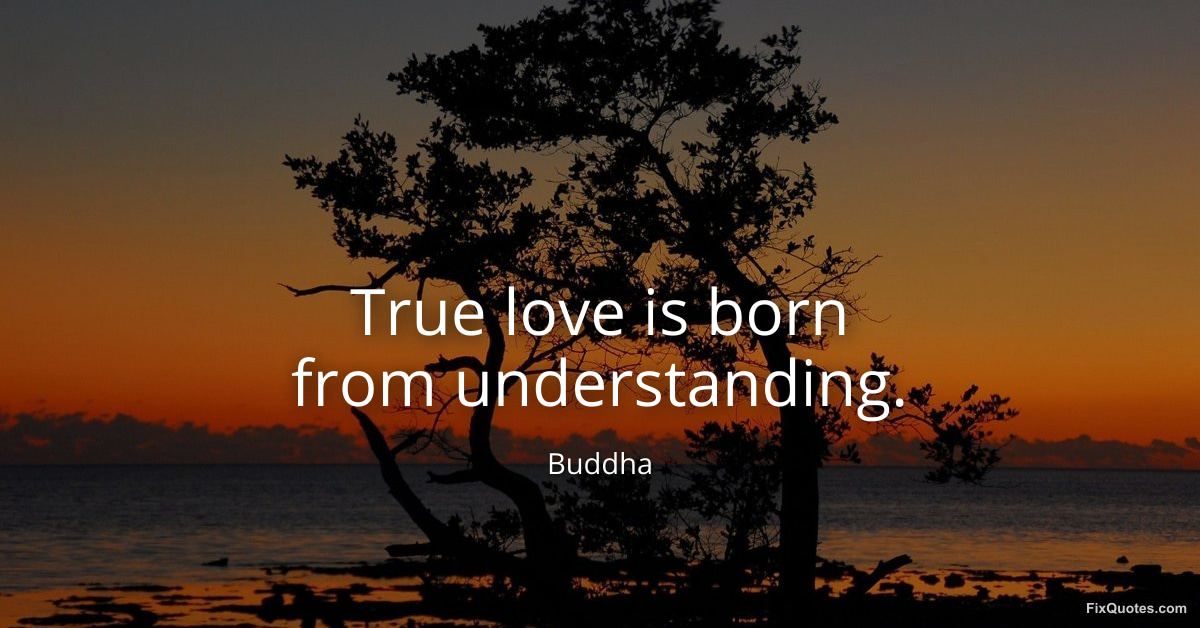
"True love is born from understanding"
About this Quote
"True love is born from understanding" carries the calm force of a moral correction. Attributed to Buddha, it pushes against a version of love built on possession, projection, or appetite. The sentence is brief, but its argument is radical: love is not primarily a feeling that strikes us; it is an achievement of perception. You do not love someone truly by wanting them, idealizing them, or attaching yourself to them. You love by seeing clearly.
That matters in a Buddhist context, where suffering is often traced to ignorance, craving, and illusion. Understanding, here, is not mere information about another person. It is a disciplined recognition of reality: their vulnerability, impermanence, inner life, and freedom from your control. The subtext is almost stern. If your love depends on fantasy, obedience, or emotional need, it is not yet love in the fullest sense. It is attachment wearing love's clothes.
The line also carries the weight of leadership. Buddha's authority came not from charisma alone but from offering a method for living with less delusion. So the quote functions as both comfort and demand. It comforts by suggesting that love can be cultivated; it is not reserved for the lucky or the romantically chosen. It demands that we outgrow the ego's habits of centering itself in every relationship.
Its rhetorical power lies in that single word, "born". Love is framed not as a permanent state but as something generated from a prior condition. Understanding is the cause; love is the consequence. That reverses a popular modern script, where love excuses misunderstanding. Here, understanding is the proof that love has begun.
That matters in a Buddhist context, where suffering is often traced to ignorance, craving, and illusion. Understanding, here, is not mere information about another person. It is a disciplined recognition of reality: their vulnerability, impermanence, inner life, and freedom from your control. The subtext is almost stern. If your love depends on fantasy, obedience, or emotional need, it is not yet love in the fullest sense. It is attachment wearing love's clothes.
The line also carries the weight of leadership. Buddha's authority came not from charisma alone but from offering a method for living with less delusion. So the quote functions as both comfort and demand. It comforts by suggesting that love can be cultivated; it is not reserved for the lucky or the romantically chosen. It demands that we outgrow the ego's habits of centering itself in every relationship.
Its rhetorical power lies in that single word, "born". Love is framed not as a permanent state but as something generated from a prior condition. Understanding is the cause; love is the consequence. That reverses a popular modern script, where love excuses misunderstanding. Here, understanding is the proof that love has begun.
Quote Details
| Topic | Love |
|---|---|
| Source | Help us find the source |
| Cite |
Citation Formats
APA Style (7th ed.)
Buddha. (2026, March 10). True love is born from understanding. FixQuotes. https://fixquotes.com/quotes/true-love-is-born-from-understanding-185865/
Chicago Style
Buddha. "True love is born from understanding." FixQuotes. March 10, 2026. https://fixquotes.com/quotes/true-love-is-born-from-understanding-185865/.
MLA Style (9th ed.)
"True love is born from understanding." FixQuotes, 10 Mar. 2026, https://fixquotes.com/quotes/true-love-is-born-from-understanding-185865/. Accessed 3 Apr. 2026.
More Quotes by Buddha
Add to List