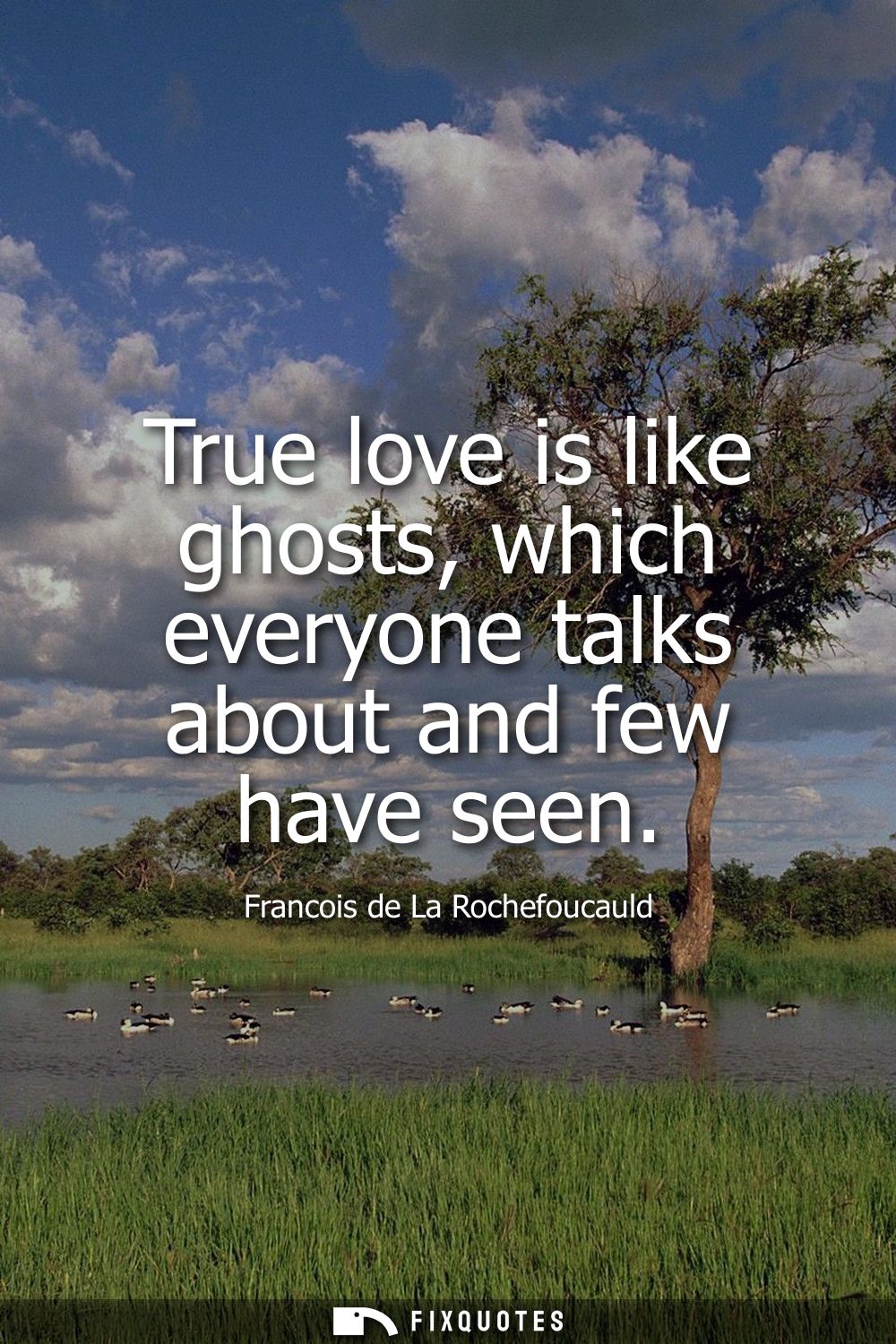
"True love is like ghosts, which everyone talks about and few have seen"
About this Quote
The line works because it weaponizes skepticism without sounding like a scold. It’s not a flat denial that love exists; it’s a diagnosis of the culture around it. “Everyone talks about” points at the market for romantic testimony - salons then, social media now - where narratives about devotion circulate as status. “Few have seen” narrows the lens to experience, not vocabulary, and quietly accuses the audience of confusing fluency with truth.
Context matters: La Rochefoucauld wrote maxims from inside the courtly world of 17th-century France, where appearances were currency and intimacy was tangled with ambition. In that environment, “love” easily becomes a strategic script: a language of allegiance, flirtation, and self-justification. The ghost metaphor also carries a theological shadow. Ghost stories thrive where people want the afterlife to be real; talk about “true love” can function the same way, as an emotional religion that promises meaning and permanence in a system designed to be transactional.
The subtext is bleak but precise: the more a society chatters about purity, the more it may be compensating for its absence.
Quote Details
| Topic | Love |
|---|---|
| Source | Unverified source: Réflexions ou sentences et maximes morales (Francois de La Rochefoucauld, 1665)
Evidence: Il est du véritable amour comme de l'apparition des esprits: tout le monde en parle, mais peu de gens en ont vu. (Maxime 76 (¶76)). This is the primary-source French wording of the aphorism that is commonly translated into English as “True love is like ghosts …”. In the Project Gutenberg transcri... Other candidates (1) What Is Love Really? (Dr. Mary Ann Pellegrino, 2016) compilation95.0% ... True love is like ghosts , which everyone talks about and few have seen . " -Francois de La Rochefoucauld It's in... |
| Cite |
Citation Formats
APA Style (7th ed.)
Rochefoucauld, Francois de La. (2026, February 16). True love is like ghosts, which everyone talks about and few have seen. FixQuotes. https://fixquotes.com/quotes/true-love-is-like-ghosts-which-everyone-talks-16160/
Chicago Style
Rochefoucauld, Francois de La. "True love is like ghosts, which everyone talks about and few have seen." FixQuotes. February 16, 2026. https://fixquotes.com/quotes/true-love-is-like-ghosts-which-everyone-talks-16160/.
MLA Style (9th ed.)
"True love is like ghosts, which everyone talks about and few have seen." FixQuotes, 16 Feb. 2026, https://fixquotes.com/quotes/true-love-is-like-ghosts-which-everyone-talks-16160/. Accessed 5 Mar. 2026.