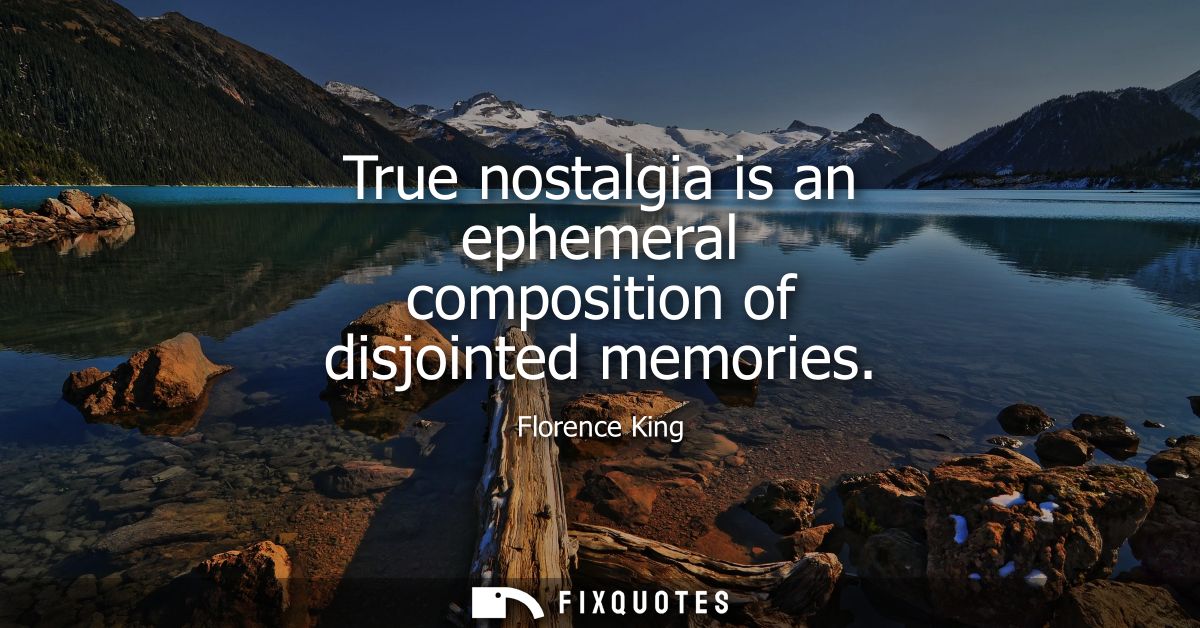
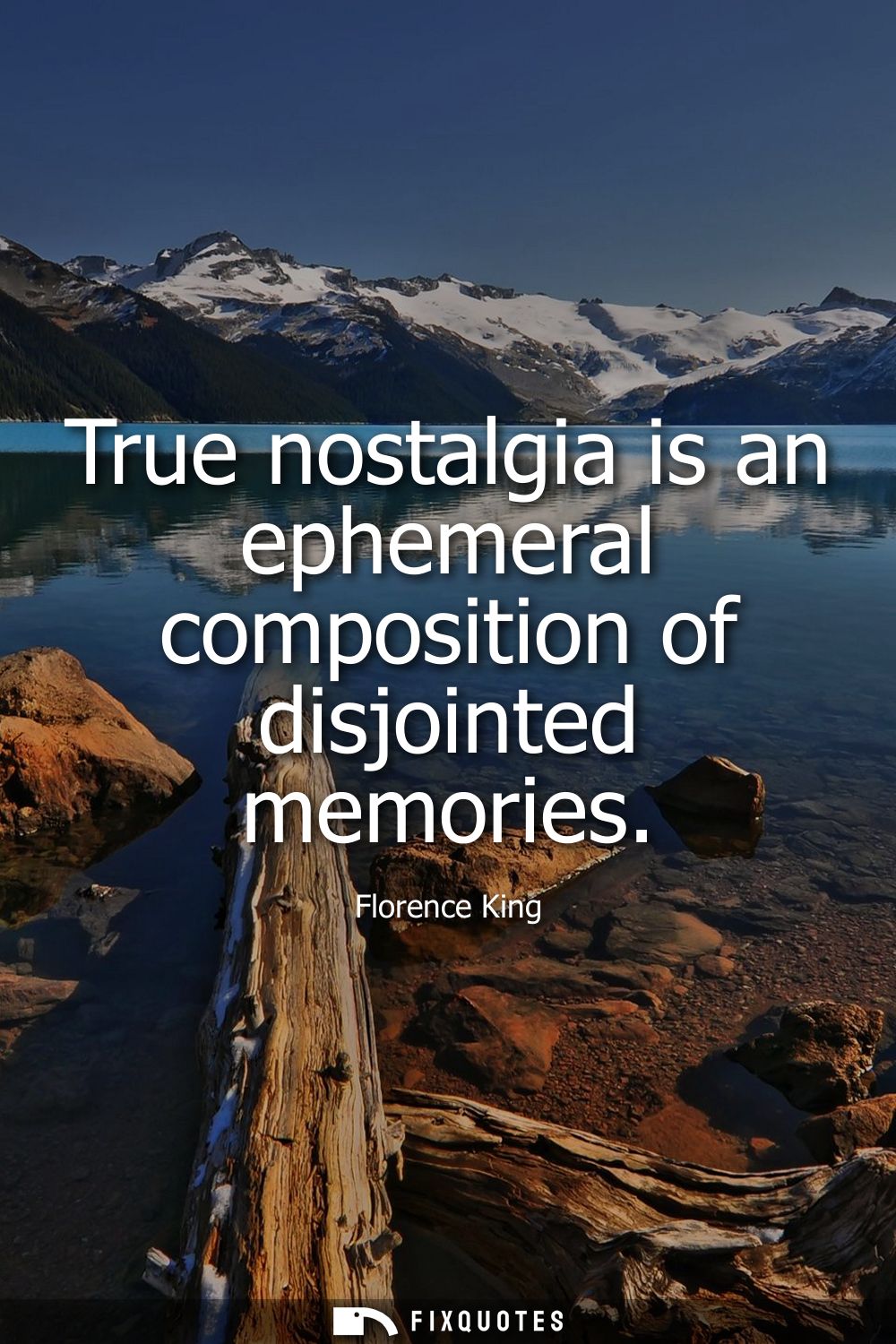
"True nostalgia is an ephemeral composition of disjointed memories"
About this Quote
Nostalgia, for Florence King, isn’t a warm blanket; it’s a patchwork with bad stitching that we insist is a masterpiece. Calling it an “ephemeral composition” does two things at once: it flatters the feeling as artful while quietly demoting it to something temporary, unstable, already evaporating as we try to hold it. “Composition” suggests choice and arrangement, the way a writer orders fragments into a convincing scene. That’s King’s sly jab. Nostalgia feels like truth because it mimics narrative craft, not because it accurately restores the past.
The phrase “disjointed memories” is the tell. King is pointing at the cognitive scam built into longing: we don’t retrieve the past whole, we cherry-pick images and sensations that cooperate with our current mood. The missing pieces don’t register as absence; they read as atmosphere. The result is an emotional montage that can be exquisitely persuasive, even as it’s structurally dishonest.
King’s larger project as a contrarian essayist was to puncture respectable sentimentality, especially the kind that doubles as politics and consumer culture: the golden-age myth, the “simpler times” pitch, the aesthetic of retro as moral proof. Her line exposes nostalgia as less a window than a collage - and a collage that fades. It’s not accusing people of lying; it’s accusing memory of being a born editor, cutting continuity so the feeling can survive.
The phrase “disjointed memories” is the tell. King is pointing at the cognitive scam built into longing: we don’t retrieve the past whole, we cherry-pick images and sensations that cooperate with our current mood. The missing pieces don’t register as absence; they read as atmosphere. The result is an emotional montage that can be exquisitely persuasive, even as it’s structurally dishonest.
King’s larger project as a contrarian essayist was to puncture respectable sentimentality, especially the kind that doubles as politics and consumer culture: the golden-age myth, the “simpler times” pitch, the aesthetic of retro as moral proof. Her line exposes nostalgia as less a window than a collage - and a collage that fades. It’s not accusing people of lying; it’s accusing memory of being a born editor, cutting continuity so the feeling can survive.
Quote Details
| Topic | Nostalgia |
|---|---|
| Source | Unverified source: Los Angeles Times: History by the Decades (Florence King, 1986)
Evidence: True nostalgia is an ephemeral composition of disjointed memories--a tremulous love affair here, a perfect Christmas there, the smell of October in a forgotten year.. I found the quote in Florence King's own Los Angeles Times article "History by the Decades," published December 28, 1986. In the a... Other candidates (1) Timothy Gaewsky: Castles In The Air (Timothy Gaewsky, 2017) compilation95.0% ... True nostalgia is an ephemeral composition of disjointed memories . ” —Florence King , Reflections in a Jaundiced... |
| Cite |
Citation Formats
APA Style (7th ed.)
King, Florence. (2026, March 11). True nostalgia is an ephemeral composition of disjointed memories. FixQuotes. https://fixquotes.com/quotes/true-nostalgia-is-an-ephemeral-composition-of-141203/
Chicago Style
King, Florence. "True nostalgia is an ephemeral composition of disjointed memories." FixQuotes. March 11, 2026. https://fixquotes.com/quotes/true-nostalgia-is-an-ephemeral-composition-of-141203/.
MLA Style (9th ed.)
"True nostalgia is an ephemeral composition of disjointed memories." FixQuotes, 11 Mar. 2026, https://fixquotes.com/quotes/true-nostalgia-is-an-ephemeral-composition-of-141203/. Accessed 25 Mar. 2026.
More Quotes by Florence
Add to List