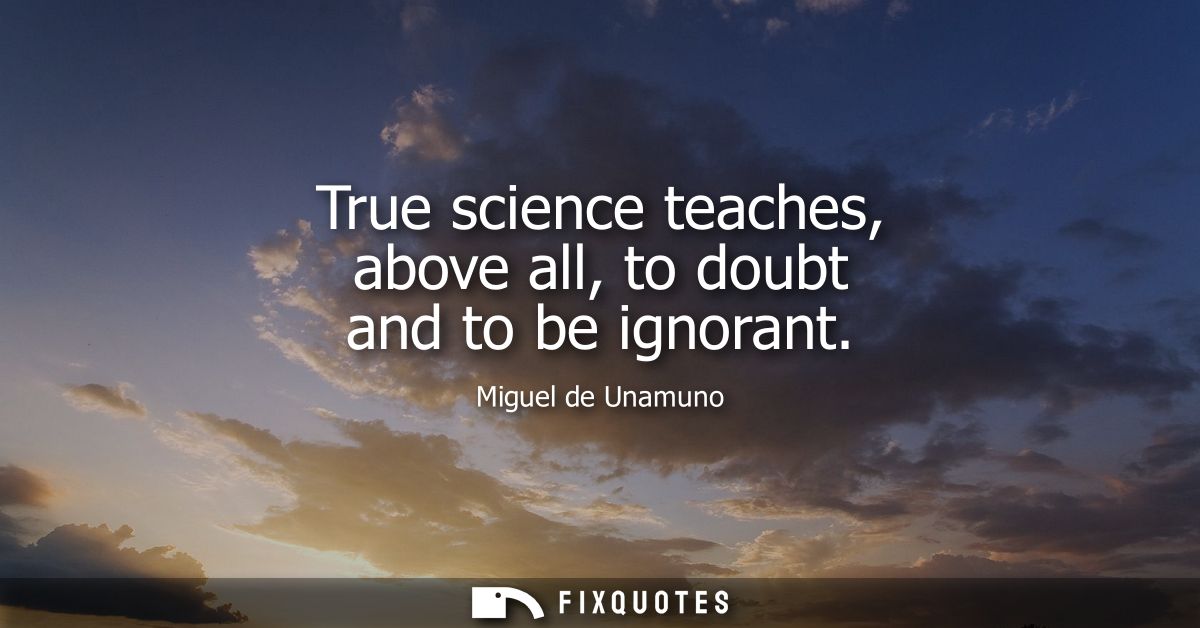
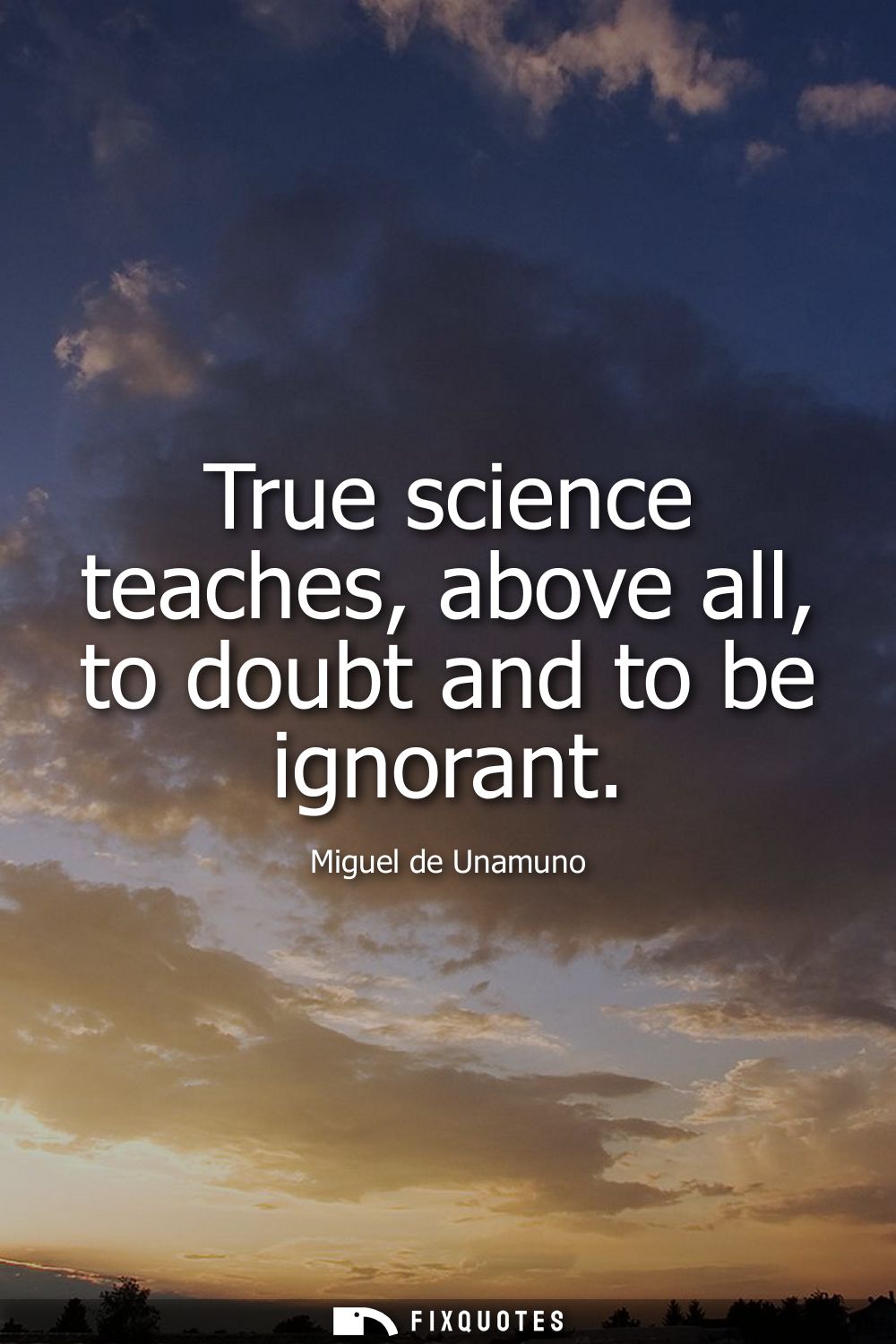
"True science teaches, above all, to doubt and to be ignorant"
About this Quote
Unamuno’s line cuts against the lab-coat myth of science as a machine that manufactures certainty. He frames “true science” not as a warehouse of facts but as a discipline of intellectual discomfort: doubt as method, ignorance as honest starting point. The sting is in the pairing. To “doubt” sounds active, even heroic; to “be ignorant” sounds like failure. Unamuno insists they belong together, because the most dangerous posture in modern life isn’t ignorance itself but unacknowledged ignorance dressed up as authority.
The subtext is aimed as much at educators as at researchers. In a classroom, “knowing” can become a performance: teachers rewarded for confident delivery, students trained to chase correct answers. Unamuno flips the incentive structure. He’s arguing for a pedagogy that treats uncertainty as productive, where the teacher models not omniscience but rigor: how to test, revise, and admit error without collapsing into relativism. Doubt here isn’t cynicism; it’s a refusal to let conclusions harden into dogma.
Context matters: Unamuno lived through Spain’s crisis of identity after 1898, the rise of scientism in Europe, and the political pressures that turned “truth” into a loyalty test. His warning anticipates how institutions can weaponize the prestige of science to shut down inquiry. Real science, he implies, is less a set of answers than a civic virtue: the courage to say “I don’t know” and mean “not yet,” while keeping the door open to being wrong.
The subtext is aimed as much at educators as at researchers. In a classroom, “knowing” can become a performance: teachers rewarded for confident delivery, students trained to chase correct answers. Unamuno flips the incentive structure. He’s arguing for a pedagogy that treats uncertainty as productive, where the teacher models not omniscience but rigor: how to test, revise, and admit error without collapsing into relativism. Doubt here isn’t cynicism; it’s a refusal to let conclusions harden into dogma.
Context matters: Unamuno lived through Spain’s crisis of identity after 1898, the rise of scientism in Europe, and the political pressures that turned “truth” into a loyalty test. His warning anticipates how institutions can weaponize the prestige of science to shut down inquiry. Real science, he implies, is less a set of answers than a civic virtue: the courage to say “I don’t know” and mean “not yet,” while keeping the door open to being wrong.
Quote Details
| Topic | Science |
|---|---|
| Source | Help us find the source |
| Cite |
Citation Formats
APA Style (7th ed.)
Unamuno, Miguel de. (2026, January 14). True science teaches, above all, to doubt and to be ignorant. FixQuotes. https://fixquotes.com/quotes/true-science-teaches-above-all-to-doubt-and-to-be-164286/
Chicago Style
Unamuno, Miguel de. "True science teaches, above all, to doubt and to be ignorant." FixQuotes. January 14, 2026. https://fixquotes.com/quotes/true-science-teaches-above-all-to-doubt-and-to-be-164286/.
MLA Style (9th ed.)
"True science teaches, above all, to doubt and to be ignorant." FixQuotes, 14 Jan. 2026, https://fixquotes.com/quotes/true-science-teaches-above-all-to-doubt-and-to-be-164286/. Accessed 28 Mar. 2026.
More Quotes by Miguel
Add to List