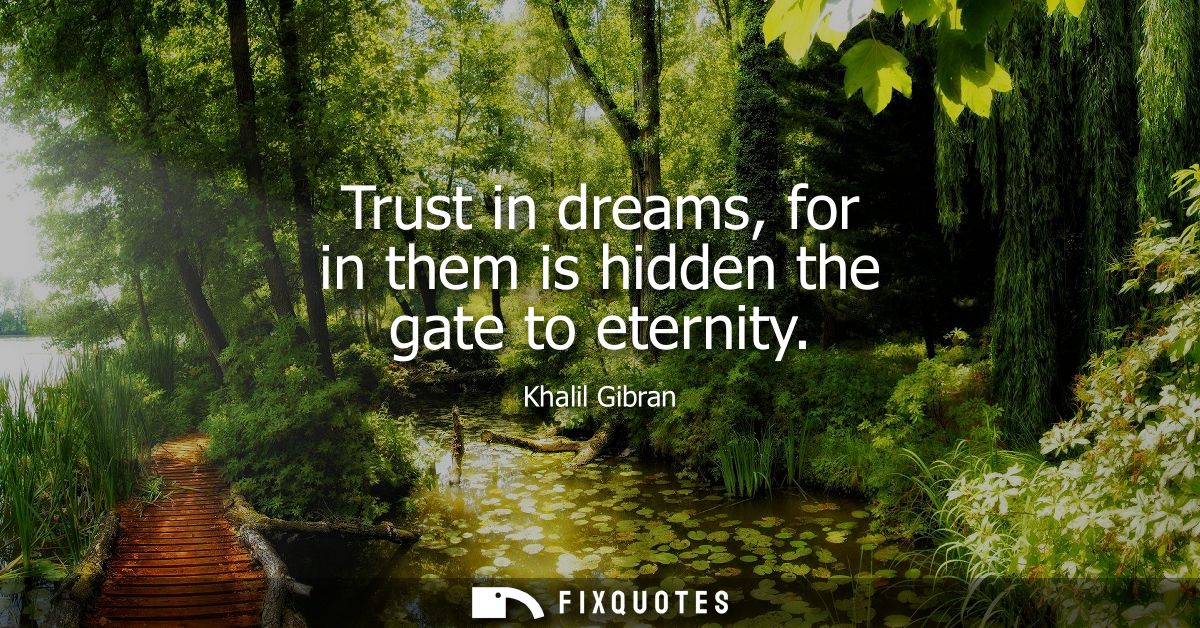
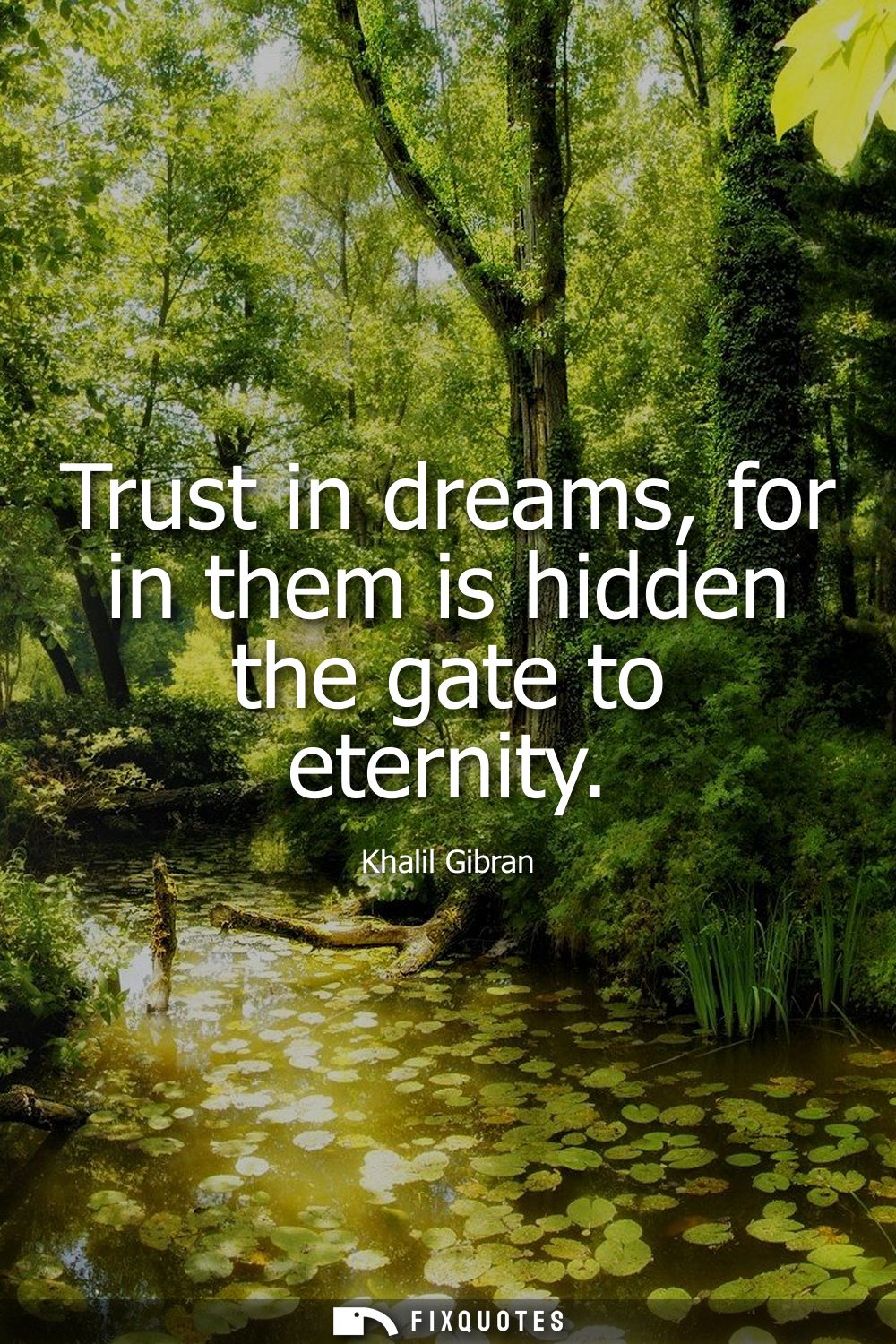
"Trust in dreams, for in them is hidden the gate to eternity"
About this Quote
Gibran’s line flatters the dreamer while quietly rebuking the modern tyrannies of the measurable. “Trust in dreams” isn’t just a Hallmark nudge toward whimsy; it’s a command to treat the irrational as a source of authority. The verb matters. You don’t merely enjoy dreams or interpret them, you trust them - the way you’d trust a witness, a compass, a sacred text. That’s the subtext: the inner life is not a private hobby but a legitimate epistemology.
Then comes the bait-and-switch: dreams aren’t valuable because they’re pleasant, but because they’re portals. “Hidden the gate to eternity” wraps mysticism in the language of architecture: a gate suggests entry, threshold, passage, permission. Eternity isn’t presented as a doctrinal heaven; it’s a dimension you approach through imagination, longing, and symbolic experience. By calling the gate “hidden,” Gibran smuggles in his central romantic premise: the deepest truths aren’t public-facing; they’re veiled, felt, and earned.
Context sharpens the intent. Writing in the early 20th century, an era intoxicated with industry, positivism, and the new prestige of psychology, Gibran offers a counter-modern spirituality: not anti-reason exactly, but suspicious of a world that mistakes calculation for wisdom. As a Lebanese-American poet shaped by Maronite Christianity, Sufi-inflected mysticism, and immigrant displacement, he’s drawn to thresholds - between cultures, languages, selves. Dreams become a metaphor for that borderland, where exile turns into insight and the finite body gets a brief appointment with the infinite.
Then comes the bait-and-switch: dreams aren’t valuable because they’re pleasant, but because they’re portals. “Hidden the gate to eternity” wraps mysticism in the language of architecture: a gate suggests entry, threshold, passage, permission. Eternity isn’t presented as a doctrinal heaven; it’s a dimension you approach through imagination, longing, and symbolic experience. By calling the gate “hidden,” Gibran smuggles in his central romantic premise: the deepest truths aren’t public-facing; they’re veiled, felt, and earned.
Context sharpens the intent. Writing in the early 20th century, an era intoxicated with industry, positivism, and the new prestige of psychology, Gibran offers a counter-modern spirituality: not anti-reason exactly, but suspicious of a world that mistakes calculation for wisdom. As a Lebanese-American poet shaped by Maronite Christianity, Sufi-inflected mysticism, and immigrant displacement, he’s drawn to thresholds - between cultures, languages, selves. Dreams become a metaphor for that borderland, where exile turns into insight and the finite body gets a brief appointment with the infinite.
Quote Details
| Topic | Wisdom |
|---|---|
| Source | Attributed to Khalil Gibran , commonly cited in the aphoristic collection 'Sand and Foam' (often given as the source for this line). |
| Cite |
Citation Formats
APA Style (7th ed.)
Gibran, Kahlil. (2026, January 15). Trust in dreams, for in them is hidden the gate to eternity. FixQuotes. https://fixquotes.com/quotes/trust-in-dreams-for-in-them-is-hidden-the-gate-to-35454/
Chicago Style
Gibran, Kahlil. "Trust in dreams, for in them is hidden the gate to eternity." FixQuotes. January 15, 2026. https://fixquotes.com/quotes/trust-in-dreams-for-in-them-is-hidden-the-gate-to-35454/.
MLA Style (9th ed.)
"Trust in dreams, for in them is hidden the gate to eternity." FixQuotes, 15 Jan. 2026, https://fixquotes.com/quotes/trust-in-dreams-for-in-them-is-hidden-the-gate-to-35454/. Accessed 31 Mar. 2026.
More Quotes by Kahlil
Add to List