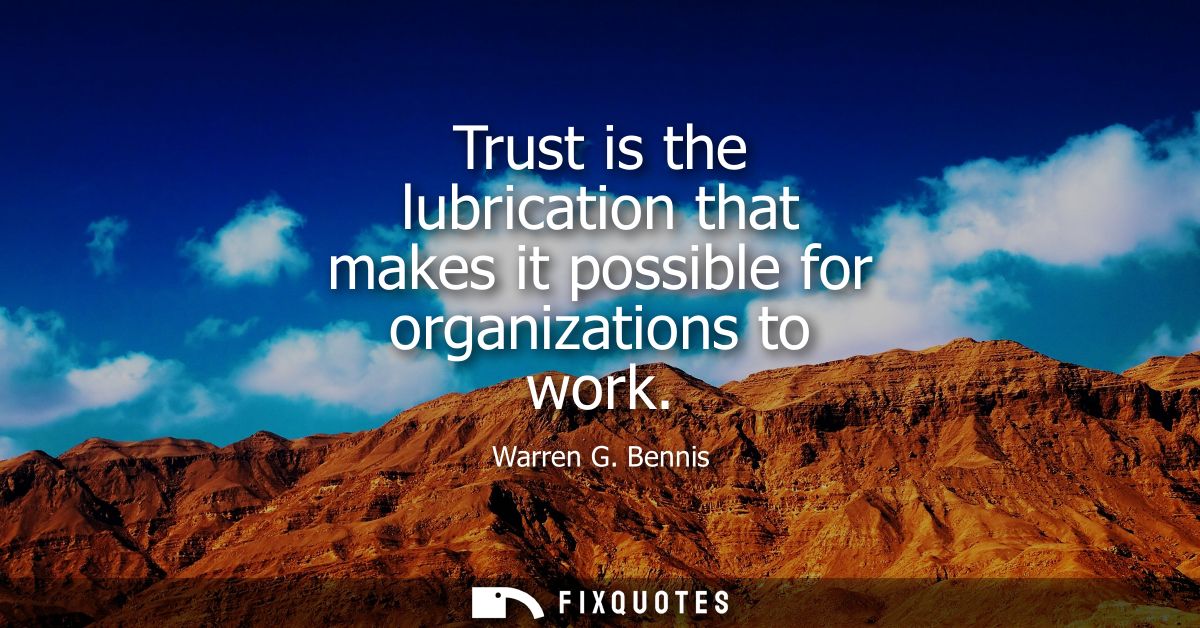
"Trust is the lubrication that makes it possible for organizations to work"
About this Quote
Trust isn’t framed here as a moral virtue or a warm interpersonal bond; it’s pitched as infrastructure. By calling it “lubrication,” Warren Bennis deliberately drags the conversation out of the HR brochure and into the engine room. Organizations, in his view, aren’t held together by inspirational posters or formal org charts. They “work” when the friction of coordination is reduced: fewer checks, fewer defensive emails, fewer meetings whose real purpose is blame management.
The metaphor is quietly unsentimental, almost technocratic. Lubrication is invisible when it’s doing its job and urgently noticed when it’s gone. That’s the subtext: trust doesn’t announce itself with slogans; it shows up as speed, simplicity, and a tolerance for reasonable risk. It also implies a cost of distrust that most workplaces normalize: duplication, micromanagement, documentation-as-armor, and decision-making that crawls because nobody believes anyone else will cover them if something goes wrong.
Context matters. Bennis helped define modern leadership studies in an era when American institutions were being reorganized into large, specialized bureaucracies, then later “flattened” and restructured again. Both models create distance between people and amplify the need for believable signals of competence and goodwill. His line is an argument against command-and-control reflexes: you can mandate compliance, but you can’t order collaboration to feel safe.
It’s also a warning. Lubrication can mask deeper mechanical problems. Trust enables performance, but it can’t substitute for clear incentives, accountability, or ethical leadership. When leaders treat trust as a tool rather than a relationship, they burn it like fuel.
The metaphor is quietly unsentimental, almost technocratic. Lubrication is invisible when it’s doing its job and urgently noticed when it’s gone. That’s the subtext: trust doesn’t announce itself with slogans; it shows up as speed, simplicity, and a tolerance for reasonable risk. It also implies a cost of distrust that most workplaces normalize: duplication, micromanagement, documentation-as-armor, and decision-making that crawls because nobody believes anyone else will cover them if something goes wrong.
Context matters. Bennis helped define modern leadership studies in an era when American institutions were being reorganized into large, specialized bureaucracies, then later “flattened” and restructured again. Both models create distance between people and amplify the need for believable signals of competence and goodwill. His line is an argument against command-and-control reflexes: you can mandate compliance, but you can’t order collaboration to feel safe.
It’s also a warning. Lubrication can mask deeper mechanical problems. Trust enables performance, but it can’t substitute for clear incentives, accountability, or ethical leadership. When leaders treat trust as a tool rather than a relationship, they burn it like fuel.
Quote Details
| Topic | Leadership |
|---|
More Quotes by Warren
Add to List