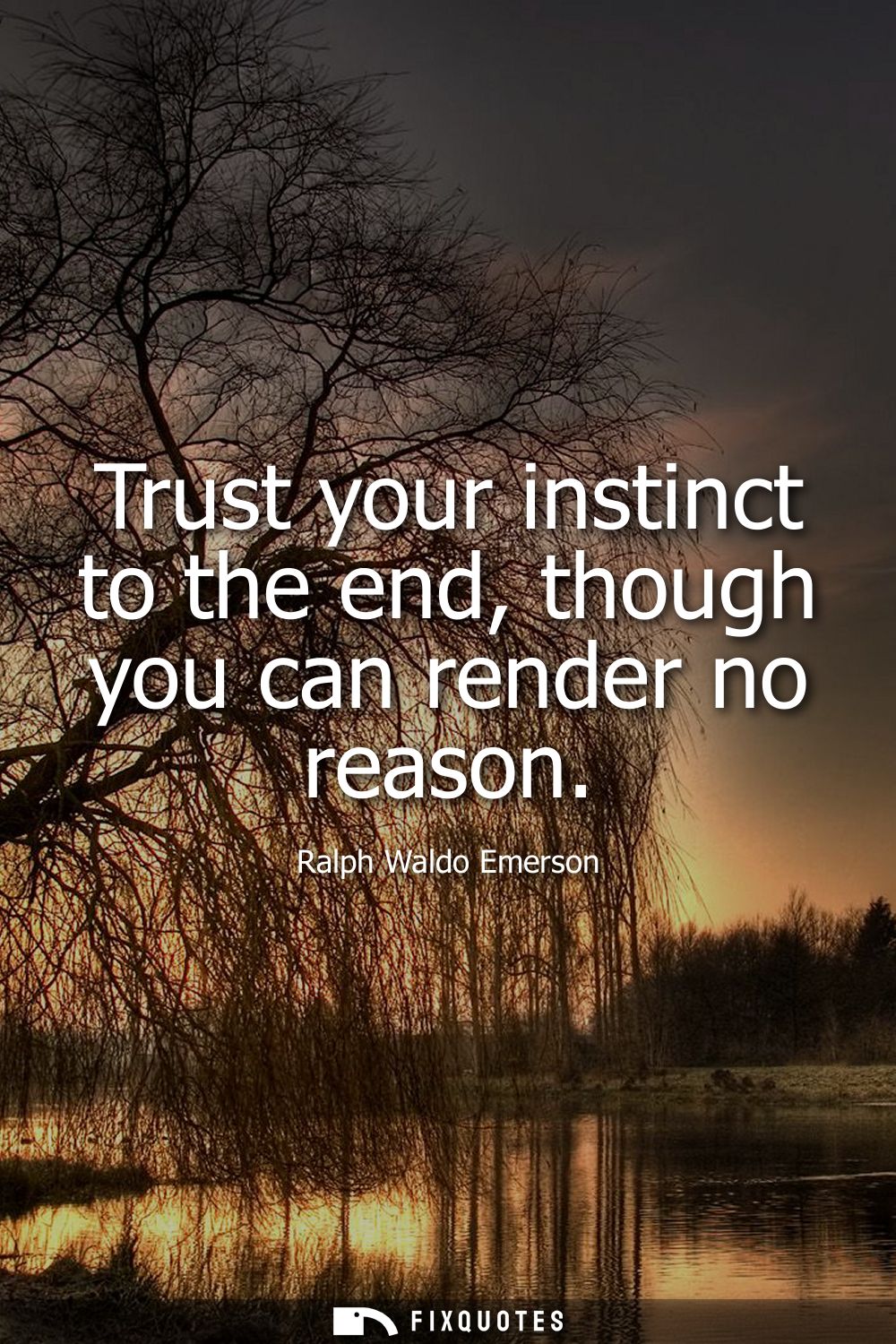
"Trust your instinct to the end, though you can render no reason"
About this Quote
Emerson’s line is a dare dressed up as advice: go all in on the hunch you can’t footnote. Its force comes from the way it flatters something modern life routinely humiliates - the uncredentialed inner voice. “To the end” isn’t about mild confidence; it’s a demand for endurance, for holding your ground when the crowd asks for a spreadsheet. Then he tightens the screw with “though you can render no reason,” turning irrationality from a liability into a kind of moral proof. If you can justify it, maybe you’re only echoing convention. If you can’t, you might actually be hearing yourself.
The subtext is Emerson’s signature rebellion against the social pressures of his moment: a young American culture obsessed with inherited authority (European tradition, church doctrine, institutional prestige) and a rising faith in systems that could quantify everything. Transcendentalism answered that climate with a risky proposition: the self is not merely an ego to be disciplined but a source of insight. The quote quietly reframes “instinct” as a form of knowledge that precedes explanation, the way artists, abolitionists, and innovators often move before they can defend the move in polite company.
It also carries a hard-edged implication: reasons can be retrofitted. Emerson isn’t denying rationality; he’s warning how easily “reason” becomes a social script - a way to sound acceptable rather than to be true. In that sense, the line isn’t self-help. It’s anti-compliance.
The subtext is Emerson’s signature rebellion against the social pressures of his moment: a young American culture obsessed with inherited authority (European tradition, church doctrine, institutional prestige) and a rising faith in systems that could quantify everything. Transcendentalism answered that climate with a risky proposition: the self is not merely an ego to be disciplined but a source of insight. The quote quietly reframes “instinct” as a form of knowledge that precedes explanation, the way artists, abolitionists, and innovators often move before they can defend the move in polite company.
It also carries a hard-edged implication: reasons can be retrofitted. Emerson isn’t denying rationality; he’s warning how easily “reason” becomes a social script - a way to sound acceptable rather than to be true. In that sense, the line isn’t self-help. It’s anti-compliance.
Quote Details
| Topic | Wisdom |
|---|---|
| Source | Help us find the source |
More Quotes by Ralph
Add to List