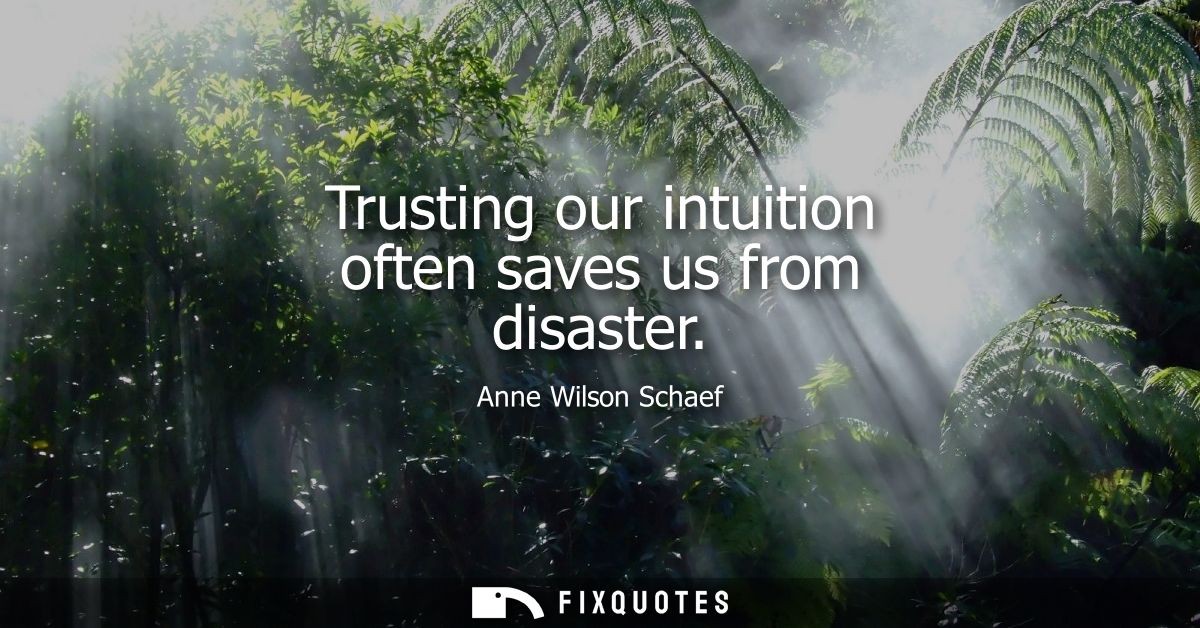
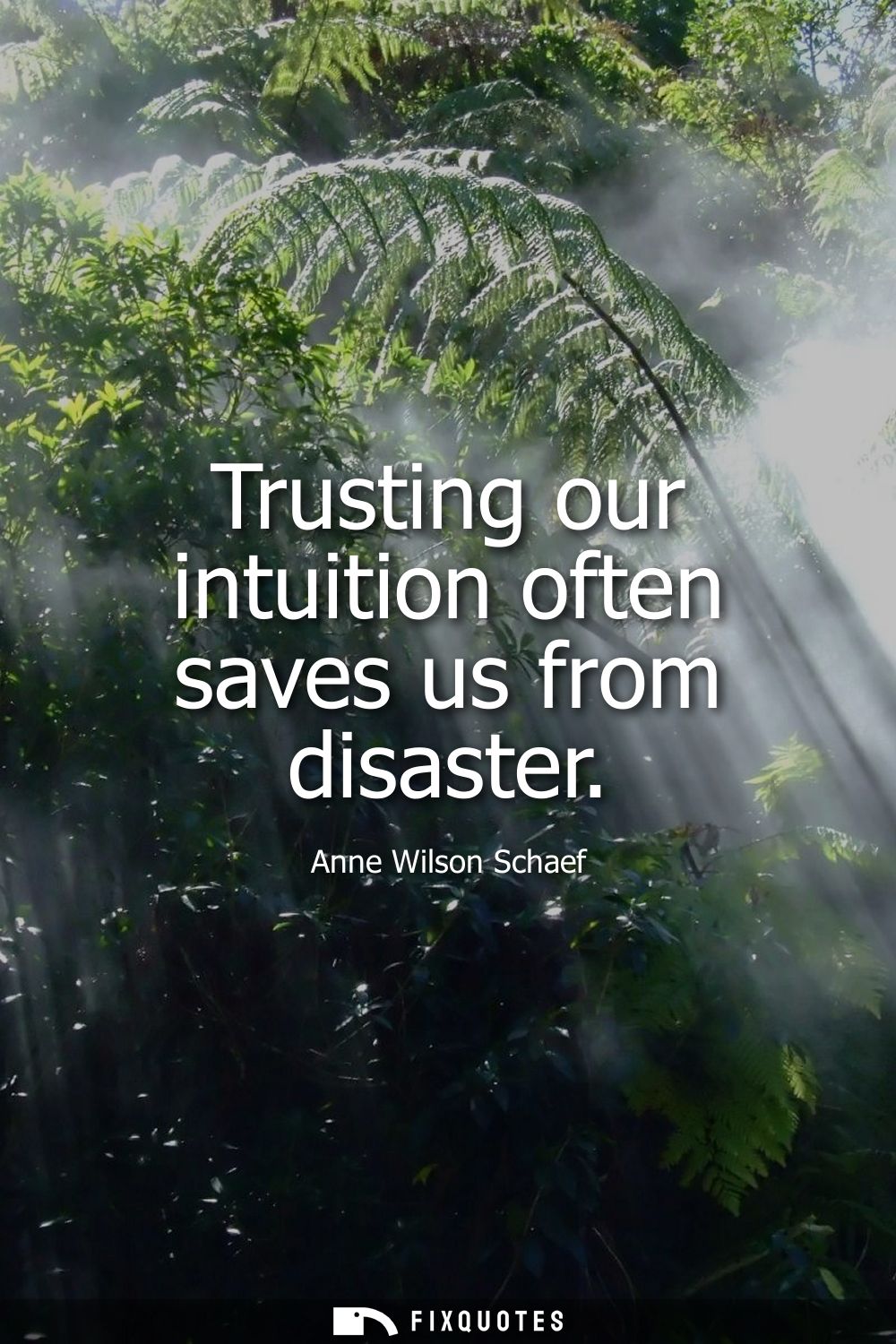
"Trusting our intuition often saves us from disaster"
About this Quote
“Trusting our intuition often saves us from disaster” is self-help language with a spine: it treats instinct not as mystical sparkle but as a survival tool. Anne Wilson Schaef wrote at the intersection of recovery culture, family-systems thinking, and feminist-inflected critiques of denial and control. In that context, “intuition” isn’t a horoscope hunch; it’s the quiet data your body and memory have been collecting while your conscious mind negotiates, rationalizes, and people-pleases.
The line’s specific intent is corrective. Schaef is pushing back against a modern habit of outsourcing judgment: to credentials, institutions, “being nice,” or the comforting story that if you can explain something logically, it must be safe. The subtext is about patterns: the partner who keeps “almost” changing, the workplace with a sweet mission statement and a predatory incentive structure, the family dynamic everyone tiptoes around. Disaster, here, isn’t only catastrophe; it’s the slow-motion wreck of ignoring early warning signals until they become unavoidable.
Why it works rhetorically is its quiet reversal of shame. Many people are taught that doubt is disloyal and that discomfort is irrational. Schaef flips that script: the uneasy feeling is not a personal defect but an alarm system. The word “often” matters, too. It’s a hedge that keeps the statement from becoming culty; intuition isn’t infallible, but it’s frequently more honest than the explanations we manufacture to stay attached to what’s hurting us.
It’s a sentence designed to give permission: to pause, to leave, to set boundaries before “proof” arrives.
The line’s specific intent is corrective. Schaef is pushing back against a modern habit of outsourcing judgment: to credentials, institutions, “being nice,” or the comforting story that if you can explain something logically, it must be safe. The subtext is about patterns: the partner who keeps “almost” changing, the workplace with a sweet mission statement and a predatory incentive structure, the family dynamic everyone tiptoes around. Disaster, here, isn’t only catastrophe; it’s the slow-motion wreck of ignoring early warning signals until they become unavoidable.
Why it works rhetorically is its quiet reversal of shame. Many people are taught that doubt is disloyal and that discomfort is irrational. Schaef flips that script: the uneasy feeling is not a personal defect but an alarm system. The word “often” matters, too. It’s a hedge that keeps the statement from becoming culty; intuition isn’t infallible, but it’s frequently more honest than the explanations we manufacture to stay attached to what’s hurting us.
It’s a sentence designed to give permission: to pause, to leave, to set boundaries before “proof” arrives.
Quote Details
| Topic | Wisdom |
|---|---|
| Source | Help us find the source |
| Cite |
Citation Formats
APA Style (7th ed.)
Schaef, Anne Wilson. (2026, January 17). Trusting our intuition often saves us from disaster. FixQuotes. https://fixquotes.com/quotes/trusting-our-intuition-often-saves-us-from-38338/
Chicago Style
Schaef, Anne Wilson. "Trusting our intuition often saves us from disaster." FixQuotes. January 17, 2026. https://fixquotes.com/quotes/trusting-our-intuition-often-saves-us-from-38338/.
MLA Style (9th ed.)
"Trusting our intuition often saves us from disaster." FixQuotes, 17 Jan. 2026, https://fixquotes.com/quotes/trusting-our-intuition-often-saves-us-from-38338/. Accessed 10 Feb. 2026.
More Quotes by Anne
Add to List