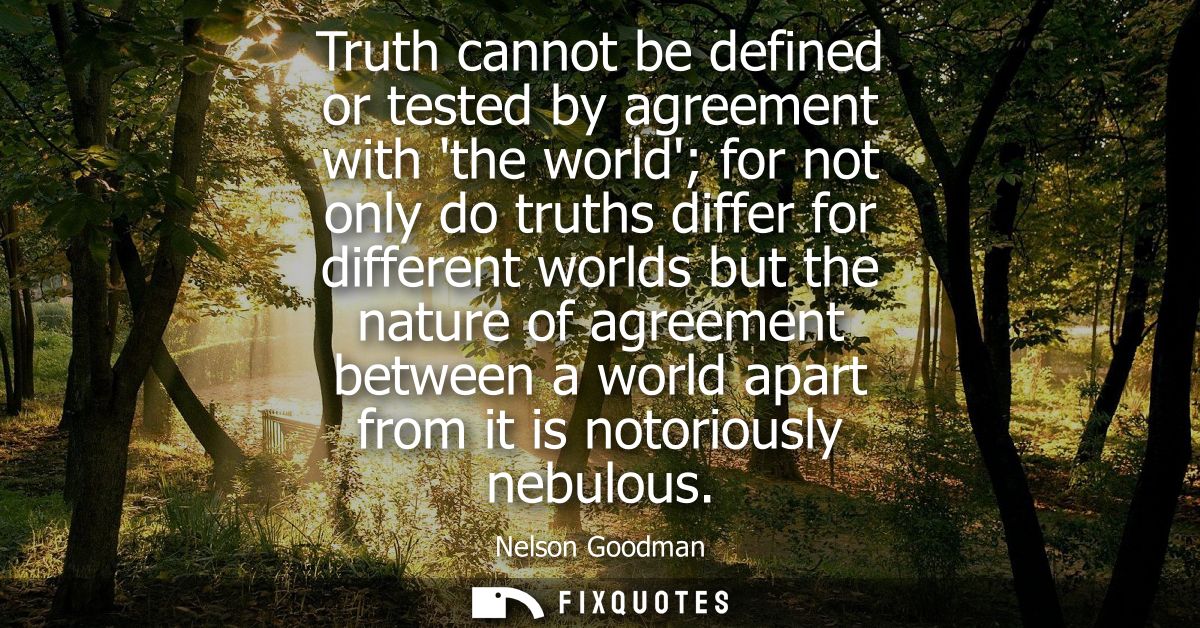
"Truth cannot be defined or tested by agreement with 'the world'; for not only do truths differ for different worlds but the nature of agreement between a world apart from it is notoriously nebulous"
About this Quote
The subtext is more subversive than a slogan about “everything being relative.” Goodman isn’t saying there are no constraints. He’s saying the constraint can’t be packaged as a clean, external comparison between sentences and a ready-made reality. The phrase “notoriously nebulous” is doing sly work: it reminds you that the supposed gold-standard method - check the claim against the world itself - is a metaphor masquerading as a procedure. Outside of specific practices (measurement conventions, perceptual training, instrument readouts, linguistic norms), what would “agreement” even look like?
Context matters: Goodman’s “worldmaking” project (in Ways of Worldmaking) argues that worlds are made through symbol systems - science, art, everyday language - each with its own standards of correctness. The bite of the quote is its reversal: instead of truth grounding our world-descriptions, world-descriptions help constitute what counts as truth, and the struggle shifts to the politics and pragmatics of which versions we live by.
Quote Details
| Topic | Truth |
|---|---|
| Source | Help us find the source |
| Cite |
Citation Formats
APA Style (7th ed.)
Goodman, Nelson. (2026, January 16). Truth cannot be defined or tested by agreement with 'the world'; for not only do truths differ for different worlds but the nature of agreement between a world apart from it is notoriously nebulous. FixQuotes. https://fixquotes.com/quotes/truth-cannot-be-defined-or-tested-by-agreement-92710/
Chicago Style
Goodman, Nelson. "Truth cannot be defined or tested by agreement with 'the world'; for not only do truths differ for different worlds but the nature of agreement between a world apart from it is notoriously nebulous." FixQuotes. January 16, 2026. https://fixquotes.com/quotes/truth-cannot-be-defined-or-tested-by-agreement-92710/.
MLA Style (9th ed.)
"Truth cannot be defined or tested by agreement with 'the world'; for not only do truths differ for different worlds but the nature of agreement between a world apart from it is notoriously nebulous." FixQuotes, 16 Jan. 2026, https://fixquotes.com/quotes/truth-cannot-be-defined-or-tested-by-agreement-92710/. Accessed 1 Apr. 2026.