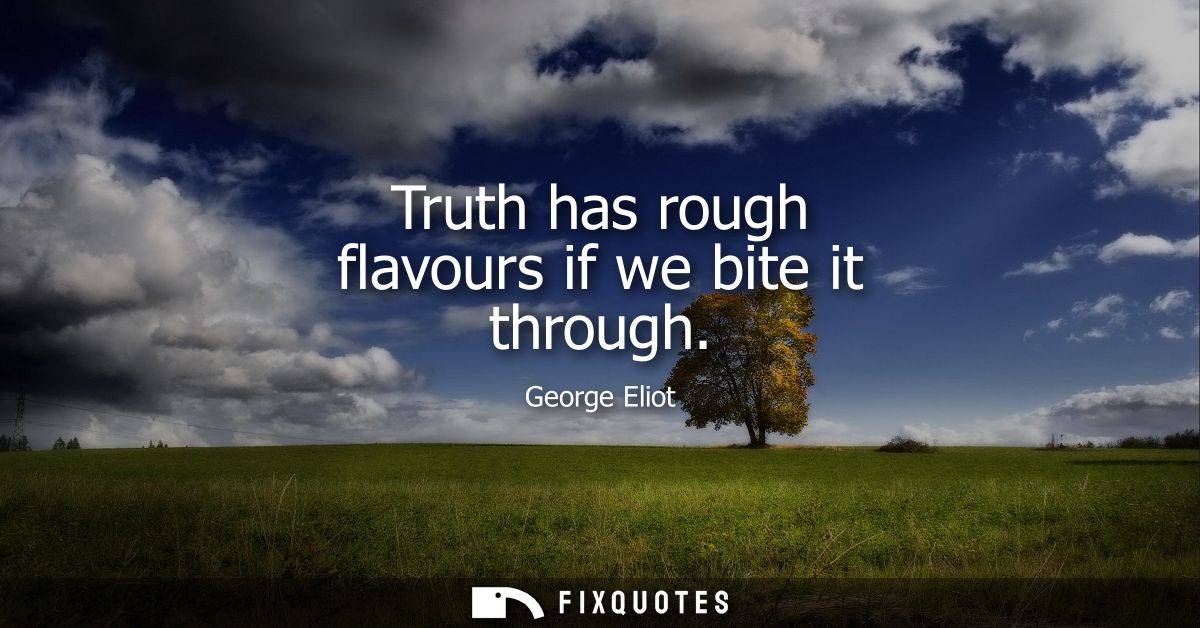
"Truth has rough flavours if we bite it through"
About this Quote
Truth, in George Eliot's hands, is not a pearl you polish into elegance but a stubborn rind you have to chew. "Truth has rough flavours if we bite it through" refuses the comforting fantasy that honesty is automatically cleansing or clarifying. Eliot frames truth as sensory and bodily: you don't "see" it, you taste it, and the taste can be abrasive. That word "rough" matters. It suggests not just pain but texture - the grain of reality catching on the tongue, the way facts scrape against appetite and self-image.
The subtext is moral, but not pious. Eliot is wary of confession as performance and of sentimentality as a substitute for reckoning. To "bite it through" implies commitment: not nibbling around the edges, not selecting only the parts that flatter us. It's a critique of genteel evasion, the Victorian talent for calling discomfort "impropriety" and leaving the lie intact. Eliot's novels are full of characters who want virtue without the aftertaste: Dorothea's idealism meeting institutional cynicism, Lydgate's ambitions corroded by debt and social pressure. Truth, for them, arrives less as revelation than as consequences.
Contextually, Eliot wrote in a culture intoxicated by respectability and increasingly pressured by modernity - scientific thinking, secular doubt, social mobility. Her line makes a compact argument against the era's sugar-coating: moral clarity isn't a mood, it's a practice that can sting. The brilliance is how she makes that sting feel immediate, lodged in the mouth, where excuses usually start.
The subtext is moral, but not pious. Eliot is wary of confession as performance and of sentimentality as a substitute for reckoning. To "bite it through" implies commitment: not nibbling around the edges, not selecting only the parts that flatter us. It's a critique of genteel evasion, the Victorian talent for calling discomfort "impropriety" and leaving the lie intact. Eliot's novels are full of characters who want virtue without the aftertaste: Dorothea's idealism meeting institutional cynicism, Lydgate's ambitions corroded by debt and social pressure. Truth, for them, arrives less as revelation than as consequences.
Contextually, Eliot wrote in a culture intoxicated by respectability and increasingly pressured by modernity - scientific thinking, secular doubt, social mobility. Her line makes a compact argument against the era's sugar-coating: moral clarity isn't a mood, it's a practice that can sting. The brilliance is how she makes that sting feel immediate, lodged in the mouth, where excuses usually start.
Quote Details
| Topic | Truth |
|---|---|
| Source | Help us find the source |
| Cite |
Citation Formats
APA Style (7th ed.)
Eliot, George. (2026, January 17). Truth has rough flavours if we bite it through. FixQuotes. https://fixquotes.com/quotes/truth-has-rough-flavours-if-we-bite-it-through-28267/
Chicago Style
Eliot, George. "Truth has rough flavours if we bite it through." FixQuotes. January 17, 2026. https://fixquotes.com/quotes/truth-has-rough-flavours-if-we-bite-it-through-28267/.
MLA Style (9th ed.)
"Truth has rough flavours if we bite it through." FixQuotes, 17 Jan. 2026, https://fixquotes.com/quotes/truth-has-rough-flavours-if-we-bite-it-through-28267/. Accessed 26 Mar. 2026.
More Quotes by George
Add to List