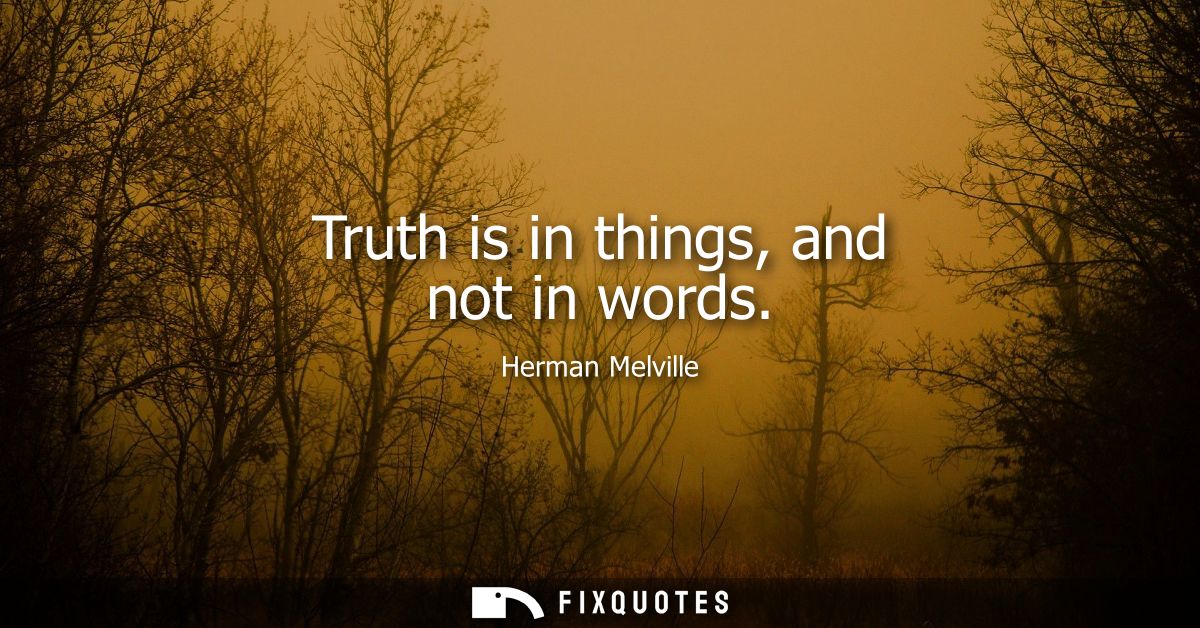
"Truth is in things, and not in words"
About this Quote
A novelist insisting that truth doesn’t live in words is a sly act of self-sabotage - and a flex. Melville is warning you about the very tool he’s using: language is a boat that can carry you toward reality, but it can also spring leaks, drift, or capsize under the weight of what it tries to name. “Truth is in things” signals a hard, almost maritime empiricism: the world has a stubborn, physical authority that doesn’t care how eloquently you describe it. “Not in words” is the jab at rhetoric, ideology, and the comforting stories people tell to make chaos feel legible.
The subtext lands especially well in Melville’s century, when sermons, patriotic slogans, and tidy moral narratives often pretended to explain everything. In Moby-Dick, the great white whale is the ultimate “thing”: massive, real, resistant to interpretation, and endlessly dressed up in meaning by the humans chasing it. The crew’s words - theories, superstitions, metaphysics - don’t change the ocean’s indifference or the whale’s brute fact. Melville’s point isn’t that language is useless; it’s that language is theatrical. It performs certainty, and that performance can seduce us into confusing a well-turned phrase for actual knowledge.
The line also reads like a dare to the reader: stop being impressed by the poetry of an argument and look at the evidence of the world. In an era drowning in spin, that feels less like literary aphorism and more like survival advice.
The subtext lands especially well in Melville’s century, when sermons, patriotic slogans, and tidy moral narratives often pretended to explain everything. In Moby-Dick, the great white whale is the ultimate “thing”: massive, real, resistant to interpretation, and endlessly dressed up in meaning by the humans chasing it. The crew’s words - theories, superstitions, metaphysics - don’t change the ocean’s indifference or the whale’s brute fact. Melville’s point isn’t that language is useless; it’s that language is theatrical. It performs certainty, and that performance can seduce us into confusing a well-turned phrase for actual knowledge.
The line also reads like a dare to the reader: stop being impressed by the poetry of an argument and look at the evidence of the world. In an era drowning in spin, that feels less like literary aphorism and more like survival advice.
Quote Details
| Topic | Truth |
|---|---|
| Source | Help us find the source |
| Cite |
Citation Formats
APA Style (7th ed.)
Melville, Herman. (2026, January 18). Truth is in things, and not in words. FixQuotes. https://fixquotes.com/quotes/truth-is-in-things-and-not-in-words-21464/
Chicago Style
Melville, Herman. "Truth is in things, and not in words." FixQuotes. January 18, 2026. https://fixquotes.com/quotes/truth-is-in-things-and-not-in-words-21464/.
MLA Style (9th ed.)
"Truth is in things, and not in words." FixQuotes, 18 Jan. 2026, https://fixquotes.com/quotes/truth-is-in-things-and-not-in-words-21464/. Accessed 12 Feb. 2026.
More Quotes by Herman
Add to List