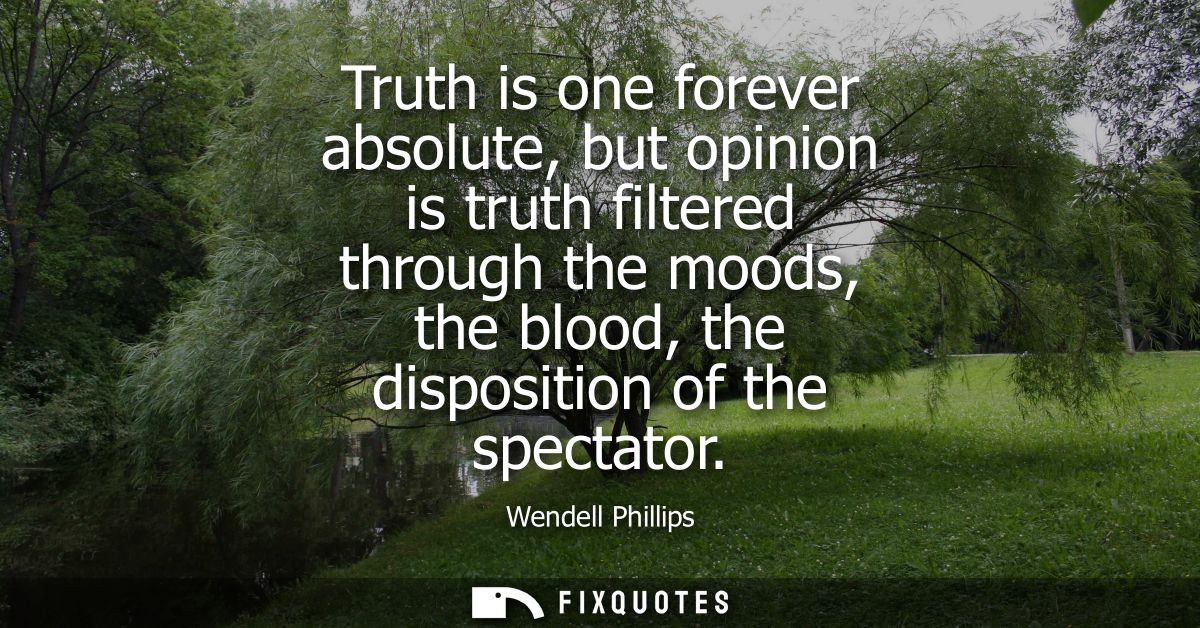
"Truth is one forever absolute, but opinion is truth filtered through the moods, the blood, the disposition of the spectator"
About this Quote
That phrasing matters. “Blood” does double work: it’s temperament and inheritance, but also class and race, the social body that decides whose suffering counts as evidence. Phillips is telling his audience that the argument over slavery (and later, over reform more broadly) isn’t stuck because the facts are unclear; it’s stuck because spectators bring a preloaded self to the scene. When your comfort is implicated, your “disposition” becomes an optical device, tinting the obvious into the debatable.
The intent is both accusatory and strategic. Accusatory, because it reframes the polite “difference of opinion” as a confession of bias. Strategic, because it arms activists against the era’s favorite dodge: treating moral crisis as a matter of perspective. By granting truth an absolute status, Phillips refuses the escape hatch of relativism; by diagnosing opinion as embodied and moody, he exposes how easily people mistake their internal weather for the world’s climate.
Quote Details
| Topic | Truth |
|---|---|
| Source | Help us find the source |
| Cite |
Citation Formats
APA Style (7th ed.)
Phillips, Wendell. (2026, January 17). Truth is one forever absolute, but opinion is truth filtered through the moods, the blood, the disposition of the spectator. FixQuotes. https://fixquotes.com/quotes/truth-is-one-forever-absolute-but-opinion-is-59284/
Chicago Style
Phillips, Wendell. "Truth is one forever absolute, but opinion is truth filtered through the moods, the blood, the disposition of the spectator." FixQuotes. January 17, 2026. https://fixquotes.com/quotes/truth-is-one-forever-absolute-but-opinion-is-59284/.
MLA Style (9th ed.)
"Truth is one forever absolute, but opinion is truth filtered through the moods, the blood, the disposition of the spectator." FixQuotes, 17 Jan. 2026, https://fixquotes.com/quotes/truth-is-one-forever-absolute-but-opinion-is-59284/. Accessed 29 Mar. 2026.