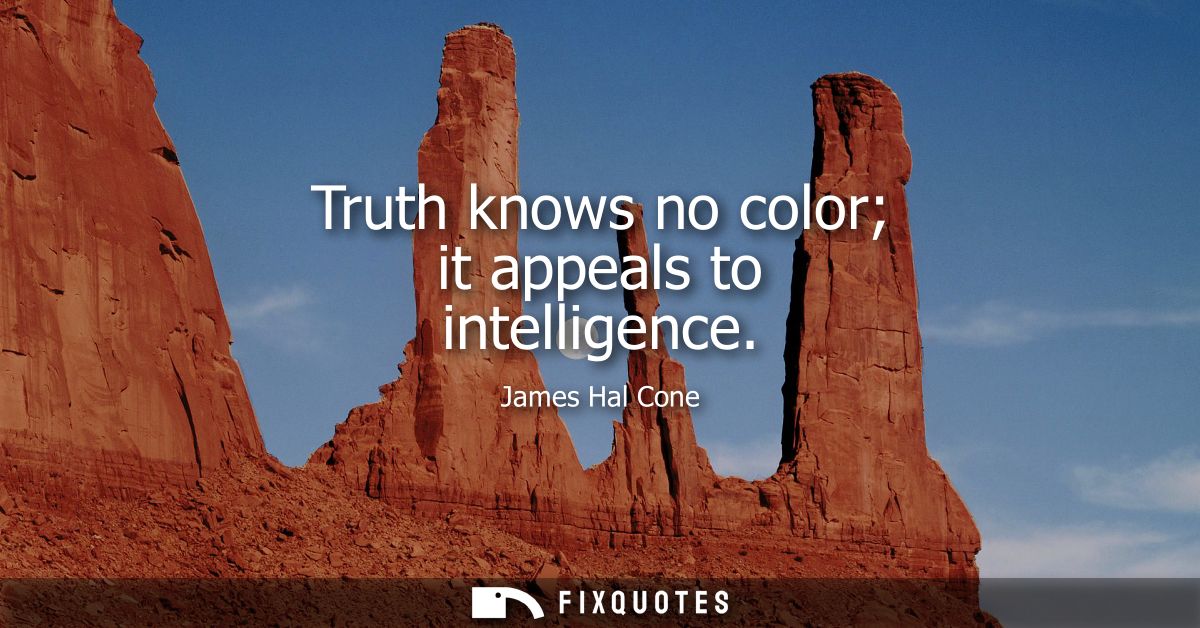
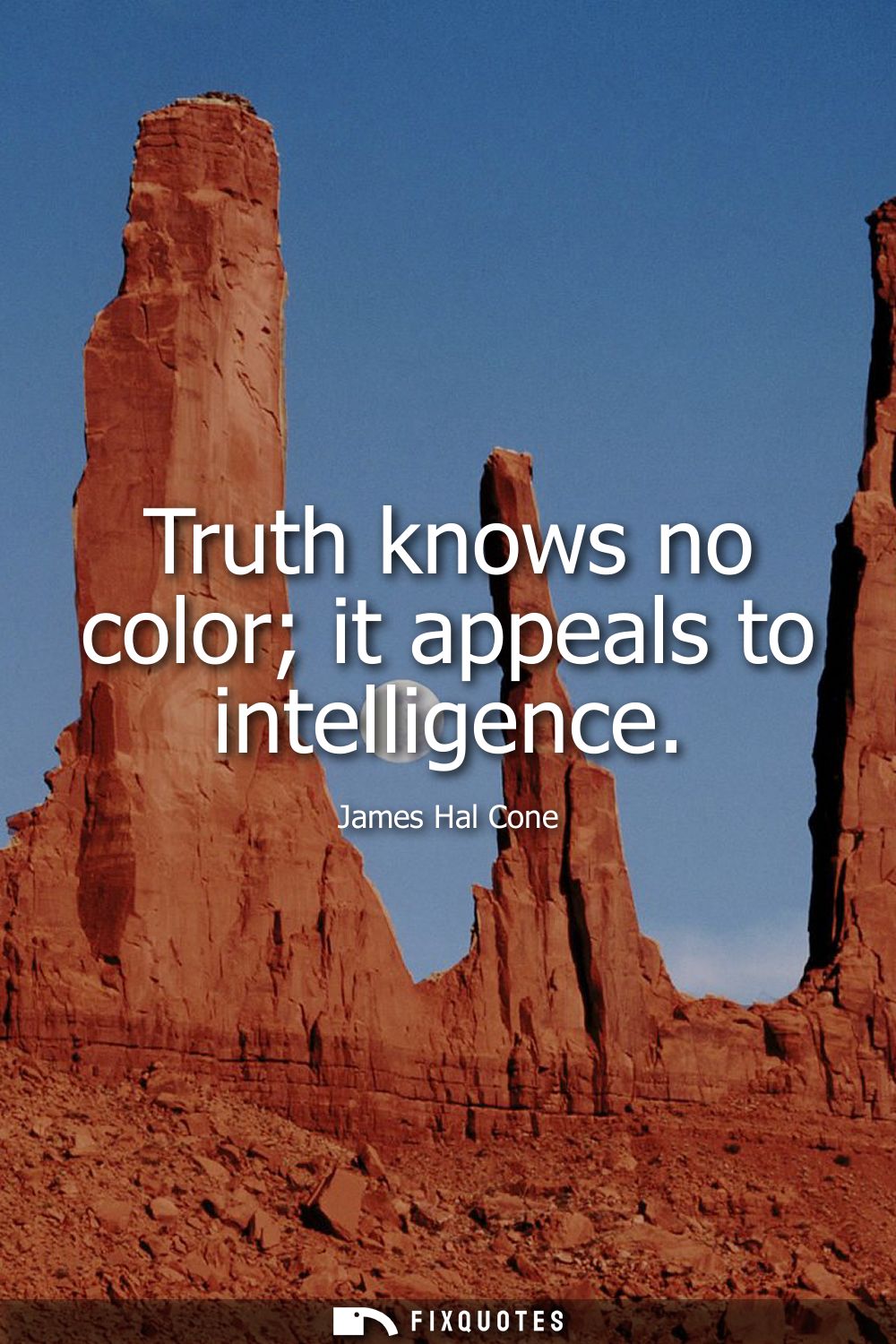
"Truth knows no color; it appeals to intelligence"
About this Quote
Cone’s line lands like a rebuke to two temptations at once: the lazy reduction of truth to tribal identity, and the equally lazy pretense that “colorblindness” can be an alibi for injustice. “Truth knows no color” sounds, at first blush, like a universalist slogan. Coming from James Hal Cone, the father of Black liberation theology, it’s better read as a strategic provocation: truth can’t be owned by whiteness, but neither can it be dismissed as merely “Black perspective.” It refuses the idea that theology is credible only when it echoes dominant culture, and it refuses the idea that naming racism makes one’s claims parochial.
The hinge is the second clause: “it appeals to intelligence.” Cone isn’t flattering the academy; he’s weaponizing a standard that institutions often claim to honor while policing who gets counted as “rational.” The subtext is aimed at gatekeepers who treat Black theological speech as emotional, political, or “biased,” while imagining their own positions as neutral. Cone flips that hierarchy: if you have to hide behind race-coded notions of objectivity to avoid confronting oppression, that’s not intelligence - it’s evasion dressed up as rigor.
Context matters. Cone wrote in the long afterlife of civil rights, when American churches frequently preached harmony without repair. This sentence insists that truth isn’t validated by the speaker’s identity, but it is recognized by a mind willing to see what race has organized and justified. It’s a call to cognition with consequences: if you’re intelligent, you can’t plead ignorance.
The hinge is the second clause: “it appeals to intelligence.” Cone isn’t flattering the academy; he’s weaponizing a standard that institutions often claim to honor while policing who gets counted as “rational.” The subtext is aimed at gatekeepers who treat Black theological speech as emotional, political, or “biased,” while imagining their own positions as neutral. Cone flips that hierarchy: if you have to hide behind race-coded notions of objectivity to avoid confronting oppression, that’s not intelligence - it’s evasion dressed up as rigor.
Context matters. Cone wrote in the long afterlife of civil rights, when American churches frequently preached harmony without repair. This sentence insists that truth isn’t validated by the speaker’s identity, but it is recognized by a mind willing to see what race has organized and justified. It’s a call to cognition with consequences: if you’re intelligent, you can’t plead ignorance.
Quote Details
| Topic | Truth |
|---|---|
| Source | Help us find the source |
| Cite |
Citation Formats
APA Style (7th ed.)
Cone, James Hal. (2026, January 14). Truth knows no color; it appeals to intelligence. FixQuotes. https://fixquotes.com/quotes/truth-knows-no-color-it-appeals-to-intelligence-136277/
Chicago Style
Cone, James Hal. "Truth knows no color; it appeals to intelligence." FixQuotes. January 14, 2026. https://fixquotes.com/quotes/truth-knows-no-color-it-appeals-to-intelligence-136277/.
MLA Style (9th ed.)
"Truth knows no color; it appeals to intelligence." FixQuotes, 14 Jan. 2026, https://fixquotes.com/quotes/truth-knows-no-color-it-appeals-to-intelligence-136277/. Accessed 31 Mar. 2026.
More Quotes by James
Add to List