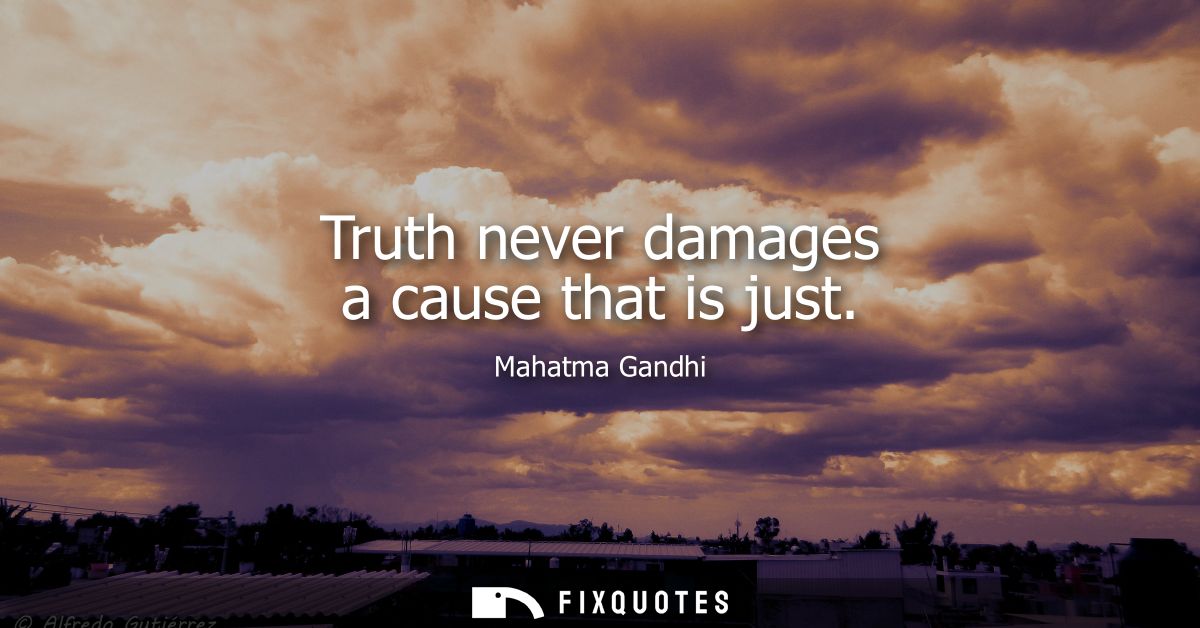
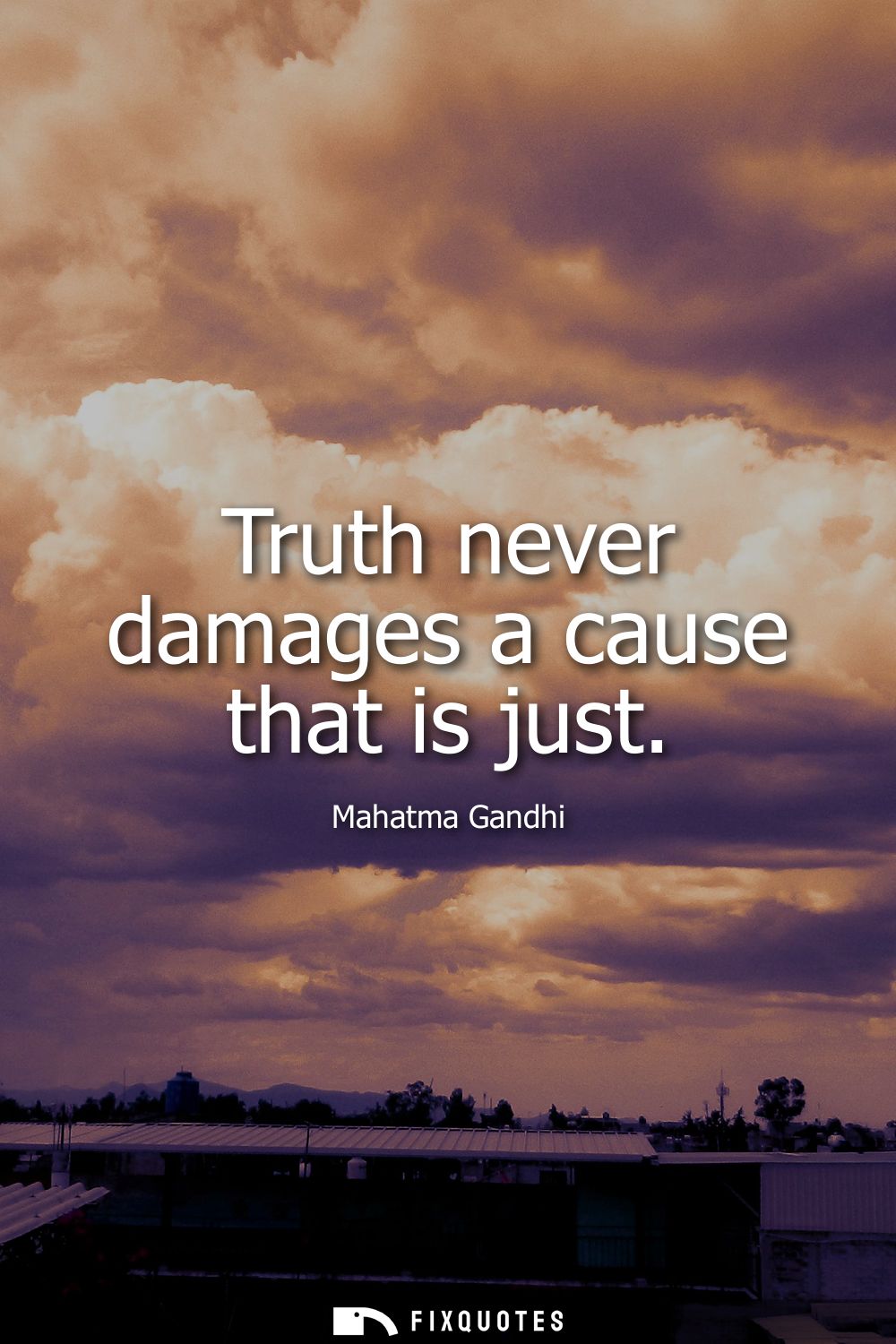
"Truth never damages a cause that is just"
About this Quote
"Truth never damages a cause that is just" is Gandhi’s moral dare, delivered with the calm confidence of someone who understood how power survives on secrecy, confusion, and fear. The line sounds serene, but it’s strategically combative: if your movement is righteous, it should be able to withstand full daylight. If it can’t, the problem isn’t bad publicity; it’s rot.
The brilliance is in how Gandhi weaponizes transparency without sounding like a scold. “Never” is absolute, almost courtroom language, turning truth into an audit. He’s not merely praising honesty; he’s setting a test for legitimacy. A just cause, in this framing, has nothing to lose by telling the whole story - including its own mistakes. That subtext matters because nationalist movements, like states, are tempted to mythologize themselves. Gandhi refuses the shortcut. He insists that ends and means are fused: a liberation struggle built on deception will reproduce the very coercion it claims to oppose.
Context sharpens the stakes. Under British rule, truth-telling wasn’t an abstract virtue; it was a tactic. Satyagraha, often translated as “truth-force,” depended on making oppression visible - through nonviolent resistance that provoked the state into revealing its brutality. The more candid the protester, the more cornered the colonizer. Gandhi’s claim also anticipates modern political media dynamics: scandals don’t destroy movements so much as expose what they were willing to excuse. If the cause collapses under truth, he implies, it was never just - only convenient.
The brilliance is in how Gandhi weaponizes transparency without sounding like a scold. “Never” is absolute, almost courtroom language, turning truth into an audit. He’s not merely praising honesty; he’s setting a test for legitimacy. A just cause, in this framing, has nothing to lose by telling the whole story - including its own mistakes. That subtext matters because nationalist movements, like states, are tempted to mythologize themselves. Gandhi refuses the shortcut. He insists that ends and means are fused: a liberation struggle built on deception will reproduce the very coercion it claims to oppose.
Context sharpens the stakes. Under British rule, truth-telling wasn’t an abstract virtue; it was a tactic. Satyagraha, often translated as “truth-force,” depended on making oppression visible - through nonviolent resistance that provoked the state into revealing its brutality. The more candid the protester, the more cornered the colonizer. Gandhi’s claim also anticipates modern political media dynamics: scandals don’t destroy movements so much as expose what they were willing to excuse. If the cause collapses under truth, he implies, it was never just - only convenient.
Quote Details
| Topic | Truth |
|---|---|
| Source | Help us find the source |
| Cite |
Citation Formats
APA Style (7th ed.)
Gandhi, Mahatma. (2026, January 17). Truth never damages a cause that is just. FixQuotes. https://fixquotes.com/quotes/truth-never-damages-a-cause-that-is-just-36742/
Chicago Style
Gandhi, Mahatma. "Truth never damages a cause that is just." FixQuotes. January 17, 2026. https://fixquotes.com/quotes/truth-never-damages-a-cause-that-is-just-36742/.
MLA Style (9th ed.)
"Truth never damages a cause that is just." FixQuotes, 17 Jan. 2026, https://fixquotes.com/quotes/truth-never-damages-a-cause-that-is-just-36742/. Accessed 6 Mar. 2026.
More Quotes by Mahatma
Add to List