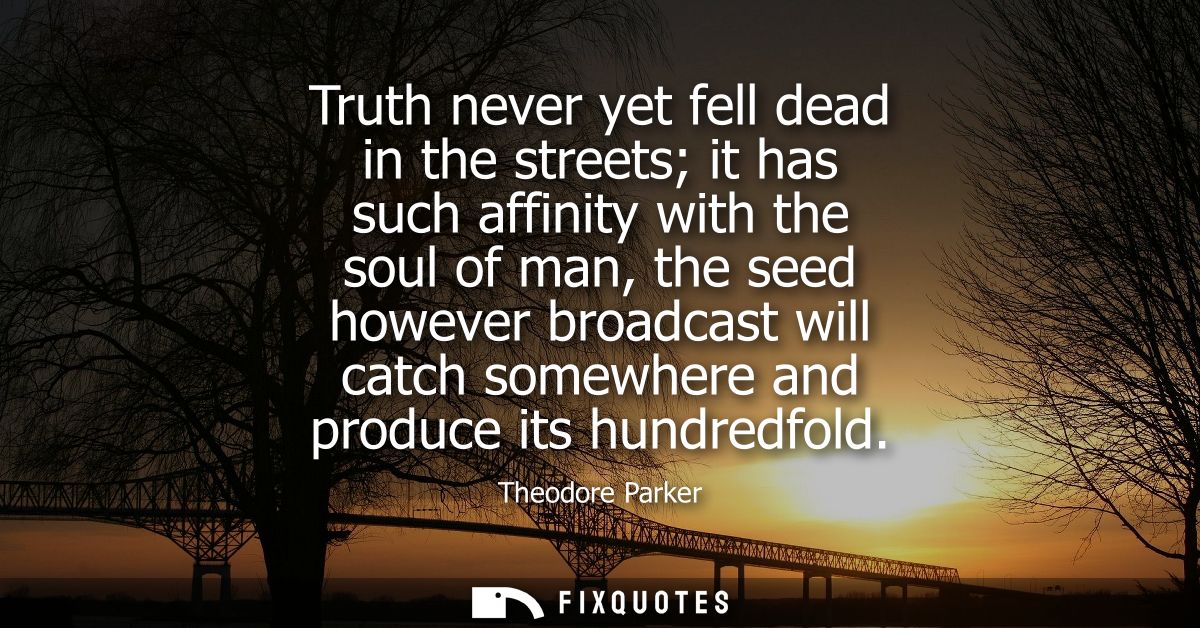
"Truth never yet fell dead in the streets; it has such affinity with the soul of man, the seed, however, broadcast will catch somewhere and produce its hundredfold"
About this Quote
The rhetoric does heavy lifting through metaphor. “Fell dead in the streets” imagines truth as a body, vulnerable to violence and public spectacle, yet refuses the melodrama of martyrdom. The next move is more radical: truth has “affinity with the soul of man.” That’s theology used as political psychology. Parker is arguing that persuasion works not merely by argument but by resonance with an inner moral sensorium. Even when institutions suppress a message, the human conscience remains porous.
The agricultural image - seed “broadcast,” catching “somewhere,” yielding “hundredfold” - smuggles in a theory of social change: progress is probabilistic, not linear. You scatter words, sermons, pamphlets, acts of witness. Most land is rocky; some takes. The subtext is a mandate for persistence: keep sowing, because the harvest may arrive offstage, in someone else’s lifetime, but it will come.
Quote Details
| Topic | Truth |
|---|---|
| Source | Help us find the source |
| Cite |
Citation Formats
APA Style (7th ed.)
Parker, Theodore. (2026, February 20). Truth never yet fell dead in the streets; it has such affinity with the soul of man, the seed, however, broadcast will catch somewhere and produce its hundredfold. FixQuotes. https://fixquotes.com/quotes/truth-never-yet-fell-dead-in-the-streets-it-has-9852/
Chicago Style
Parker, Theodore. "Truth never yet fell dead in the streets; it has such affinity with the soul of man, the seed, however, broadcast will catch somewhere and produce its hundredfold." FixQuotes. February 20, 2026. https://fixquotes.com/quotes/truth-never-yet-fell-dead-in-the-streets-it-has-9852/.
MLA Style (9th ed.)
"Truth never yet fell dead in the streets; it has such affinity with the soul of man, the seed, however, broadcast will catch somewhere and produce its hundredfold." FixQuotes, 20 Feb. 2026, https://fixquotes.com/quotes/truth-never-yet-fell-dead-in-the-streets-it-has-9852/. Accessed 21 Mar. 2026.