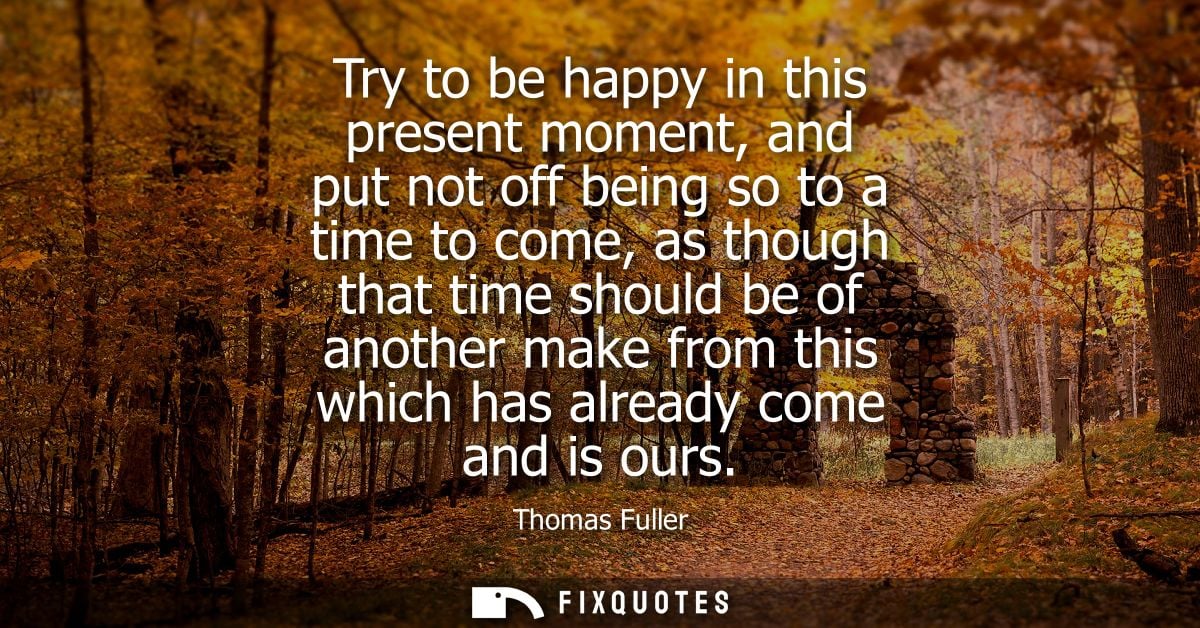
"Try to be happy in this present moment, and put not off being so to a time to come, as though that time should be of another make from this which has already come and is ours"
About this Quote
The key move is his phrasing “as though that time should be of another make.” “Make” suggests manufacture, composition, the grain of reality itself. He’s puncturing the fantasy that tomorrow is made from different stuff than today. That fantasy isn’t innocent; it’s a moral loophole. If happiness can be postponed until conditions are ideal, then one never has to confront the uneasy truth that the conditions are never ideal, and that the self doing the postponing will be the same self tomorrow, armed with new excuses.
Fuller writes as a clergyman in a culture steeped in providence, plague, civil conflict, and uncertainty. His counsel carries pastoral pragmatism: don’t build your inner life on a hypothetical peace treaty with the future. The closing clause, “which has already come and is ours,” lands like a receipt in the hand. You already possess the only time you’ll ever touch. The subtext is bracing: if you can’t locate a workable happiness here, you’re unlikely to discover it in any later chapter, because the author of that chapter is still you.
Quote Details
| Topic | Live in the Moment |
|---|---|
| Source | Help us find the source |
| Cite |
Citation Formats
APA Style (7th ed.)
Fuller, Thomas. (2026, January 15). Try to be happy in this present moment, and put not off being so to a time to come, as though that time should be of another make from this which has already come and is ours. FixQuotes. https://fixquotes.com/quotes/try-to-be-happy-in-this-present-moment-and-put-171411/
Chicago Style
Fuller, Thomas. "Try to be happy in this present moment, and put not off being so to a time to come, as though that time should be of another make from this which has already come and is ours." FixQuotes. January 15, 2026. https://fixquotes.com/quotes/try-to-be-happy-in-this-present-moment-and-put-171411/.
MLA Style (9th ed.)
"Try to be happy in this present moment, and put not off being so to a time to come, as though that time should be of another make from this which has already come and is ours." FixQuotes, 15 Jan. 2026, https://fixquotes.com/quotes/try-to-be-happy-in-this-present-moment-and-put-171411/. Accessed 30 Mar. 2026.