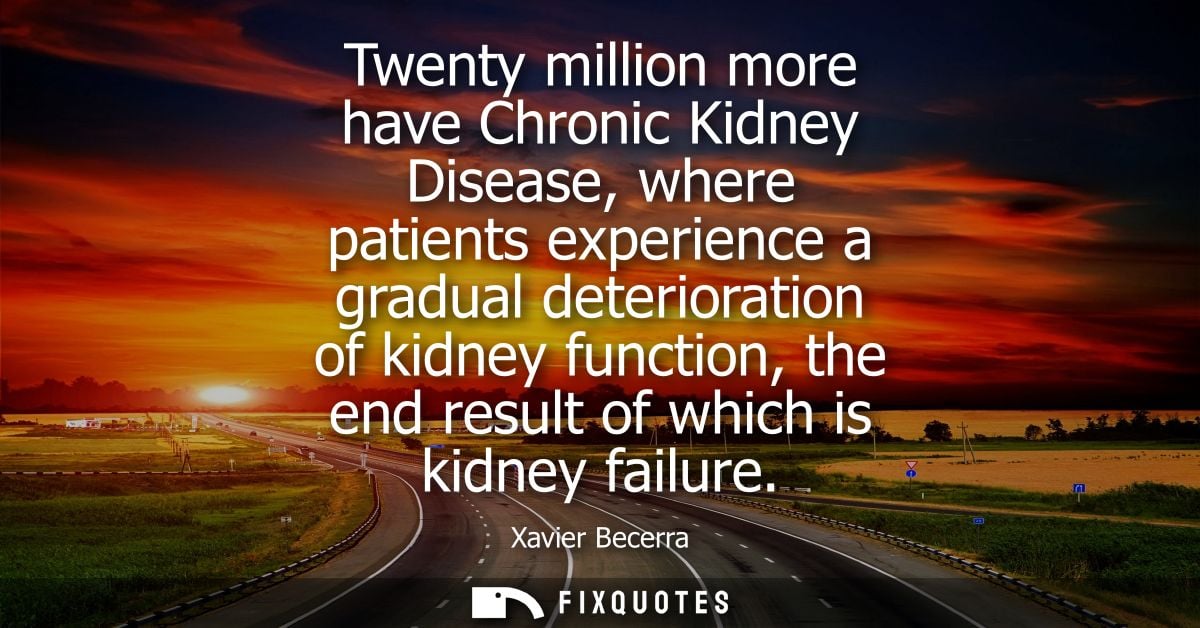
"Twenty million more have Chronic Kidney Disease, where patients experience a gradual deterioration of kidney function, the end result of which is kidney failure"
About this Quote
The specific intent reads as agenda-setting: move CKD from the realm of individual medical misfortune to a public-health crisis worthy of funding, prevention campaigns, and policy attention. The phrase "Twenty million more" quietly implies a larger baseline number already on the table, a rhetorical stacking that amplifies the scope without sounding alarmist. It also frames CKD as a pipeline problem: if you don’t intervene upstream, the system pays downstream.
Subtext: kidney failure isn’t just a medical outcome; it’s an economic one. Dialysis is expensive, time-consuming, and disproportionately borne by lower-income and minority communities, often alongside diabetes and hypertension. Becerra’s choice to end on "kidney failure" isn’t melodrama, it’s leverage - a way to justify big, preventative interventions by pointing to the human and budgetary costs of waiting.
Quote Details
| Topic | Health |
|---|---|
| Source | Help us find the source |
| Cite |
Citation Formats
APA Style (7th ed.)
Becerra, Xavier. (2026, January 16). Twenty million more have Chronic Kidney Disease, where patients experience a gradual deterioration of kidney function, the end result of which is kidney failure. FixQuotes. https://fixquotes.com/quotes/twenty-million-more-have-chronic-kidney-disease-97917/
Chicago Style
Becerra, Xavier. "Twenty million more have Chronic Kidney Disease, where patients experience a gradual deterioration of kidney function, the end result of which is kidney failure." FixQuotes. January 16, 2026. https://fixquotes.com/quotes/twenty-million-more-have-chronic-kidney-disease-97917/.
MLA Style (9th ed.)
"Twenty million more have Chronic Kidney Disease, where patients experience a gradual deterioration of kidney function, the end result of which is kidney failure." FixQuotes, 16 Jan. 2026, https://fixquotes.com/quotes/twenty-million-more-have-chronic-kidney-disease-97917/. Accessed 4 Apr. 2026.