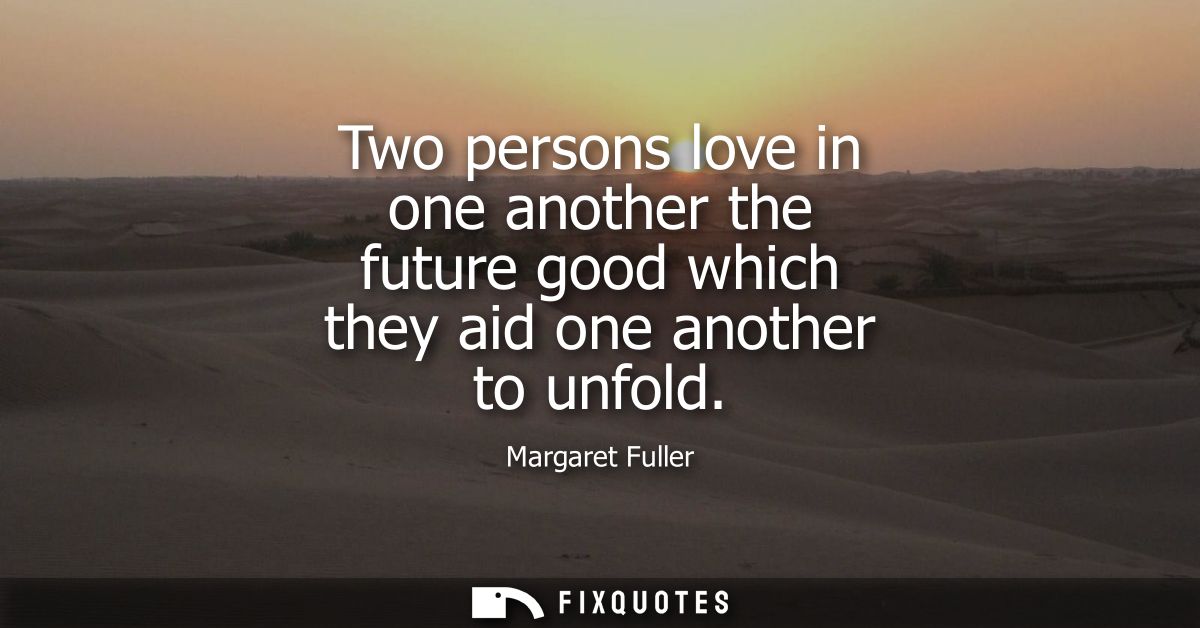
"Two persons love in one another the future good which they aid one another to unfold"
About this Quote
The subtext is quietly radical: love is not possession, not rescue, not worship. It’s mutual cultivation. Fuller smuggles an ethic of equality into an emotion often used to justify hierarchy. “Two persons” signals symmetry, not the gendered script of her era where one partner (often the man) is presumed the agent and the other the project. Even the grammar insists on reciprocity: each sees the other’s future, each helps unfold it. That unfolding metaphor pushes against the era’s fixation on fixed “character” and social roles. People aren’t static; they open, like a book being read and written at the same time.
Context sharpens the intent. As a Transcendentalist critic and early feminist voice (Woman in the Nineteenth Century), Fuller was arguing for women’s self-culture and full personhood. Here, she offers a blueprint for intimacy that aligns with that broader fight: the best love doesn’t shrink you into someone’s ideal. It enlarges your range, makes the future feel actionable, and turns devotion into shared work.
Quote Details
| Topic | Love |
|---|---|
| Source | Help us find the source |
| Cite |
Citation Formats
APA Style (7th ed.)
Fuller, Margaret. (2026, January 15). Two persons love in one another the future good which they aid one another to unfold. FixQuotes. https://fixquotes.com/quotes/two-persons-love-in-one-another-the-future-good-152326/
Chicago Style
Fuller, Margaret. "Two persons love in one another the future good which they aid one another to unfold." FixQuotes. January 15, 2026. https://fixquotes.com/quotes/two-persons-love-in-one-another-the-future-good-152326/.
MLA Style (9th ed.)
"Two persons love in one another the future good which they aid one another to unfold." FixQuotes, 15 Jan. 2026, https://fixquotes.com/quotes/two-persons-love-in-one-another-the-future-good-152326/. Accessed 24 Mar. 2026.