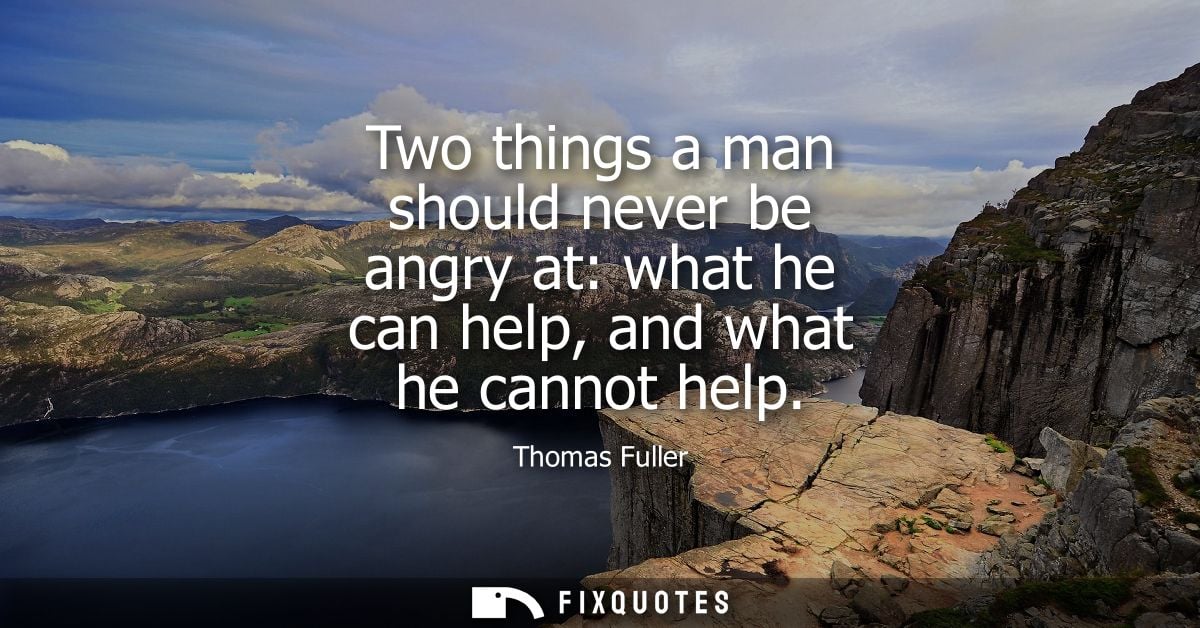
"Two things a man should never be angry at: what he can help, and what he cannot help"
About this Quote
The subtext is pastoral and disciplinary. As a 17th-century English clergyman living through civil war, regime change, plague years, and religious factionalism, Fuller is speaking into a culture where anger easily dressed itself up as moral seriousness. His sentence quietly demotes that pose. It doesn’t deny injustice or pain; it denies anger’s claim to be useful. What’s left is a Protestant ethic of stewardship: attention, will, and conscience are finite, and you’re accountable for how you spend them.
There’s also a social intent. A society riven by grievances needs emotional triage. Fuller offers a portable, almost algorithmic rule for self-governance, the kind that could keep private temper from becoming public violence. The neat symmetry is the persuasion: it feels like common sense, which is exactly how moral instruction travels best.
Quote Details
| Topic | Anger |
|---|---|
| Source | Help us find the source |
| Cite |
Citation Formats
APA Style (7th ed.)
Fuller, Thomas. (2026, January 18). Two things a man should never be angry at: what he can help, and what he cannot help. FixQuotes. https://fixquotes.com/quotes/two-things-a-man-should-never-be-angry-at-what-he-10341/
Chicago Style
Fuller, Thomas. "Two things a man should never be angry at: what he can help, and what he cannot help." FixQuotes. January 18, 2026. https://fixquotes.com/quotes/two-things-a-man-should-never-be-angry-at-what-he-10341/.
MLA Style (9th ed.)
"Two things a man should never be angry at: what he can help, and what he cannot help." FixQuotes, 18 Jan. 2026, https://fixquotes.com/quotes/two-things-a-man-should-never-be-angry-at-what-he-10341/. Accessed 28 Mar. 2026.