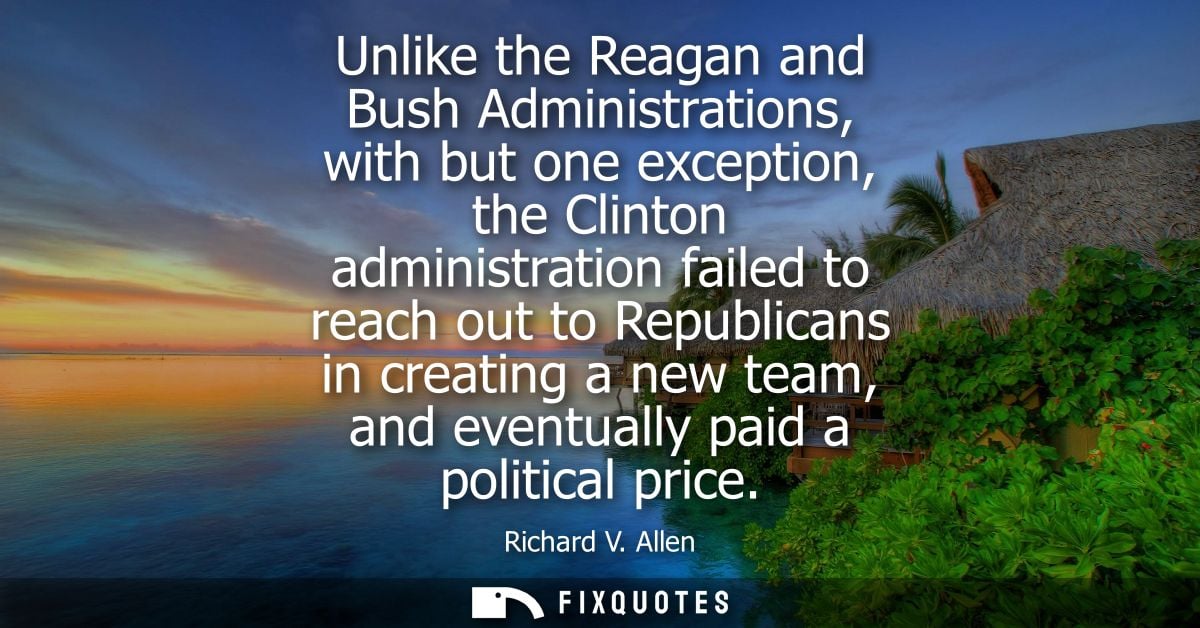
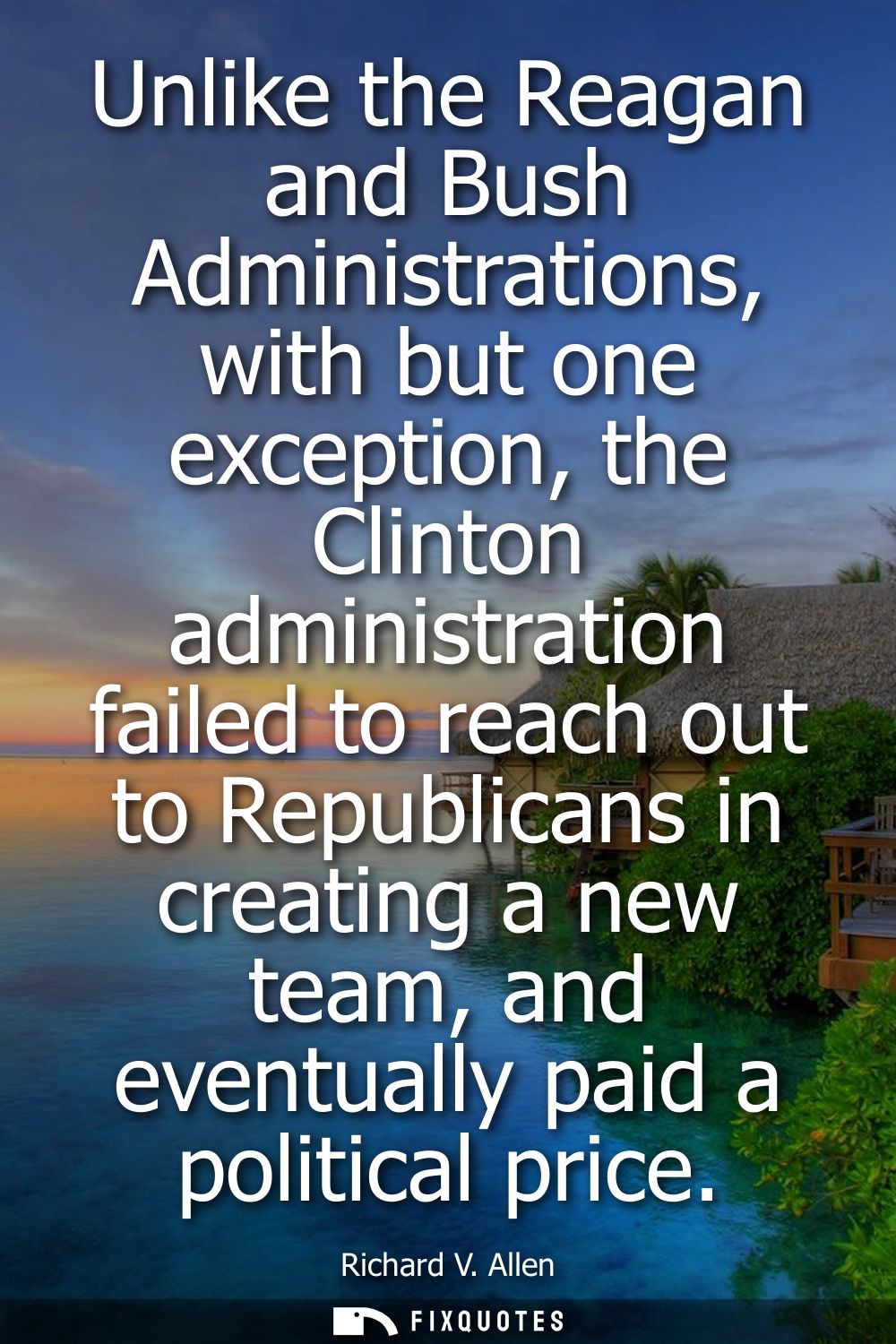
"Unlike the Reagan and Bush Administrations, with but one exception, the Clinton Administration failed to reach out to Republicans in creating a new team, and eventually paid a political price"
About this Quote
The subtext is an argument about legitimacy. “Reach out” implies not just courtesy but an obligation to share power after an election, as if governing is a coalition by default rather than a mandate with constraints. The “with but one exception” aside is doing quiet work, signaling the author’s awareness that the historical record is messier while refusing to litigate it. That ellipsis invites the reader to accept his authority rather than demand specifics.
Context matters: Allen, a Republican national security figure from the Reagan orbit, is defending a political culture that prizes cross-party credibility when it serves stability and elite consensus, especially on foreign policy and appointments. The dig at Clinton also echoes the 1990s storyline that Democrats, newly ascendant after the Cold War, overread their moment and underestimated the organizational aggression of Gingrich-era Republicans. “Paid a political price” is the kicker: not a critique of governance outcomes, but a warning about power. In Allen’s telling, exclusion isn’t just ungentlemanly; it’s tactically stupid.
Quote Details
| Topic | Team Building |
|---|---|
| Source | Help us find the source |
| Cite |
Citation Formats
APA Style (7th ed.)
Allen, Richard V. (2026, February 16). Unlike the Reagan and Bush Administrations, with but one exception, the Clinton Administration failed to reach out to Republicans in creating a new team, and eventually paid a political price. FixQuotes. https://fixquotes.com/quotes/unlike-the-reagan-and-bush-administrations-with-161356/
Chicago Style
Allen, Richard V. "Unlike the Reagan and Bush Administrations, with but one exception, the Clinton Administration failed to reach out to Republicans in creating a new team, and eventually paid a political price." FixQuotes. February 16, 2026. https://fixquotes.com/quotes/unlike-the-reagan-and-bush-administrations-with-161356/.
MLA Style (9th ed.)
"Unlike the Reagan and Bush Administrations, with but one exception, the Clinton Administration failed to reach out to Republicans in creating a new team, and eventually paid a political price." FixQuotes, 16 Feb. 2026, https://fixquotes.com/quotes/unlike-the-reagan-and-bush-administrations-with-161356/. Accessed 5 Apr. 2026.