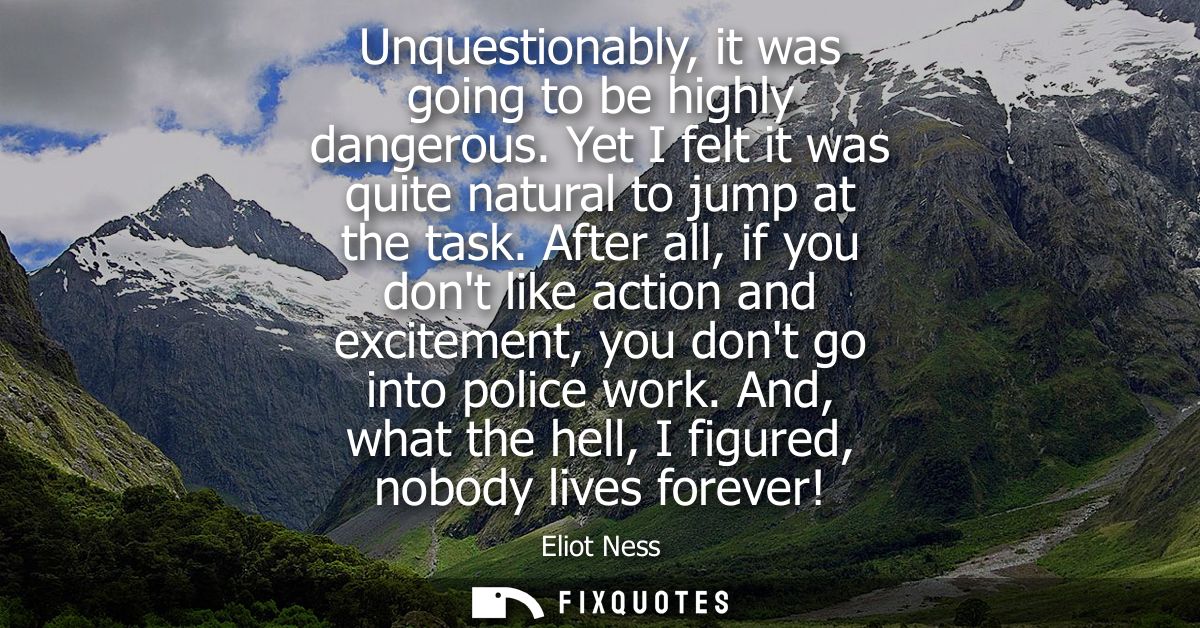
"Unquestionably, it was going to be highly dangerous. Yet I felt it was quite natural to jump at the task. After all, if you don't like action and excitement, you don't go into police work. And, what the hell, I figured, nobody lives forever!"
About this Quote
The subtext is a performance of legitimacy. In an era when policing, Prohibition enforcement, and organized crime were tangled in bribery and spectacle, the claim that action-seeking is “natural” in police work reads like an attempt to purify the job through personal ethos: I’m not reckless, I’m professionally suited. Even the profanity-lite “what the hell” works as a pressure valve, signaling plainspoken authenticity rather than bureaucratic sanctimony.
Context sharpens the stakes. Ness’s public image was built in opposition to corruption, and that requires more than evidence; it requires narrative. This quote supplies it: the incorruptible man who enters danger without melodrama, who treats risk as duty with a grin. There’s also a quiet moral bargaining going on. If death is inevitable, then the meaningful question becomes how to spend your finite time: hedging, or confronting the machinery of violence with a badge and a backbone.
It works because it flatters neither heroism nor doom. It sells courage as everyday professionalism, and that’s a far more persuasive myth.
Quote Details
| Topic | Police & Firefighter |
|---|---|
| Source | Help us find the source |
| Cite |
Citation Formats
APA Style (7th ed.)
Ness, Eliot. (2026, January 15). Unquestionably, it was going to be highly dangerous. Yet I felt it was quite natural to jump at the task. After all, if you don't like action and excitement, you don't go into police work. And, what the hell, I figured, nobody lives forever! FixQuotes. https://fixquotes.com/quotes/unquestionably-it-was-going-to-be-highly-155373/
Chicago Style
Ness, Eliot. "Unquestionably, it was going to be highly dangerous. Yet I felt it was quite natural to jump at the task. After all, if you don't like action and excitement, you don't go into police work. And, what the hell, I figured, nobody lives forever!" FixQuotes. January 15, 2026. https://fixquotes.com/quotes/unquestionably-it-was-going-to-be-highly-155373/.
MLA Style (9th ed.)
"Unquestionably, it was going to be highly dangerous. Yet I felt it was quite natural to jump at the task. After all, if you don't like action and excitement, you don't go into police work. And, what the hell, I figured, nobody lives forever!" FixQuotes, 15 Jan. 2026, https://fixquotes.com/quotes/unquestionably-it-was-going-to-be-highly-155373/. Accessed 29 Mar. 2026.