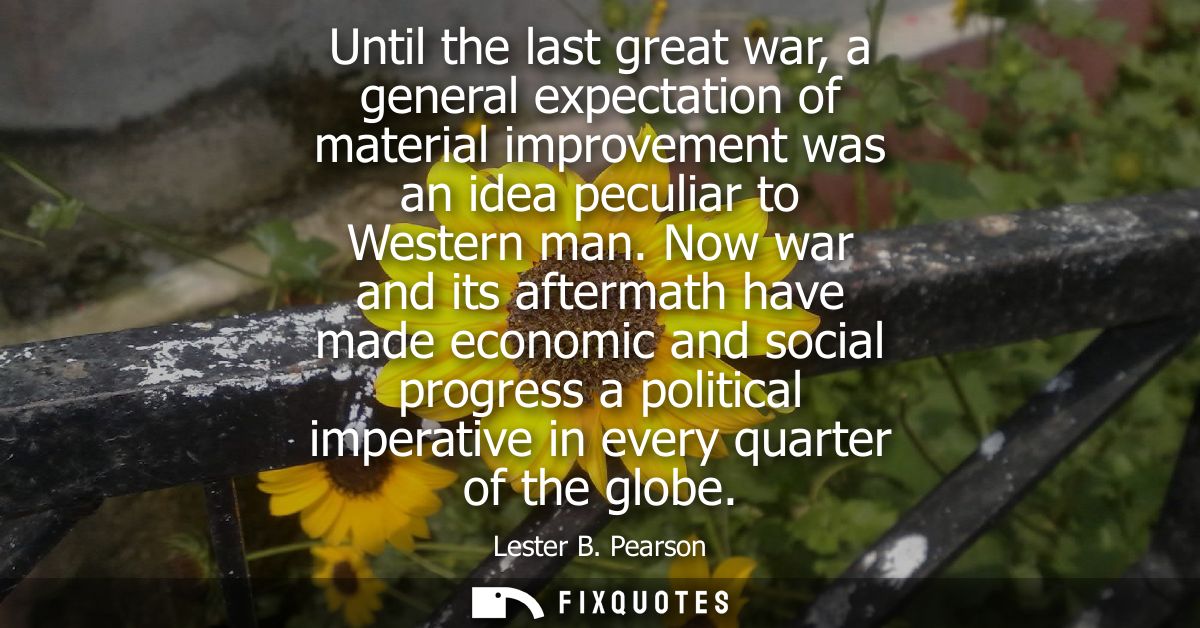
"Until the last great war, a general expectation of material improvement was an idea peculiar to Western man. Now war and its aftermath have made economic and social progress a political imperative in every quarter of the globe"
About this Quote
The second sentence tightens the screw. War doesn’t merely interrupt progress; it forces governments to treat progress as a “political imperative.” That phrase is doing heavy lifting. Pearson is describing the post-World War II world - devastated economies, mass mobilization, decolonization, the rise of welfare states, and the Cold War competition where capitalism and communism both marketed themselves as delivery systems for better living standards. In that environment, “economic and social progress” isn’t philanthropy or moral aspiration; it’s the price of staying in power and, just as crucially, the price of staying aligned.
The subtext is pragmatic and slightly chastening: once people have seen the state marshal resources at wartime scale, they won’t accept peacetime scarcity as inevitable. Governments everywhere are now trapped by the expectations modernity unleashed. Pearson, the diplomat, is also making a case for development as stability policy: if improvement is globally mandatory, then international cooperation isn’t idealism - it’s triage.
Quote Details
| Topic | War |
|---|---|
| Source | Help us find the source |
| Cite |
Citation Formats
APA Style (7th ed.)
Pearson, Lester B. (2026, January 17). Until the last great war, a general expectation of material improvement was an idea peculiar to Western man. Now war and its aftermath have made economic and social progress a political imperative in every quarter of the globe. FixQuotes. https://fixquotes.com/quotes/until-the-last-great-war-a-general-expectation-of-69991/
Chicago Style
Pearson, Lester B. "Until the last great war, a general expectation of material improvement was an idea peculiar to Western man. Now war and its aftermath have made economic and social progress a political imperative in every quarter of the globe." FixQuotes. January 17, 2026. https://fixquotes.com/quotes/until-the-last-great-war-a-general-expectation-of-69991/.
MLA Style (9th ed.)
"Until the last great war, a general expectation of material improvement was an idea peculiar to Western man. Now war and its aftermath have made economic and social progress a political imperative in every quarter of the globe." FixQuotes, 17 Jan. 2026, https://fixquotes.com/quotes/until-the-last-great-war-a-general-expectation-of-69991/. Accessed 5 Apr. 2026.