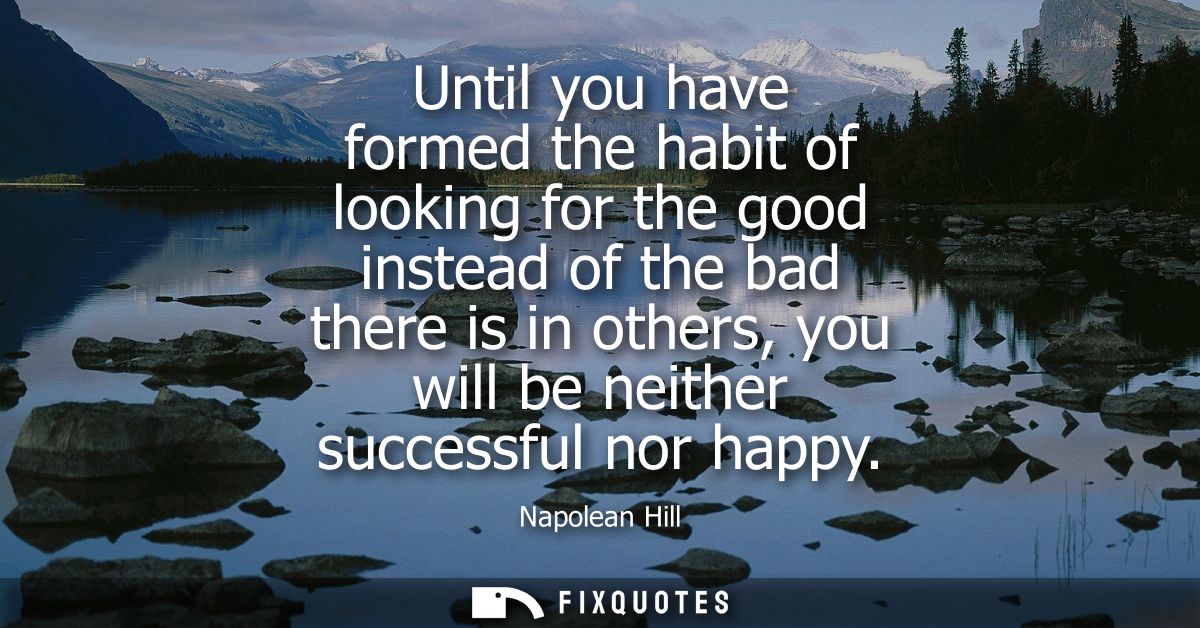
"Until you have formed the habit of looking for the good instead of the bad there is in others, you will be neither successful nor happy"
About this Quote
The intent is practical, not purely ethical. Hill ties “looking for the good” to “successful,” then bolts “happy” onto it as the emotional dividend. That’s classic early-20th-century American uplift logic: prosperity and inner peace are rewards for disciplined mindset. Subtext: your outcomes are largely your responsibility, and if you’re stuck, the problem is your perception. It flatters the reader with agency while quietly blaming them for failure.
Context matters. Hill wrote in the boom-and-bust era that made “positive thinking” feel like both survival skill and civic duty. In a culture anxious about class mobility and competition, suspicion looks like realism; Hill calls it self-sabotage. The line also functions as a relationship hack: people respond to being “seen” for their best selves, and networks run on goodwill.
The darker edge is what it omits. Systemic barriers don’t vanish because you practice benevolent interpretation. “Look for the good” can slide into denial, or into tolerating harm to preserve a success narrative. Still, the sentence works because it names a brutal truth: cynicism is a costly habit, and attention, once trained, becomes destiny.
Quote Details
| Topic | Habits |
|---|---|
| Source | Help us find the source |
| Cite |
Citation Formats
APA Style (7th ed.)
Hill, Napolean. (2026, January 16). Until you have formed the habit of looking for the good instead of the bad there is in others, you will be neither successful nor happy. FixQuotes. https://fixquotes.com/quotes/until-you-have-formed-the-habit-of-looking-for-104899/
Chicago Style
Hill, Napolean. "Until you have formed the habit of looking for the good instead of the bad there is in others, you will be neither successful nor happy." FixQuotes. January 16, 2026. https://fixquotes.com/quotes/until-you-have-formed-the-habit-of-looking-for-104899/.
MLA Style (9th ed.)
"Until you have formed the habit of looking for the good instead of the bad there is in others, you will be neither successful nor happy." FixQuotes, 16 Jan. 2026, https://fixquotes.com/quotes/until-you-have-formed-the-habit-of-looking-for-104899/. Accessed 1 Apr. 2026.