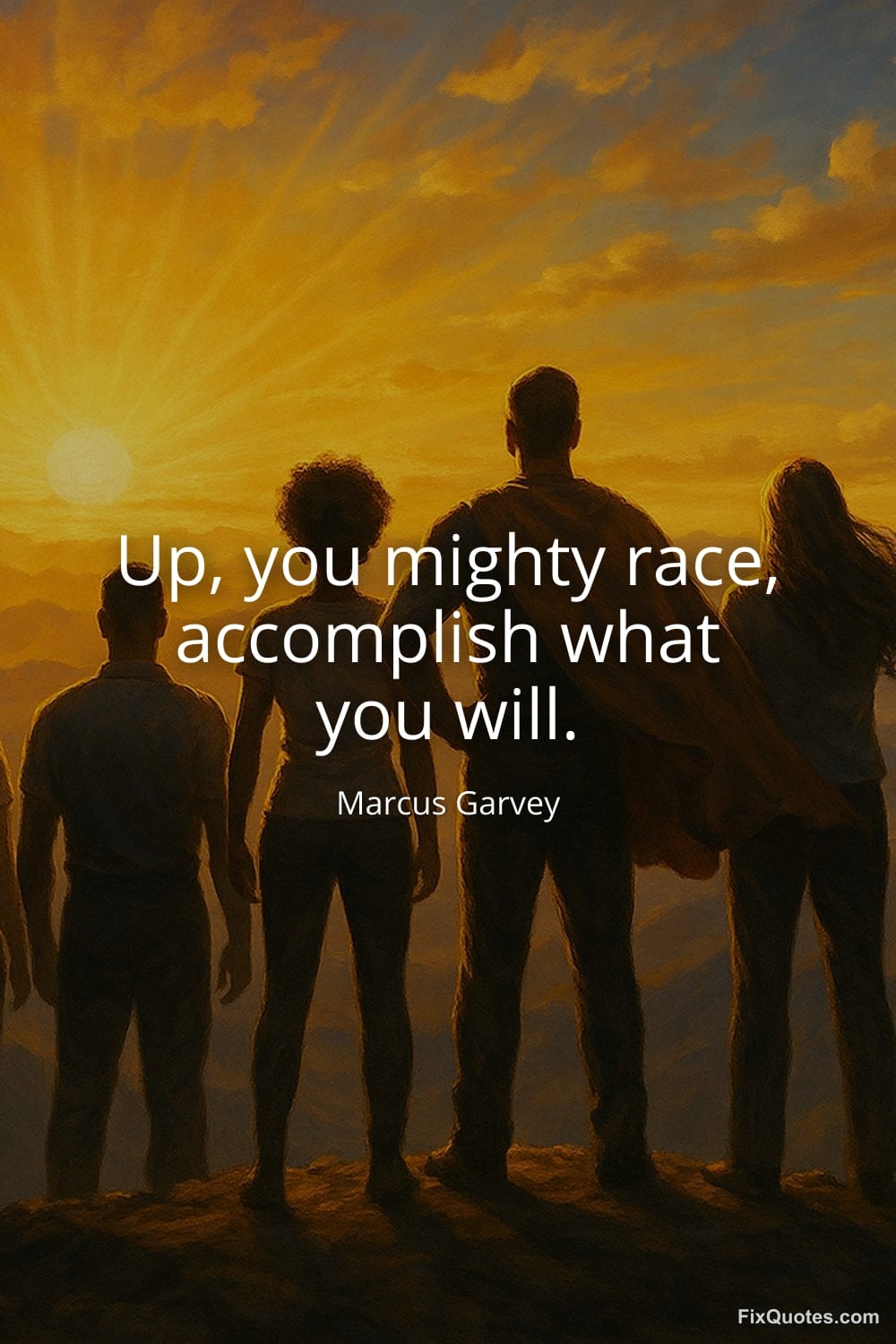
"Up, you mighty race, accomplish what you will"
About this Quote
A trumpet blast disguised as a single sentence, Garvey's line is built to do one thing: turn a people treated as a problem into a people who act like a force. "Up" is pure imperative, the language of a rally, not a seminar. It's not asking permission from the world that has denied it. It's also a subtle refusal of the posture Black life was expected to perform in the early 20th century: grateful, deferential, endlessly "patient". Garvey replaces that script with motion.
"Mighty race" is doing complicated work. On its surface, it's affirmation - an antidote to white supremacist propaganda that framed Blackness as deficiency. Underneath, it's a deliberate act of collective branding. Garvey, a publisher as much as a political organizer, understood that movements need slogans that can travel: across newspapers, street corners, parades, and diaspora lines. The phrase is meant to stitch together a global Black identity, even at the risk of flattening differences, because unity was a strategic weapon in a world organized to fragment.
"Accomplish what you will" is where the rhetoric opens its fist. It's not a to-do list; it's a transfer of agency. Garvey doesn't promise liberation as a gift, or even as a guarantee. He frames it as capacity - will as the engine, accomplishment as the proof. That matters in context: post-World War I disillusionment, colonial rule abroad, Jim Crow at home, and the rise of mass politics. The sentence is both uplift and provocation, insisting that dignity isn't merely asserted; it's built, published, marched, and made real.
"Mighty race" is doing complicated work. On its surface, it's affirmation - an antidote to white supremacist propaganda that framed Blackness as deficiency. Underneath, it's a deliberate act of collective branding. Garvey, a publisher as much as a political organizer, understood that movements need slogans that can travel: across newspapers, street corners, parades, and diaspora lines. The phrase is meant to stitch together a global Black identity, even at the risk of flattening differences, because unity was a strategic weapon in a world organized to fragment.
"Accomplish what you will" is where the rhetoric opens its fist. It's not a to-do list; it's a transfer of agency. Garvey doesn't promise liberation as a gift, or even as a guarantee. He frames it as capacity - will as the engine, accomplishment as the proof. That matters in context: post-World War I disillusionment, colonial rule abroad, Jim Crow at home, and the rise of mass politics. The sentence is both uplift and provocation, insisting that dignity isn't merely asserted; it's built, published, marched, and made real.
Quote Details
| Topic | Motivational |
|---|---|
| Source | Unverified source: The Principles of the Universal Negro Improvement Associa... (Marcus Garvey, 1922)
Evidence: Primary-source identification: the line is widely tied to Marcus Garvey’s UNIA rhetoric and is explicitly attributed in multiple secondary references to Garvey’s 1922 address commonly titled “The Principles of the Universal Negro Improvement Association,” delivered in New York City on November 25... Other candidates (2) The Nonviolent Right To Vote Movement Almanac (Helen L. Bevel, 2012) compilation95.0% ... Up, you mighty race, accomplish what you will.” “Liberate the minds of men and ultimately you will liberate the .... Marcus Garvey (Marcus Garvey) compilation37.5% fidence in self you are twice defeated in the race of life with confidence you h |
| Featured | This quote was our Quote of the Day on July 8, 2025 |
| Cite |
Citation Formats
APA Style (7th ed.)
Garvey, Marcus. (2026, January 11). Up, you mighty race, accomplish what you will. FixQuotes. https://fixquotes.com/quotes/up-you-mighty-race-accomplish-what-you-will-8863/
Chicago Style
Garvey, Marcus. "Up, you mighty race, accomplish what you will." FixQuotes. January 11, 2026. https://fixquotes.com/quotes/up-you-mighty-race-accomplish-what-you-will-8863/.
MLA Style (9th ed.)
"Up, you mighty race, accomplish what you will." FixQuotes, 11 Jan. 2026, https://fixquotes.com/quotes/up-you-mighty-race-accomplish-what-you-will-8863/. Accessed 8 Mar. 2026.
More Quotes by Marcus
Add to List